Research on Alzheimer's disease has an idea worth testing: if certain still-soluble protein aggregates in the brain are disrupting communication between neurons, could an antibody reduce that disruption by binding to them?
Sabirnetug, code-named ACU193 and developed by US company Acumen, followed this approach. On October 30, 2026, however, the company announced that the antibody's phase 2 trial had failed to demonstrate the expected clinical benefit and that it planned to stop development.[1]
The market reacted sharply. On October 30, Acumen's shares (Nasdaq: ABOS) fell from the previous trading day's close of $2.29 to approximately $0.21, a one-day decline of about 90.8%. They rebounded to approximately $0.24 on November 2, but remained about 90% below their level before the announcement. All comparisons here use closing prices from regular US trading sessions.[9]
A fall of that size quickly turns a clinical failure into market news. Behind the share price, though, lies a chain of work extending from scientific hypotheses and animal experiments to patients' participation in research. Understanding this failure requires seeing what evidence that work established and where it failed to demonstrate the expected patient benefit.
The question left by the failure is more specific than whether “clearing plaques works”: how much evidence still separates a drug's ability to bind the protein researchers want to address from helping patients preserve memory and daily functioning?
What was it trying to address?
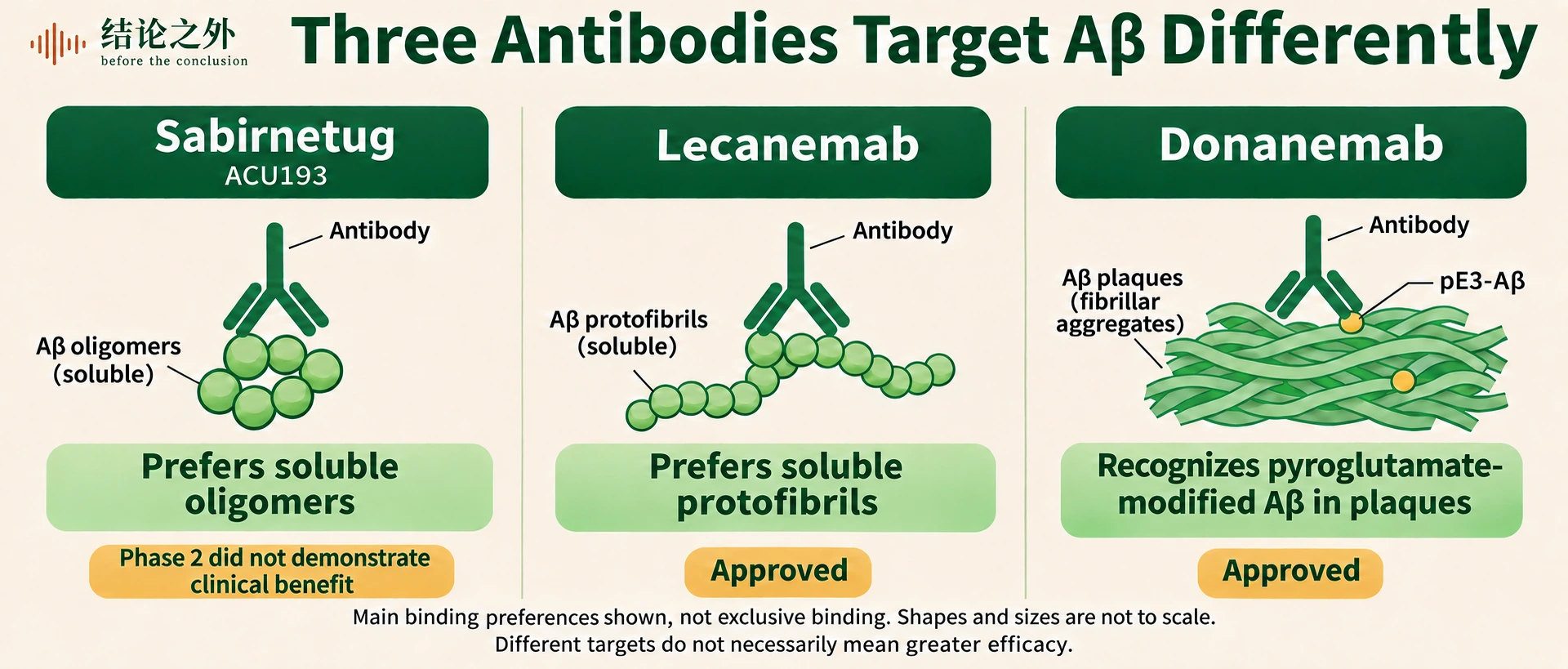
When Alzheimer's disease is discussed, “amyloid plaques” often come up. Amyloid beta, or Aβ, the protein that forms these deposits, can exist as individual molecules or form aggregates of different sizes and structures. Several Aβ molecules can join into oligomers that remain soluble, while deposits of fibrillar Aβ are an important component of plaques.[2]
Experimental research suggests that some soluble oligomers can disrupt synaptic function. Synapses are important connections through which neurons transmit information, making oligomers a reasonable treatment target to investigate. But experimental evidence of toxicity does not directly establish that addressing these oligomers in patients will change the course of disease.[2]
A design feature of sabirnetug is its preference for recognizing soluble, globular Aβ oligomers. Early research showed relatively little direct binding to mature plaques. Understanding its design requires attention to its binding preferences among different forms of Aβ.[2]
It aimed to test a more specific hypothesis: could selectively binding these aggregates reduce their disruption of neuronal communication and thereby slow the decline in cognition and daily functioning?
© Before the Conclusion
What hope had animal experiments offered?
The idea went beyond molecular speculation. Several mouse experiments had reported improvements in learning, memory, or behavior. Many used ACU3B3, the murine precursor antibody from which sabirnetug was humanized. A closer look, however, shows that improvement did not occur in every test.[6]
A 2019 conference abstract reported that ACU3B3 improved transgenic mice's learning in a new environment and their performance learning the location of a visible platform in a water maze, but did not improve spatial learning in a hidden-platform test. Behaviors such as hyperactivity also improved. Behavioral changes should therefore not all be read as restoration of memory. A conference abstract also discloses fewer details than a full research paper.[6]
Another study used imaging probes made from ACU193 and observed improved novel-object recognition memory in 5xFAD transgenic mice, approaching normal-control performance. But these antibodies were linked to imaging labels or magnetic nanoparticles, and their administration also differed. They cannot be directly equated with the unconjugated antibody later used clinically.[7]
These findings gave reasons to continue research, but they did not answer the efficacy question for human trials. The models produce Aβ-related pathology through specific genetic changes, and some experiments began intervention at a very early pathological stage. Clinical patients, in contrast, already had cognitive symptoms. Improving dysfunction in a model does not guarantee that damage accumulated over years in patients can likewise be reversed. This is a factor to consider when understanding differences between animals and humans; it cannot yet be identified as the cause of this failure.[6,8]
If imaging cannot see it, how do we know the drug bound its target?
This raises a measurement problem. Conventional amyloid PET mainly reflects fibrillar plaque burden. It cannot directly quantify the soluble oligomers this antibody sought to address, or tell us how many the antibody has bound.[3]
Researchers therefore developed another assay: looking for “antibody–oligomer complexes” in cerebrospinal fluid, the fluid surrounding the brain and spinal cord. Detecting complexes formed by the two binding together provides evidence that the drug encountered and bound its target.[3]
In the earlier phase 1 INTERCEPT-AD study, this binding signal increased with dose and drug exposure. The findings also helped inform subsequent dose selection. That early study mainly examined safety, the drug's behavior in the body, and target engagement. It was not designed to confirm long-term cognitive benefit.[2,3]
Phase 1 had thus provided evidence of binding. But complexes in cerebrospinal fluid cannot directly tell us how much target the antibody bound in critical brain regions or around synapses, or for how long. Still less does their mere presence establish that the relevant toxicity was sufficiently suppressed.
Another distinction must be maintained: these are phase 1 results. They cannot stand in for what actually happened in this phase 2 study.
Phase 2 had to demonstrate patient benefit
The phase 2 ALTITUDE-AD trial enrolled 542 patients with early disease, at the stage of mild cognitive impairment or mild dementia. It compared two drug doses with placebo and assessed changes in cognition and daily function at 18 months.[1]
Trials of this kind mainly seek to slow worsening. For example, the confirmatory trial for the already approved lecanemab showed slower decline than placebo, rather than restoration of memories already lost.[5]
For sabirnetug, the company's announced conclusion was that neither dose group met the primary efficacy endpoint. Key secondary endpoints, including another important measure of cognition and function, also showed no statistically significant benefit. Meanwhile, PET-measured plaque burden did decrease.[1]
This shows that the drug affected a disease-related measure, but did not establish clinical evidence of slower deterioration in this trial. Reduced plaques alone also cannot establish that the oligomers it originally sought to address were sufficiently affected in the right locations.
The failure is clear; the point of failure still needs explanation
Whether Alzheimer's-related pathology is present, how clinically impaired a patient is now, and whether a drug improves the disease course are three related but different questions. The Alzheimer's Association's 2024 framework distinguishes biological staging from clinical severity; the two do not change in step in every patient.[4]
This single result therefore cannot directly establish that “plaques are unrelated to cognition.” Equally, measuring binding early on is insufficient to conclude that this trial fully tested every prerequisite of the proposition that suppressing pathogenic oligomers can help patients.
The next questions include whether the antibody reached sufficient concentrations in critical locations; whether the aggregates it bound included the genuinely important pathogenic forms; and whether binding changed the relevant toxicity and downstream damage enough to affect the disease course. These are explanations to be tested. None can currently be selected as the cause of failure.
As of November 2, complete numerical clinical effect results and key mechanistic analyses remained to be provided. The company said it would continue analyzing fluid biomarkers and imaging data, while stating that it did not expect these analyses to change the efficacy conclusion. We are waiting for a more accurate explanation of failure, rather than treating undisclosed data as grounds for reversing the efficacy finding.[1]
A drug's failure can force us to revise our judgment of that drug. Whether it can also change our understanding of the disease depends on the evidence that follows. For patients, the ultimate research question remains whether these biological changes can help preserve memory and daily functioning for longer.
Before the Conclusion will continue to follow further evidence disclosed by the company and research team, including fuller clinical results, target-engagement analyses, and biomarker analyses. As new evidence appears, we will return to the discussion when appropriate, develop a more complete assessment, and reexamine the questions that remain unanswered.
References
[2] Siemers et al., 2025: the phase 1 INTERCEPT-AD study.
[4] Jack et al., 2024: revised framework for Alzheimer's disease diagnosis and staging.
[5] FDA, July 6, 2023: lecanemab's confirmatory trial and traditional approval.
[6] Ma et al., 2019 AAIC conference abstract: effects of ACU3B3 on learning and behavior in mice.
[7] Viola et al., 2022: oligomer-selective antibody imaging probes and memory research in mice.
[8] Siemers et al., 2022: preclinical pharmacology and animal experiments for ACU193.
[9] Stock Analysis: historical ABOS closing prices for October 29, October 30, and November 2, 2026.
Additional sources for the illustration: FDA lecanemab label; FDA donanemab label; Research on lecanemab binding to protofibrils (PubMed: 38906341).
Information current through November 2, 2026.
Beyond the conclusion, there are still questions worth asking.
Medicine · Science · Ideas and reading
Follow Before the Conclusion to stay curious and think independently together.