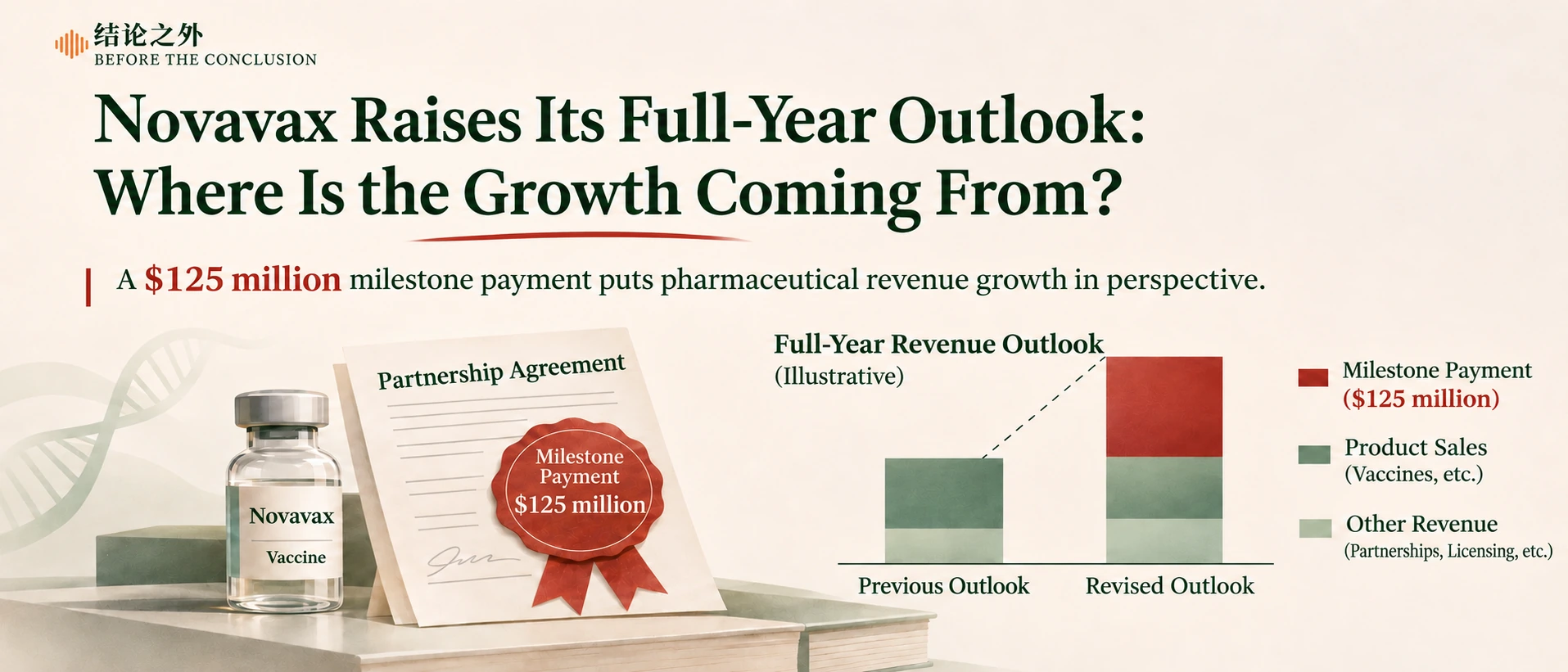
On November 5, 2026, U.S. vaccine company Novavax reported its third-quarter results and raised its full-year adjusted total revenue outlook from $235–275 million to $385–415 million. At the midpoint, the forecast rose from $255 million to $400 million, an increase of approximately 57%.[1]
That looks like a substantial improvement. But the first distinction matters: this is the increase in a revenue forecast for the same year, not 57% year-over-year growth in revenue already earned.
The same report showed actual third-quarter total revenue of $68.3 million, down approximately 3% year over year, while the net loss narrowed from approximately $202 million a year earlier to $31.4 million.[1]
Why did the full-year revenue outlook rise sharply when quarterly revenue did not grow? The answer lies in a collaboration agreement with Sanofi.
1. Where does the $125 million come from?
In 2024, Novavax signed a collaboration agreement with Sanofi. Since then, product sales, licensing partnerships, research and development support, milestones, and royalties have become important clues to understanding Novavax’s business.[2][3]
On October 28, 2026, the fifth participant was dosed in Sanofi’s Phase 3 influenza–COVID-19 combination vaccine trial in Europe. This met the contractually agreed initiation condition and triggered a $125 million milestone payment.[2][3]
The two companies had agreed on this condition in advance. Once it was met, a potential contractual payment became a triggered payment obligation. But two important distinctions apply.
First, this payment does not belong to the third quarter, which ended on September 30. The condition was met in October and cannot be counted retroactively in third-quarter results.[3]
Second, meeting the condition does not mean the cash has arrived. In its 10-Q, the company said it expected to receive the payment by the first quarter of 2027; “by the first quarter of 2027” should not be interpreted as requiring receipt before that quarter begins.[3]
Three dates therefore need to be distinguished: when the contractual condition is met, when revenue is recognized under accounting principles, and when cash is actually received. They are not necessarily the same.
Likewise, the initiation of a Phase 3 trial cannot be treated as a successful Phase 3 outcome, much less as approval of the combination vaccine. It is progress in development and a contractual event, but not yet final validation of efficacy or commercial success.
2. Breaking down the $145 million increase
The company’s November 5 adjusted full-year revenue framework provided the following forecasts. Figures are in millions of U.S. dollars; one million dollars is $1,000,000.[1]
| 2026 adjusted revenue category | Previous August forecast | New November forecast |
|---|---|---|
| Nuvaxovid product sales | 35–45 | 40–50 |
| Adjusted supply revenue | 45–55 | 50–60 |
| Sanofi combination vaccine Phase 3 milestone | No forecast provided | 125 |
| Adjusted licensing, royalties, and other revenue | 155–175 | 170–180 |
| Adjusted total revenue | 235–275 | 385–415 |
At the midpoints, the overall outlook increased by $145 million. Of this, $125 million came from the triggered Sanofi milestone, approximately 86% of the increase. The remaining approximately $20 million came from forecast revisions in other categories. The percentage calculations above are the author’s own, based on company disclosures.[1]
The main driver of this revision was a collaboration reaching a payment condition, not end-market vaccine sales already growing by nearly 60%.
There is another distinction in the measure used: the company provided a non-GAAP “adjusted total revenue framework,” not a complete forecast of full-year GAAP total revenue. This framework excludes certain Sanofi supply revenue, royalties, and future milestones that have not yet been triggered.[1]
Quarterly GAAP revenue and the full-year adjusted revenue forecast therefore differ not only in time period but also in what they include. Placing them side by side can prompt useful questions, but their growth rates cannot be compared directly as if they were the same measure.
3. One-time revenue is not bad revenue, but it is not sustained growth
A one-time milestone is not “revenue without value.” It shows that a collaboration has reached an agreed stage and that some previously uncertain contractual proceeds are materializing.
But it represents a different kind of operating result from product sales and royalties that may recur each quarter.
When assessing a licensing business, at least three categories of payments should be considered separately: payments whose conditions have already been met, potential payments still contingent on development or commercial goals, and royalties that require continued product sales.
Novavax may also receive a $225 million milestone after Sanofi’s combination vaccine meets the relevant clinical and U.S. regulatory requirements and is commercially launched in the United States. It may receive another $75 million after manufacturing technology transfer is completed. Both payments are conditional and should not be treated as equivalent to the $125 million already triggered.[2]
A licensing model may reduce the burden of maintaining an independent commercialization organization, but it can also make revenue more dependent on a partner’s development, approval, and sales timelines. Several milestones occurring in one year can substantially improve that year’s revenue without automatically demonstrating that a similar amount will recur the next year.
The question worth asking is therefore: after the one-time payment, what will support the business?
4. Does a smaller loss mean profitability is approaching?
Novavax’s third-quarter research and development expenses fell from approximately $98.3 million to $52.4 million, while selling, general, and administrative expenses declined from approximately $31.7 million to $23.6 million. The quarterly net loss also narrowed.[1][3]
But not all of this improvement can be interpreted as stronger ongoing operations: the year-earlier quarter included approximately $97 million in impairment charges on assets held for sale, with no equivalent item this year. One-time expenses in the comparison period also affected the year-over-year change in losses.[3]
How much of the expense reduction came from transferring business activities and streamlining the organization? Could expenses rise again as development advances? Can more stable revenue cover the remaining research and administrative costs? These questions still need to be watched.
As of September 30, 2026, cash, cash equivalents, restricted cash, and marketable securities totaled approximately $627 million. Net cash used in operating activities for the first nine months of the year was approximately $200 million. The $627 million is not all cash available for immediate use: it includes securities and restricted cash.[3]
Reuters reported on November 5 that Novavax had pushed its profitability target back from 2028 to 2029. That is a change in the company’s future target, not a financial result already achieved.[4]
A higher revenue outlook and a delayed profitability target can therefore coexist: the former may primarily reflect a payment being triggered, while the latter concerns when the business model as a whole can sustainably cover its costs.
5. What this adds to how we read pharmaceutical earnings
Our earlier discussions of Pfizer and Novo Nordisk examined product portfolios, revenue growth, and different measures of profit. Novavax adds another question: has the revenue forecast risen because the sustainable business has improved, or because a specific contractual condition has been met?
When reading financial reports, ask questions in this order: first establish the metric’s name and time period, then break down revenue sources, assess which revenues can recur and under what conditions, and finally consider whether cash flow and costs can support the business.
This does not mean excluding all one-time revenue from the analysis. Rather, it means putting each type of revenue in the context of what it actually represents.
A development milestone can be highly valuable without independently proving long-term product demand. An ongoing royalty stream may be more stable, but still depends on the product’s competitiveness and market size.
6. What is most worth watching next?
First, when will the triggered $125 million be received, and how will it be recognized in subsequent financial reports? Second, can the clinical and regulatory progress of Sanofi’s combination vaccine support future commercialization? Finally, can Novavax build more partnerships around technologies such as Matrix-M so that revenue is less dependent on the timelines of a small number of projects?[1][2][3]
These questions concern the sustainability of the business model, not merely whether one quarter’s figures look attractive.
A collaboration agreement can generate substantial revenue, but sustained profitability also requires the ability to generate revenue repeatedly.
When a revenue outlook rises, we should therefore keep asking: where is the growth coming from, how long can it last, and what will it cost?
Key sources
[1] Novavax, third-quarter results and revenue framework, November 5, 2026
[2] Novavax, milestone payment announcement, October 29, 2026
[3] Novavax, third-quarter 2026 Form 10-Q
[4] Reuters, report on the profitability target, November 5, 2026