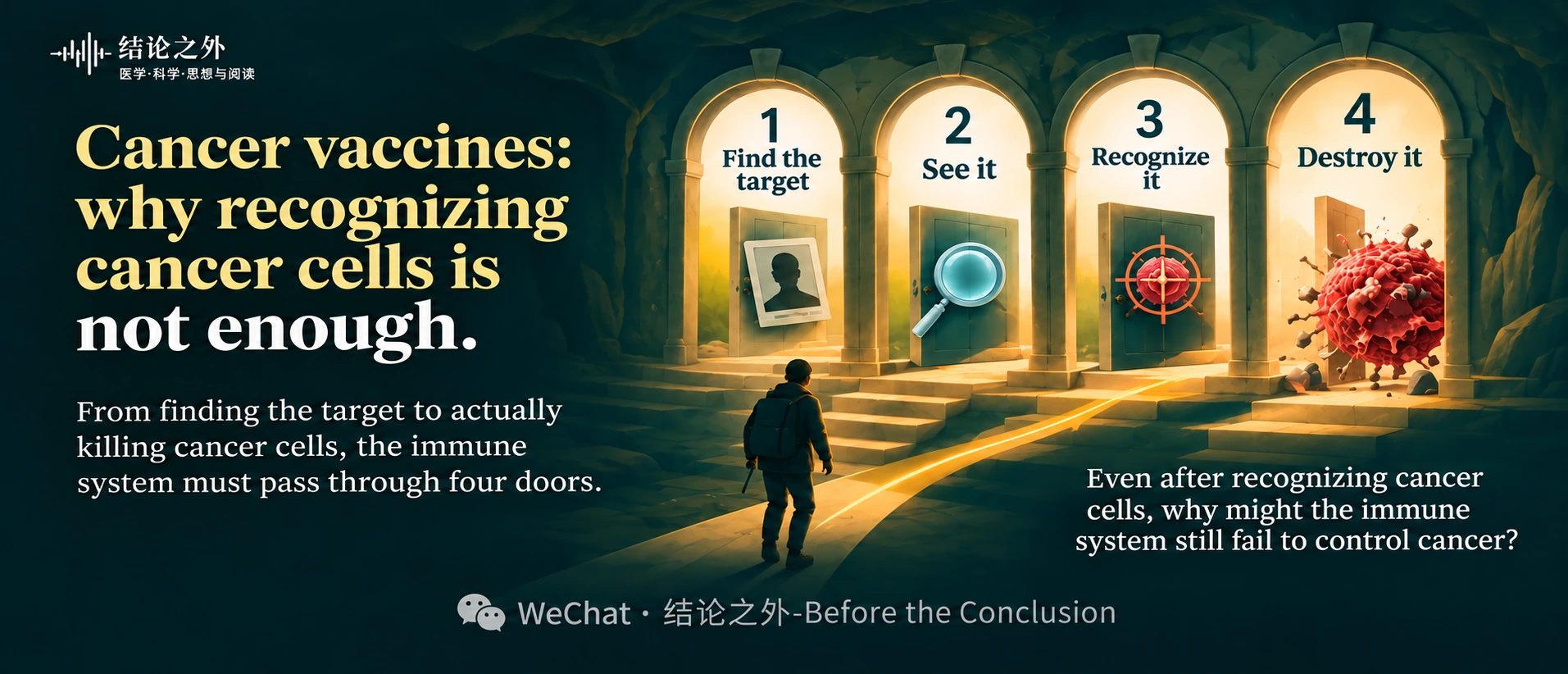
From a photograph of a suspect to actually catching the target, how many doors must the immune system pass through?
Imagine a group of thieves appearing in a city.
Security staff have photographs of the suspects, have received special training, and can even identify the targets accurately in simulated tests.
Yet during a real operation, the thieves may still escape.
Why?
Knowing what a target looks like and actually finding and catching it are different things.
Some of the challenges facing cancer vaccines are similar.
In the previous article, we compared three cancer vaccine studies.
A melanoma vaccine significantly reduced patients' risk of recurrence in a large phase III trial.
A head and neck cancer vaccine, by contrast, did not meet its expected progression-free survival endpoint.
And an early ovarian cancer study found that even when the immune system responds to a vaccine, cancer cells may find ways to escape recognition.
Why does this happen?
What lies between teaching the immune system to recognize cancer cells and actually helping patients control their cancer?
In this article from Before the Conclusion, a story about finding thieves will help explain the four doors that cancer vaccines must pass through.
1. First, why are cancer cells so hard to recognize?
Our immune system carries out complex patrols every day.
It needs to identify foreign threats such as viruses and bacteria, while also detecting cells that have become abnormal within the body.
But cancer cells have a particular characteristic.
They began as the body's own cells.
Although some genes may mutate during cancer development and cell behavior changes, cancer cells retain many characteristics of normal human cells.
This creates a difficulty for the immune system.
If recognition is insufficiently accurate, cancer cells may be missed.
If the attack is too broad, normal tissues may be damaged.
Therapeutic cancer vaccines seek to help the immune system identify the targets it should attack more accurately.
One strategy is to look for specific genetic mutations in cancer cells.
These mutations sometimes give rise to new protein fragments called neoantigens.
Researchers try to provide information about these neoantigens to the immune system so that particular T cells learn to recognize them.
But there is no unobstructed, straight path from finding a neoantigen to eliminating cancer cells.
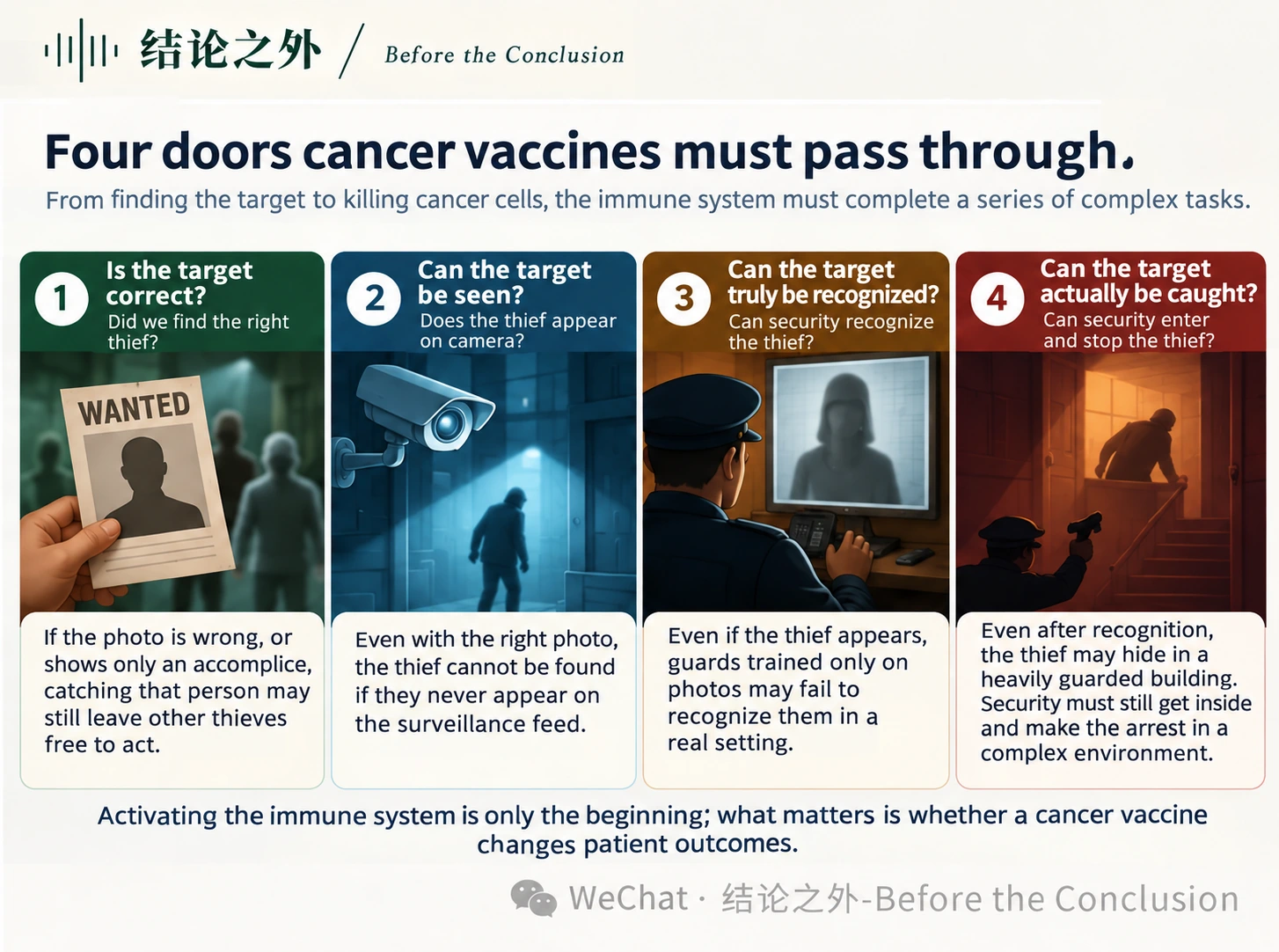
2. The first door: have we found the right target?
Imagine police responding to a report and deciding to look for a gang of thieves.
The first step is, of course, to establish whom they should catch.
Suppose surveillance footage shows five suspects.
But the security staff receive a photograph of only one.
Even if they eventually catch that person, the accomplices may remain active.
Something similar can happen in cancer.
Not all cancer cells within the same tumor are identical.
Some mutations occur in the great majority of the cancer cells.
Others may be present in only a small fraction.
If a vaccine targets something found in only a minority of cells, even an effective immune attack against those cells may leave other, unrecognized cancer cells behind.
Those cells may still have an opportunity to grow.
Researchers therefore need to consider:
Is the target antigen really present?
Is it sufficiently stable?
How many cancer cells carry it?
In theory, the more representative a vaccine's target, the greater its chance of covering more of the cancer cells that need to be attacked.
But selecting the right target is only the first step.
3. The second door: why might a target be present but invisible?
Now suppose the security staff have the correct photograph.
But the suspect never appears on surveillance footage.
Even the most accurate photograph will not help them locate the target.
The immune system faces a similar problem.
The presence of an abnormal protein inside a cancer cell does not mean that a T cell can necessarily recognize it.
Cells generally need to process proteins into shorter fragments and display them on the cell surface using particular molecules.
These antigen-presenting molecules include HLA molecules.
Think of them as identification displays on the cell surface.
T cells cannot freely inspect every protein inside a cancer cell.
They rely on these displays to recognize information presented at the cell surface.
The problem is that some cancer cells may lose aspects of HLA-related function or reduce antigen presentation in other ways.
It is as though the suspect remains in the building but has disappeared from the surveillance system.
The target is still there, but the immune system may no longer be able to see it.
This is one key to understanding cancer immune escape.
4. The third door: does seeing a target guarantee recognition?
Suppose the suspect finally appears on camera.
But the security officer searching for him has only been trained using photographs.
In the training room, the officer can identify the person in the photograph accurately.
At the actual scene, different angles, lighting, and surroundings may prevent accurate recognition.
Cancer vaccine research must distinguish these situations too.
In the laboratory, a synthetic antigen fragment can be added to a sample to see whether T cells respond.
Researchers might, for example, test whether T cells release particular immune signals.
A response suggests that these T cells may have recognized the antigen supplied in the experiment.
But this alone does not establish that:
Real cancer cells will naturally produce the same antigen fragment.
Nor does it establish that they will display enough of those fragments on their surface.
Still less does it directly establish that these T cells can kill cancer cells in the patient's body.
This is why researchers also need experiments that more closely resemble the actual tumor environment.
An ovarian cancer NeoVax study published in October 2026 offers a useful example.
The researchers measured vaccine-induced immune responses and also searched tumor-associated T cells for T-cell receptors capable of recognizing cancer cells.
A T-cell receptor, or TCR, can be thought of as the sensor a T cell uses to identify a particular target.
The researchers then used patient-derived tumor organoids to test whether some of these receptors could recognize antigens naturally presented by the cancer cells.
Tumor organoids are three-dimensional models grown in the laboratory from patients' tumor cells, retaining some of the tumor's biological characteristics.
They cannot fully reproduce the cancer environment inside the body, but can help researchers ask questions closer to the actual tumor.
The significance of these experiments is like going beyond showing security officers photographs to testing whether they can identify a target under more realistic conditions.
An immune response in the laboratory and effective recognition in a real tumor are not exactly the same kind of evidence.
5. The fourth door: does recognition guarantee capture?
Finally, suppose the security staff have successfully recognized the suspect.
But the suspect has hidden inside a building with a complicated layout.
The building has many entrances, obstacles, and blocked passages.
Even knowing where the target is, the staff must still enter the building, find the target, and complete their task in difficult surroundings.
Similar challenges exist within tumors.
T cells need to reach the tumor's location.
Once inside, they may encounter cells and signals that suppress immune responses.
Some immune cells gradually lose their ability to sustain an attack.
Some cancer cells may alter their biological characteristics, reducing the chance that the immune system will clear them.
Together, these factors make up the complex tumor microenvironment.
They may prevent T cells that can recognize cancer cells from working effectively enough.
Thus, even after the earlier doors have been passed, a clinical benefit is not guaranteed.
Recognizing a target is only part of catching it. Completing the task also requires reaching, attacking, and maintaining control over the target.
6. Another perspective: cancer cells can change their “identity information”
If the four doors describe how the immune system searches for cancer cells, another question remains:
Can cancer cells change during the process?
They can.
Return to the story of finding thieves.
Suppose the security staff have developed an effective identification method.
But the suspect discovers he is being tracked and changes his disguise, or exploits gaps in surveillance to conceal his movements.
The previously effective method of recognition may then stop working.
Cancer cells do not consciously plan an escape as a person would.
But as a tumor evolves, cells that evade immune attack may be more likely to survive and continue growing.
This is related to immune selection pressure.
The NeoVax ovarian cancer study provided a noteworthy example.
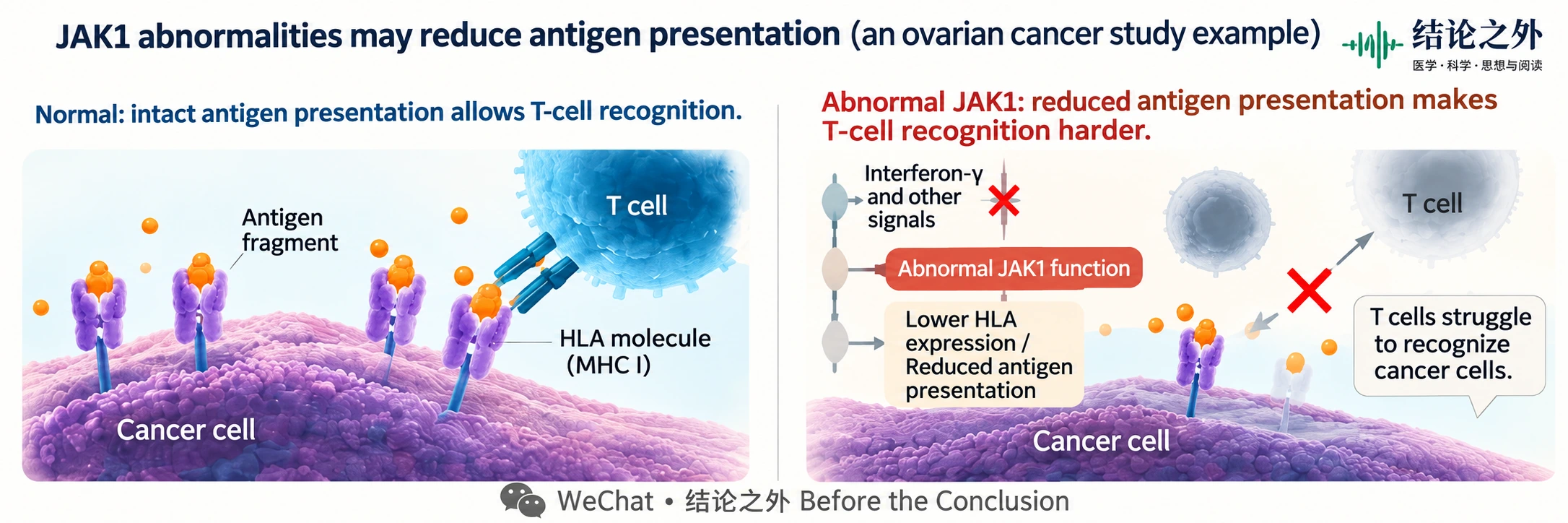
One patient's recurrent tumor developed a structural abnormality affecting JAK1.
JAK1 participates in intracellular immune signaling, including responses to signals such as interferon-γ.
If this pathway is disrupted, the expression of certain antigen-presenting molecules on cancer-cell surfaces may fall.
The result is that the cancer cells remain, but are harder for particular T cells to find.
When the researchers restored the relevant JAK1 function in a patient-derived tumor model, some antigen presentation and T-cell recognition were restored too.
This is a valuable mechanistic clue.
But caution is still needed.
It does not mean that every patient receiving a cancer vaccine will develop a JAK1 abnormality, or prove that JAK1 is the sole reason cancer vaccines fail.
It reveals one possible route of cancer immune escape.
Cancer vaccines must help the immune system recognize cancer cells while also confronting changes those cells may undergo under immune pressure.
7. Why do all four doors matter?
Now look again at the whole process.
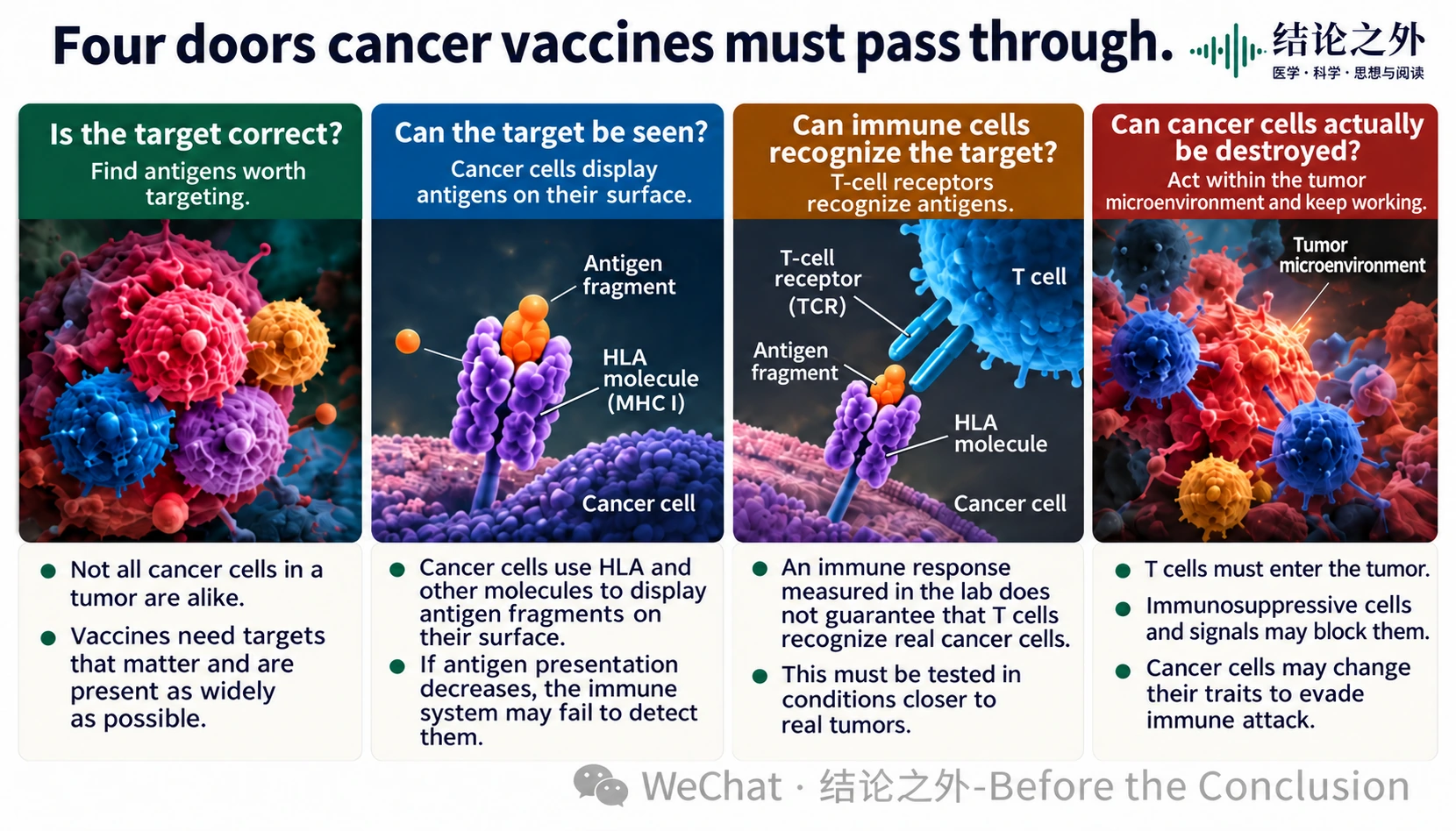
The first door: has the right target for attack been chosen?
The second door: do the cancer cells display information about that target?
The third door: can immune cells actually recognize the information?
The fourth door: after recognition, can they enter the tumor and act effectively?
These are not four unrelated steps.
Together they form a chain from vaccine design and immune recognition to potential clinical benefit.
A barrier at any critical point may affect the final treatment outcome.
The four doors primarily help us understand biological mechanisms.
Determining whether patients actually benefit still requires clinical studies to answer:
Does the disease recur less often?
Does the tumor progress later?
Do patients live longer?
Are the side effects and treatment burden worth the benefit?
An improvement in a single immune measure cannot answer these questions.
We therefore need both early research that reveals immune mechanisms and large clinical trials that assess patient outcomes.
Both are essential, but they serve different purposes.
8. Beyond the conclusion, what should we keep asking?
The four doors help explain why cancer vaccine research can produce encouraging results, trials that miss expectations, and very small studies with substantial mechanistic value at the same time.
They do not simply cancel each other out.
Some studies tell us that a treatment strategy may genuinely improve patient outcomes.
Others help explain why a reasonable scientific idea may not translate into clinical efficacy.
Still others reveal new problems for scientists to solve.
Medical progress is more than the accumulation of successful results.
Sometimes understanding why something failed can also change the direction of the next study.
The real distance cancer vaccines must cross is more than the distance from an antigen to a T cell. It is the distance from an immune response to a real benefit patients can experience.
This is also a continuing concern of Before the Conclusion:
When we see a medical news story, an impressive number, or an encouraging research result, what exactly has it demonstrated?
And which questions remain unanswered?
Principal reference
Sellars et al., Nature Medicine, October 14, 2026.
Personalized neoantigen-targeting cancer vaccines in ovarian cancer: a phase 1 trial.
https://www.nature.com/articles/s41591-026-04717-8
Further reading and audio:
Cancer vaccines: why did three clinical studies reach different results?
Beyond the conclusion, there are still questions worth asking.
Medicine · Science · Ideas and Reading
Follow Before the Conclusion, and keep exploring with curiosity and independent thought.
Text and image use
This article was originally compiled and written by Before the Conclusion, with AI tools assisting its production. You are welcome to share the article's link. Without separate permission, please do not reproduce or excerpt the text by copying, republishing, or reposting screenshots, or separately use its original illustrations. Relevant rights are subject to applicable law.
This article is intended for the communication of medical and scientific knowledge and does not constitute individual medical advice.
Companion reading: Cancer vaccines: why did three clinical studies reach different results?
Listen to the related audio on the original WeChat article ↗
© Before the Conclusion | Text originally compiled and written by Before the Conclusion; illustrations conceived by Before the Conclusion and created with AI tools. Please do not republish, copy, modify, or use commercially without permission.