Why do some cancer vaccines significantly reduce recurrence risk, while others fall short of expectations and still others demonstrate only an immune response?
In October 2026, three developments in cancer vaccines deserved attention.
The first was encouraging.
In a phase 3 clinical trial involving more than 1,100 patients, a personalized vaccine for melanoma reduced the relative risk of recurrence or death by 42%.
The second did not meet expectations.
Another mRNA cancer vaccine, for head and neck cancer and also combined with immunotherapy, did not significantly extend patients' progression-free survival.
The third came from an early ovarian cancer trial in which only 10 patients received a vaccine.
Researchers observed vaccine-induced immune responses and identified some mechanisms through which cancer cells might escape immune attack.
Three studies, all involving cancer vaccines, produced different results.
Why?
1. First, these are not the preventive vaccines we know
When we hear “vaccine,” we usually think of influenza, hepatitis B or HPV vaccines.
These vaccines are primarily intended to prevent infection.
But the vaccines discussed here belong to another category: therapeutic cancer vaccines.
They are intended for patients who already have cancer.
Researchers hope that vaccination will help a patient's immune system recognize cancer cells more accurately and attack them.
Think of the immune system as a security team on patrol.
Cancer cells originate in the body itself and share many features with normal cells. The immune system can therefore have difficulty distinguishing them accurately.
Cancer vaccines try to give that security team clearer identifying features for its target.
But one point must be remembered:
Recognizing a target does not guarantee that it can be eliminated. Generating an immune response does not guarantee clinical benefit for the patient.
With that distinction in mind, let us examine the three studies.
2. V940: positive phase 3 results for a melanoma vaccine
The first is V940, a personalized mRNA cancer vaccine jointly developed by Moderna (NASDAQ: MRNA) and Merck (NYSE: MRK) in the United States.
It is also called intismeran autogene.
What distinguishes this vaccine is that patients do not all receive exactly the same formulation.
Researchers analyze particular genetic mutations in each patient's tumor, select neoantigens that the immune system might recognize and use mRNA technology to make a personalized vaccine.
The study involved melanoma patients whose tumors had been completely removed surgically but who remained at high risk of recurrence.
Melanoma is a potentially aggressive skin cancer.
Even when surgery removes every detectable tumor, small numbers of cancer cells may remain in the body and cause recurrence.
Could a personalized cancer vaccine after surgery further reduce that risk?
A total of 1,137 patients took part in the phase 3 trial, INTerpath-001.
Both groups received immunotherapy with pembrolizumab, sold as Keytruda.
One group also received V940; the other received placebo.
Detailed results announced on October 22, 2026 showed:
Adding V940 reduced the relative risk of recurrence or death by 42% compared with the control group.
What does 42% mean?
It does not mean that 42 of every 100 patients avoided recurrence because of the vaccine, or that the cure rate increased by 42 percentage points.
It is a relative measure of risk, reflecting the difference between groups in the risk of recurrence or death during observation.
The absolute proportions are easier to grasp:
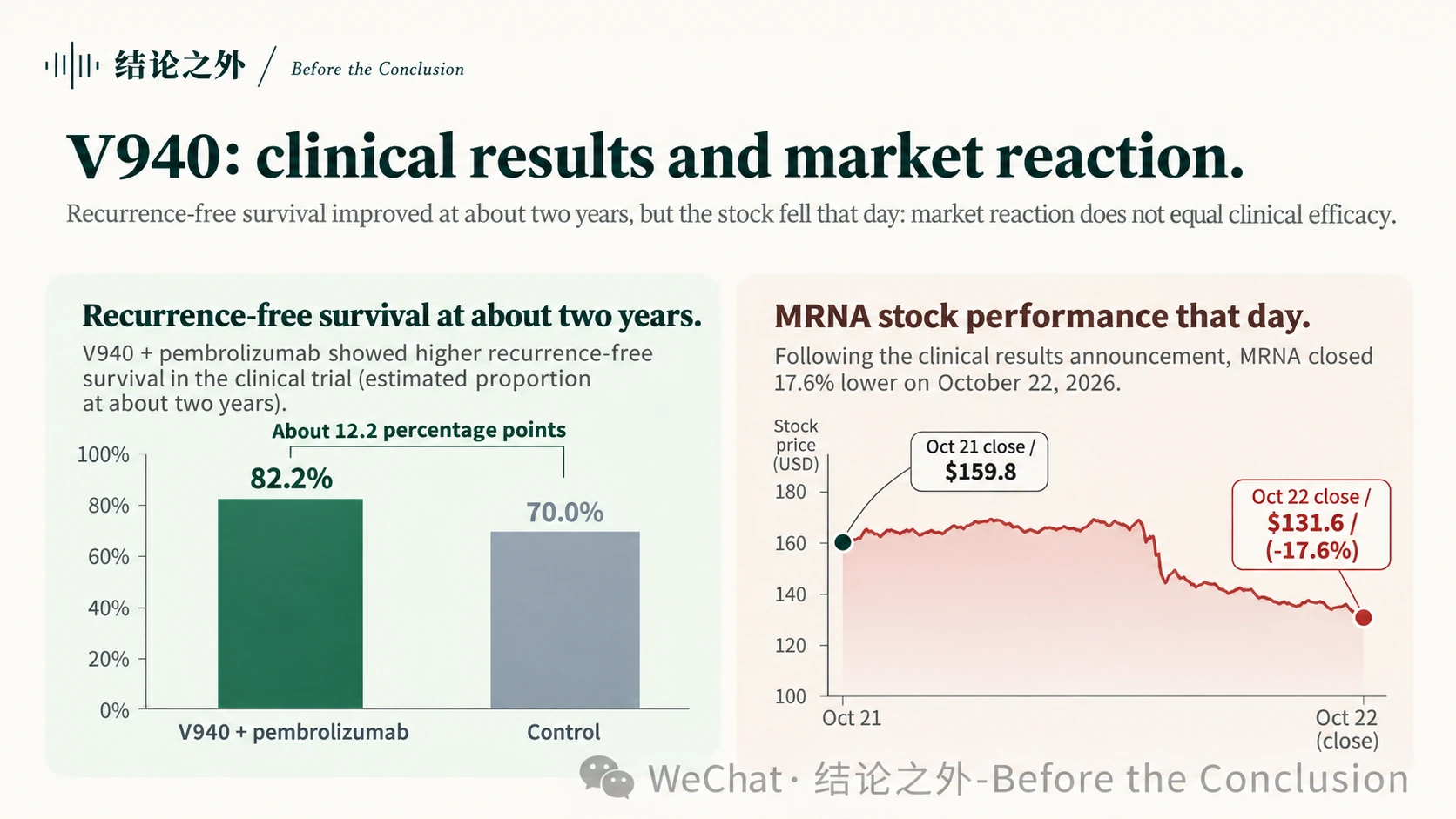
At approximately two years, about 82.2% of patients in the combination group were alive without recurrence, compared with about 70.0% in the control group.
That is a difference of approximately 12.2 percentage points.
The study also found a significant reduction in the risk of distant metastasis or death.
Why do these results matter?
They come from a large randomized controlled phase 3 trial, rather than simply from observing activated immune cells in a laboratory.
But positive results do not answer every question.
The overall survival data are still immature.
Will reducing recurrence also help patients live longer? Longer follow-up is needed.
Treatment also has costs. Grade 3–5 treatment-related adverse events were reported in approximately 14.2% of the combination group and 13.4% of the control group.
We can therefore say that V940 has produced positive evidence of clinical importance. We cannot claim on that basis that it has cured cancer.
3. BNT113: why did another mRNA vaccine fall short?
The second study comes from Germany's BioNTech (NASDAQ: BNTX).
Its BNT113 is also an mRNA cancer vaccine, but its design differs from V940's.
BNT113 targets head and neck squamous cell carcinoma associated with HPV16 infection.
Some of these cancer cells express E6 and E7 proteins from HPV16.
The viral proteins can serve as targets through which the immune system recognizes cancer cells.
Unlike V940, which is individually designed around each patient's tumor mutations, BNT113 primarily targets a fixed set of viral antigens.
That might sound like an advantage.
If cancer cells bear conspicuous viral features, shouldn't the immune system find them more easily?
The clinical trial did not offer so simple an answer.
In the phase 2/3 AHEAD-MERIT study, researchers compared BNT113 plus pembrolizumab with pembrolizumab alone.
The patients had unresectable, recurrent or metastatic HPV16-positive head and neck cancer.
On October 13, 2026, the company announced the first main results:
The combination did not significantly improve progression-free survival, or PFS.
PFS measures how long patients remain alive without disease progression, starting from a point defined by the study.
In other words, the analysis published so far does not establish that adding BNT113 significantly delays disease progression or death.
Does that mean BNT113 has failed completely?
That would also be too strong.
The study has another co-primary endpoint: overall survival, or OS.
This measures how long patients actually survive.
That part of the study is continuing.
Under the trial's prespecified statistical design, even without a significant PFS improvement, the study could still have a positive overall conclusion if OS later meets the corresponding criteria.
The more accurate statement is therefore:
BNT113 did not meet the current PFS endpoint. Whether it ultimately extends survival remains to be determined.
4. NeoVax: why pay attention to a study with only 10 vaccinated patients?
The third study was published in Nature Medicine on October 14, 2026.
Researchers tested a personalized neoantigen vaccine called NeoVax in selected patients with high-grade epithelial ovarian cancer.
It was a phase 1 clinical trial, and ultimately only 10 patients actually received the vaccine.
It was far smaller than either of the preceding studies.
But its main purpose was not to establish that patients lived longer.
It sought a better understanding of whether the vaccine could generate an antitumor immune response and how tumors might escape that attack.
In 6 of the 10 vaccinated patients, changes in biomarkers suggested that the vaccine might have biological activity.
This needs particular care:
6/10 is neither a 60% cure rate nor evidence that 60% of patients had a definite clinical response.
It suggests only that some patients may have developed immune changes related to the vaccine's action.
More interestingly, researchers went on to analyze immune cells in the patients' tumors and how they recognized cancer cells.
They found that some immune cells could indeed recognize particular antigens displayed by the patients' cancer cells.
At the same time, they found that cancer cells might escape recognition by changing their capacity to present antigens.
A JAK1 abnormality in one patient's recurrent tumor provided a clue to understanding this immune escape.
The study had a very small sample, no randomized control group and patients who had also received other treatments.
It therefore cannot establish that NeoVax extends progression-free or overall survival.
But it helps explain why a vaccine may fail to control cancer even after generating an immune response.
That matters too.
5. How should these three studies be compared?
Now let us put them side by side.
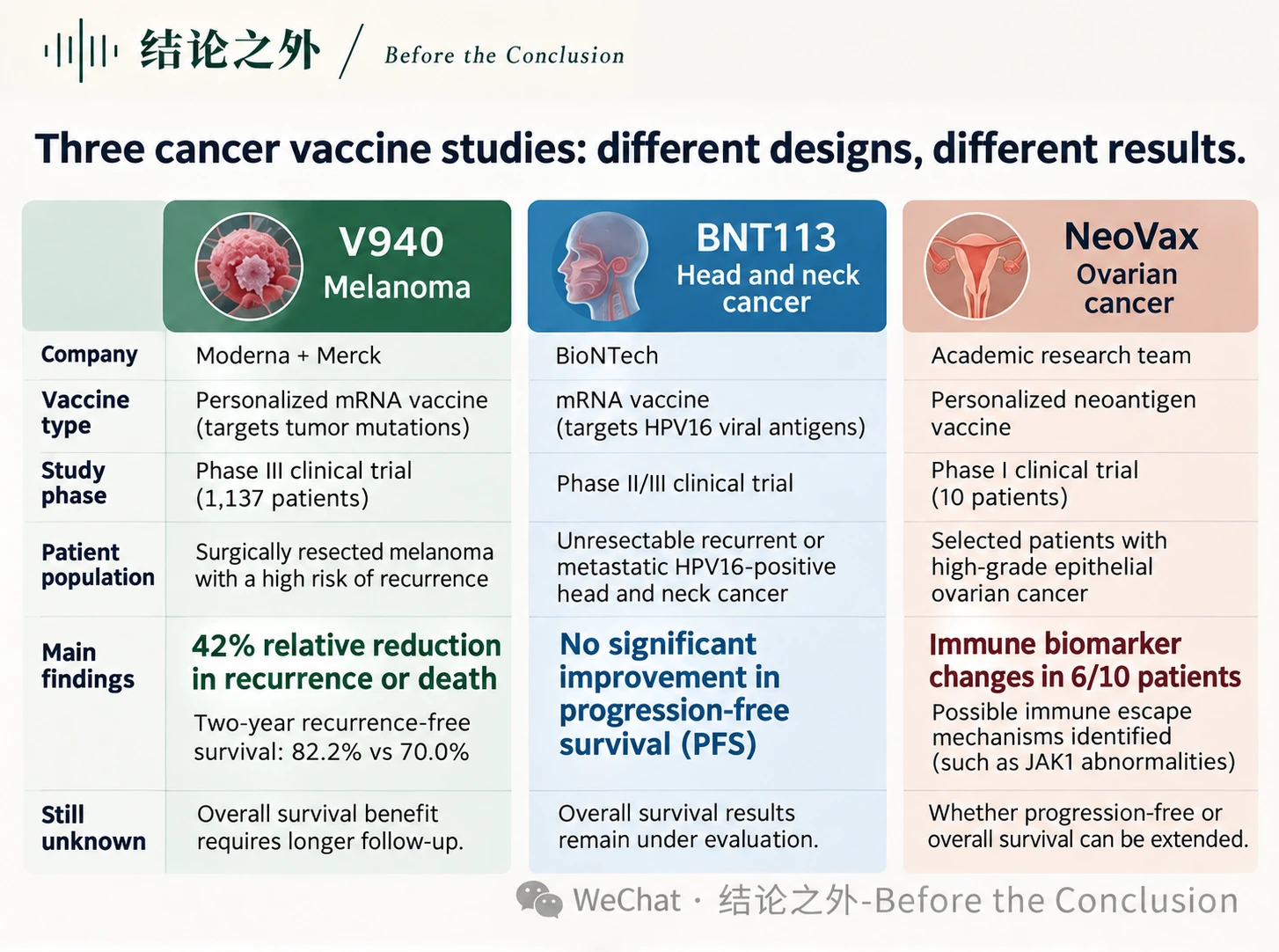
They cannot simply be ranked first, second and third.
Why?
Because they are not asking exactly the same question.
V940 asks how to reduce future recurrence after surgical removal of a tumor.
BNT113 asks whether adding a vaccine can improve outcomes in cancer that has already recurred or metastasized.
NeoVax mainly explores the feasibility and preliminary safety of a personalized vaccine, and its relationship with the cancer immune response.
The patients, disease stages and vaccine strategies differ.
More importantly:
The evidence they provide sits at different levels of clinical research.
An immune response in the laboratory is one kind of evidence.
Delayed disease progression is another.
A reduction in recurrence risk is a different clinical endpoint again.
Ultimately, whether patients live longer and better requires further investigation.
These results are related, but cannot substitute for one another.
6. What is the real question for cancer vaccines?
Looking back, the three studies do not really contradict one another.
One shows that a particular cancer vaccine strategy can reduce recurrence risk in a defined patient population.
Another tells us that a reasonable vaccine design does not guarantee that every clinical trial will meet expectations.
The third helps scientists continue to understand why some cancer cells evade immune recognition.
Together, they remind us:
There are still many steps between activating the immune system and actually improving patient outcomes.
The next time we see a report of a “breakthrough in cancer vaccines,” perhaps we should first ask:
At which step did the breakthrough occur?
Did the study demonstrate an immune response, or an improvement in disease progression, recurrence or survival?
These questions help us understand the real meaning of medical research better than simply deciding whether a vaccine succeeded or failed.
Beyond the conclusion, one more question
On October 22, 2026, Moderna announced encouraging phase 3 data for V940, yet its shares closed down approximately 17.6% that day.
Why did the share price fall sharply despite positive clinical results?
We have produced a separate audio episode exploring this apparent contradiction through the differences between clinical data and market expectations.
Further listening | Why did shares fall despite positive cancer vaccine data?
From a medical perspective, another question remains:
If the immune system has recognized cancer cells, why might it still fail to defeat the cancer?
In the next article, a story about “finding a thief” will illustrate the four doors a cancer vaccine must pass through.
Study sources
Merck and Moderna. Phase 3 INTerpath-001 results, October 22, 2026.
BioNTech. Phase 2/3 AHEAD-MERIT trial update, October 13, 2026.
Sellars et al. Nature Medicine, October 14, 2026.
Personalized neoantigen-targeting cancer vaccines in ovarian cancer: a phase 1 trial.
https://www.nature.com/articles/s41591-026-04717-8
Moderna share price: closing data for October 22, 2026.
Beyond the conclusion, there are still questions worth pursuing.
Medicine · Science · Ideas and Reading
Follow Before the Conclusion to stay curious and think independently together.
Text and image usage statement
This article was originally compiled and written by Before the Conclusion, with AI assistance in production. You are welcome to share a link to this webpage. Without separate permission, please do not reproduce or excerpt the text by copying, reposting or republishing screenshots, or use its original illustrations separately. Rights are governed by applicable law.
This article interprets medical and scientific information and does not provide individual medical advice. Stock-related information is used only to analyze medical research and market reactions and does not constitute investment advice.
Companion reading