
What does a piece of news, a number, a product, or an apparently good result actually mean?
A pharmacist had to leave work because her speech became slurred and thinking and expression grew increasingly difficult to coordinate. Another family member said her daughter needed help brushing her teeth and getting dressed, and even needed her food cut up. These experiences appear in the FDA's 2016 report on patients' perspectives on Huntington's disease. The report collected statements from an earlier public meeting and public submissions. They cannot represent every patient, but they show us the lives behind the diagnosis.[1]
On November 2, 2026, uniQure, a gene therapy company headquartered in Amsterdam, the Netherlands, announced that the FDA had accepted its marketing application for the Huntington's disease gene therapy AMT-130 and granted priority review, with a target decision date of May 1, 2027. This gives patients and families a more concrete date to look toward. But acceptance does not end the assessment of efficacy and long-term risks.[5,14]
With a disease that gradually takes away everyday abilities, it is easy to understand why patients want effective treatment as soon as possible. The difficulty is that medicine must also answer: how confidently can the changes observed so far be attributed to treatment? And if we wait for more certain evidence, what will patients lose during that wait? Understanding the burden of disease helps us weigh the value of real benefit, but cannot establish that a particular drug is already effective.
A disease that changes the life of an entire family
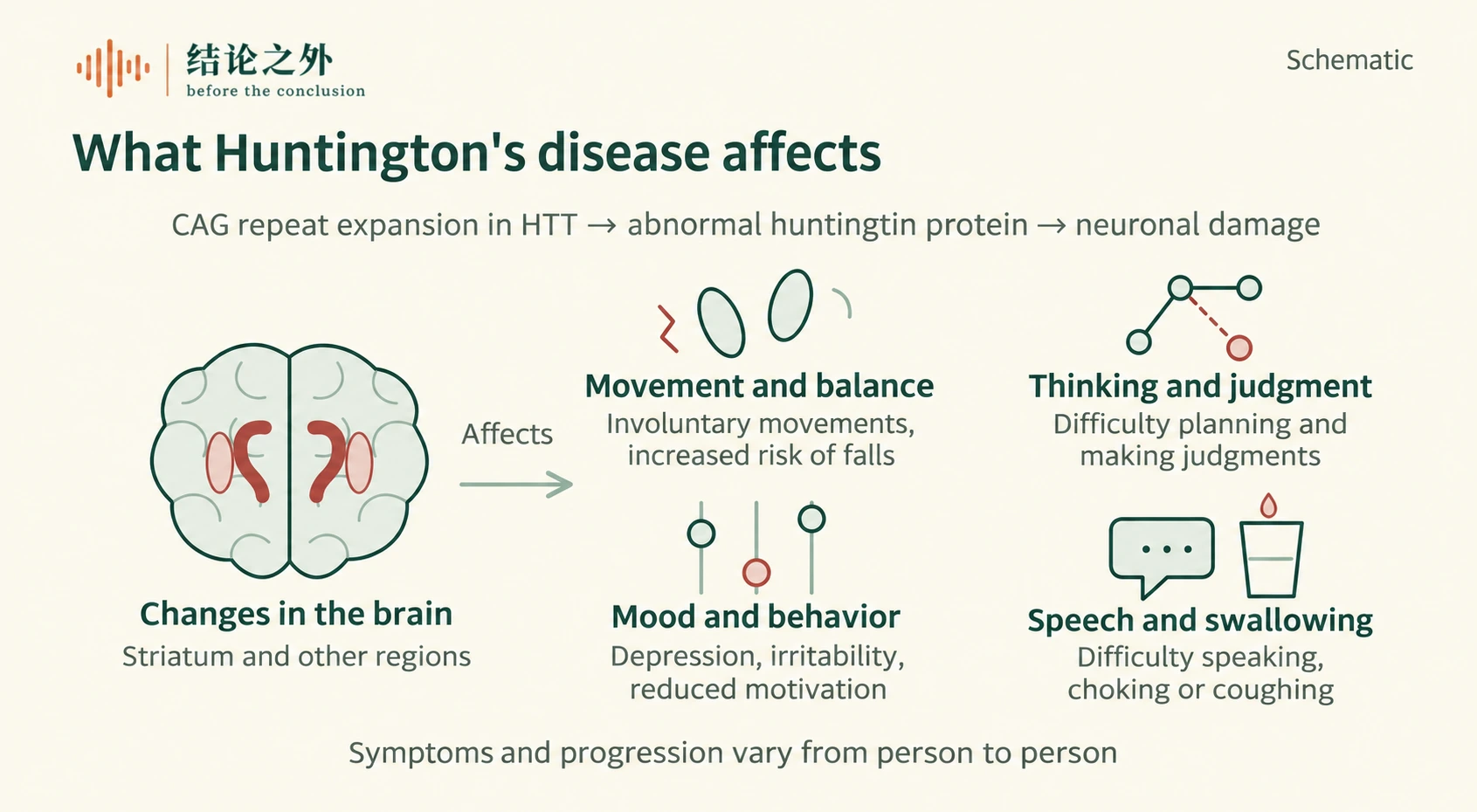
Huntington's disease is an inherited, progressively worsening brain disorder affecting movement, cognition, mood, and behavior. Adult-onset symptoms commonly begin in a person's thirties or forties, although onset can be earlier or later. Early changes may be as subtle as increased irritability, difficulty managing tasks, or small involuntary movements. As the disease advances, walking, speaking, and swallowing can all be affected.[2]
It is also known as Huntington's chorea, but the emphasis on movement can be misleading. Someone may still be able to walk yet already struggle to organize a day, assess a complicated problem, or express thoughts fluently. Changes in mood and behavior may affect family relationships too. These changes have medical causes and cannot simply be attributed to unwillingness to cooperate.[1,4]
The disease arises from an abnormally expanded repeated sequence in the HTT gene, leading to the production of abnormal huntingtin protein. Typically, when one parent carries the disease-causing variant, each child has about a one-in-two chance of inheriting it. In some families, the demands of care today coexist with concern for the next generation.[3,4]
People with adult-onset disease typically live about 15 to 20 years after symptoms begin, with substantial individual variation. That number does not mean they retain the same quality of daily life throughout those years. As the disease progresses, the abilities to work, care for oneself, and communicate may be damaged in succession, while care needs increase.[2]
Huntington's disease generally worsens over time, but the rate differs between patients, and one person's day-to-day performance can fluctuate. A treated person changing little over a period therefore still needs an appropriate comparison before we can judge whether treatment was responsible.[1,4]
“Unable to wait” can thus have a very concrete meaning: by the time the answer is more certain, some patients may have lost further ability to communicate or care for themselves.
What slowing progression means to patients
For a progressively worsening disease, a treatment's value may lie in postponing the loss of an ability. Someone still able to work may hope to remain employed. Someone who needs family care may care more about getting dressed independently, doing simple household tasks, or clearly telling another person where something hurts.
In the patient perspectives collected by the FDA, some described treatment success as retaining a better, more engaged life for longer; others hoped to preserve cognition and communication longer.[1] These wishes help explain why “merely slowing” a disease could still mean a great deal.
We must distinguish the benefits patients hope for from the effects a drug has demonstrated. These everyday examples show what matters to patients; they are not evidence that AMT-130 has already delivered those improvements. Whether the drug works, and how much, must be judged from the clinical comparison itself. Reliably connecting differences on rating scales to patients' actual lives remains an important question in evaluating a new drug.
How this drug aims to alter the disease course
Patients are not entirely without treatment. Existing medicines can help control some involuntary movements and mood or psychiatric symptoms. Rehabilitation, nutritional management, and swallowing support also matter. But these approaches primarily address symptoms and care needs. As of November 2, 2026, no disease-modifying treatment had been approved to delay Huntington's disease progression. What patients most lack is a reliable way to alter the disease course.[4,6]
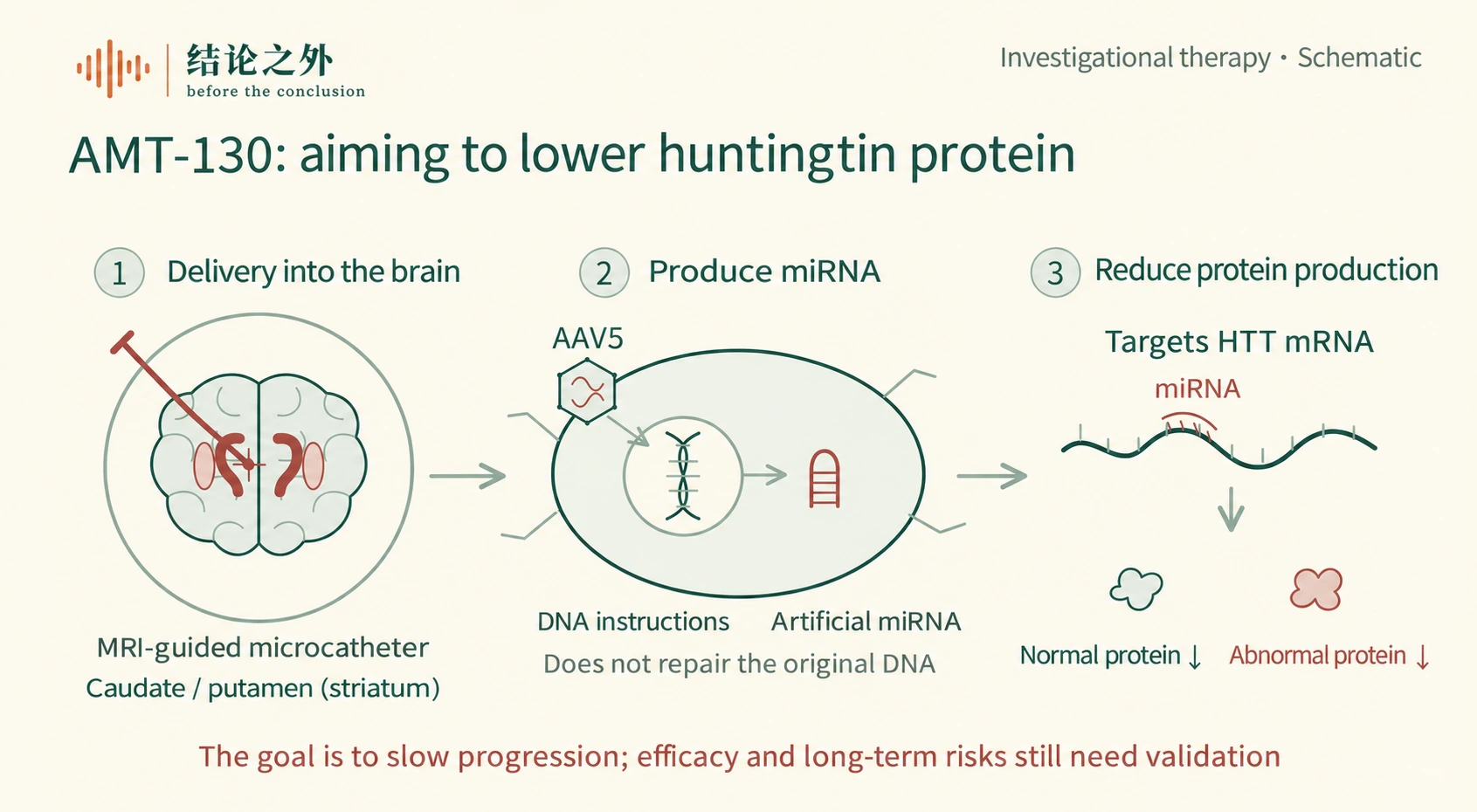
AMT-130 attempts to intervene in protein production, testing whether reducing huntingtin protein can slow the disease.[5,6]
It uses a viral vector to deliver genetic instructions that produce an artificial microRNA, causing cells to make less of the relevant protein. The approach lowers both normal and abnormal huntingtin. It is a gene-silencing strategy, rather than a direct repair of the disease-causing DNA sequence.[6]
Administration requires neurosurgery to deliver the therapy into selected brain regions. Once delivered, the treatment cannot be withdrawn simply by stopping it, as an oral medicine can. Its potentially long-lasting action therefore demands serious assessment of long-term risk. Studies have reported serious adverse events associated with central nervous system inflammation; the company says these events have all resolved.[6,8]
Understanding why patients may be willing to accept risk should go hand in hand with explaining those risks fully.
How to interpret the three- and four-year results
In September 2025, the company announced three-year follow-up results. Among the 12 high-dose patients who had reached that follow-up point, progression measured by the composite cUHDRS scale was approximately 75% slower than in a matched external natural-history control group. The statistical comparison reached significance.[7]
This scale combines measures of movement, cognition, and everyday function to track disease changes.[9] “75% slower” describes the relative difference between the groups' average score declines over a particular observation period. It does not mean that 75% of patients improved, and cannot be translated directly into additional years of life.
A closer look
The following is for readers interested in the calculation; it can be skipped without losing the main thread.
In the analysis announced in 2025, the treatment group's mean cUHDRS score had fallen 0.38 points from baseline at three years, versus 1.52 points in the external controls. Since 0.38 is one quarter of 1.52, the treatment group's average decline was about three quarters, or 75%, smaller. Average scores declined in both groups; the treatment group declined less. This relative percentage must be considered alongside sample size, the absolute point difference, and the source of the controls.[7]
End of the calculation; back to the main discussion.
In September 2026, the company announced longer-term results. The four-year cUHDRS analysis of 12 high-dose patients estimated approximately 44% slower progression relative to external controls, but this comparison did not reach statistical significance. The TFC scale, which assesses everyday functional capacity, continued to show a positive signal.[8]
There is still a step of causal judgment between “less decline was observed” and “the drug has been reliably shown to slow the disease.” We can more confidently attribute the difference to treatment only if other explanations, such as the comparison method or missing follow-up, can reasonably be excluded.
These findings increase uncertainty but do not establish that the drug is ineffective. The sample is very small, and different scales capture different changes. At the same time, quoting only the more favorable functional-scale result would overlook the fact that the composite scale has not yet provided a definite answer.
The three- and four-year percentages also cannot simply be joined into a curve showing “efficacy falling from 75% to 44%.” In addition to the different time points, the later analysis used an updated external-control database. A change in the comparison group affects the percentage too.[7,8]
The hardest question: what would have happened without the drug?
To determine whether treatment changes the disease course, we need to know how quickly these patients would otherwise have deteriorated. The early US AMT-130 study included a randomized sham-surgery control, but the key comparison supporting the long-term application mainly uses external controls from the Enroll-HD natural-history database. These are separate facts and must be understood separately.[5,6]
Researchers look in the database for people with similar baseline characteristics to match. This uses valuable long-term follow-up and reduces the difficulty of establishing another control group. But matching can address only differences that have been recorded and can be compared; it cannot guarantee equality in every factor affecting progression. The FDA's 2023 draft guidance on externally controlled trials also discusses these potential biases. The document remains a draft, not a mandatory rule.[10]
Long-term loss to follow-up is particularly difficult. If people whose disease worsens faster have more difficulty returning for visits, those still represented in the database years later may appear to progress more slowly. Comparing treatment with them could underestimate its advantage. If bias occurs elsewhere, the estimate could move in the opposite direction. These possibilities must be examined when interpreting external controls.
uniQure argues that, in the updated controls, loss to follow-up was associated with faster deterioration and may have underestimated the treatment advantage at four years. The company also reported a post hoc analysis using the older control data, which produced different results.[8] That explanation requires scrutiny. A more positive result under a different analysis does not settle the dispute.
What we need to know is how well the conclusion holds when reasonable analytical methods, assumptions about missing data, or matching approaches are changed. The reliability patients need lies within these apparently technical details.
How can patients wait less and still get an answer sooner?
Priority review means that the FDA devotes more resources to reaching a decision sooner; it does not change the scientific and medical standards for approval. Accelerated approval is a separate pathway. Under conditions including serious disease and unmet need, approval may be considered on the basis of a surrogate endpoint or intermediate clinical endpoint reasonably likely to predict clinical benefit, with further verification of benefit required.[11,12]
Within that framework, the questions include what evidence can support an initial decision and how remaining uncertainty can be tested promptly. Even for scales that already have clinical meaning, the observation period, comparative design, and reliability of results must still be assessed.
Today's company announcement disclosed plans for a randomized confirmatory study of approximately 200 people, allocated about 2:1 to treatment or standard care, assessing Total Functional Capacity (TFC) at three years. This scale covers work, financial management, household tasks, self-care, and care needs, connecting it with the everyday abilities patients hope to retain.[5,13]
It is crucial that the plan become a study that actually enrolls patients promptly, maintains follow-up, and reaches completion. For a one-time therapy delivered into the brain, risk monitoring must keep pace as well. Results in adults with early symptomatic disease cannot yet be generalized directly to all ages and all disease stages.[6]
Patients certainly have reason to value earlier access, and they have a right to know exactly how far the supporting evidence extends. Some will accept substantial uncertainty; others will be more concerned about surgery and long-term risks. “Patients cannot wait” cannot make the same choice for everyone.
Equally, those asking for reliable evidence must seriously account for the cost of waiting. For someone losing everyday abilities, waiting several more years does not mean they will be able to return to today's position and choose again.
If a treatment in fact offers no clinical benefit, receiving it also consumes patients' time and may bring additional risk. The seriousness of the disease increases the value of two things at once: obtaining effective treatment early, and identifying early which treatments truly work.
AMT-130 has now entered review, and a final conclusion remains pending. The question it raises is already concrete: how can medicine bring a valuable opportunity forward as much as possible, while determining more quickly how reliable that opportunity is—while patients can still benefit?
Understanding patients' circumstances should help us choose more meaningful endpoints, reduce unproductive delays in research, and discuss risks seriously. It cannot replace assessment of a particular drug. What ultimately needs to be established is how much meaningful life a treatment can preserve and whether that benefit justifies its risks.
Beyond the conclusion, there are questions worth continuing to ask.
Medicine · Science · Ideas and Reading
Follow Before the Conclusion as we stay curious and think independently together.
Main sources
- FDA, The Voice of the Patient—Huntington's Disease, 2016, recording the 2015 patient meeting and public comments. See the sections on effects on daily life and desired treatments. Original report.
- NIH GARD: Huntington's disease overview, adult-onset manifestations and natural history. Disease information.
- NIH MedlinePlus Genetics: HTT gene changes and inheritance in Huntington's disease. Genetics information.
- GeneReviews: Huntington Disease, clinical manifestations, genetic counseling, and current treatments. Professional review.
- uniQure, November 2, 2026: acceptance of the AMT-130 marketing application, priority review, and the confirmatory-study plan. Company announcement.
- uniQure: AMT-130 clinical trial and patient FAQs, administration, mechanism, and risks. Study introduction; Investigational program and trial design.
- uniQure, September 24, 2025: key three-year analysis of the phase I/II study, with a June 30, 2025 data cutoff. Original results announcement.
- uniQure, September 29, 2026: updated three- and four-year analyses, with a June 30, 2026 data cutoff. Original results announcement.
- Schobel et al., Neurology, 2017: development and validation of the composite cUHDRS scale. DOI: 10.1212/WNL.0000000000004743. Original study.
- FDA, 2023: draft guidance on the design and conduct of externally controlled trials, providing nonbinding recommendations. Full draft.
- FDA: Priority Review, its purpose and approval standards. Pathway explanation.
- FDA: Accelerated Approval, surrogate endpoints, intermediate clinical endpoints, and confirmatory studies. Pathway explanation.
- “Total functioning capacity scale in Huntington's disease: natural course over time,” 2025, the TFC scale and its functional domains. Original study.
- uniQure: second-quarter 2026 Form 10-Q, listing the company's headquarters in Amsterdam, the Netherlands. SEC filing.
Sources current through November 2, 2026. Drug results and regulatory communications are described as disclosed by the company. Approval and the final eligible patient population remain subject to the regulator's review conclusion.