Before the Conclusion | Ideas and reading · Long read 04
On the limits of medical knowledge, human choices, and how we face the unknown together.
When you leave the consulting room, what do you most hope your doctor will have told you?
Perhaps a definite diagnosis and a clear treatment plan, ideally followed by: “Don't worry. Everything will be all right.”
In practice, however, doctors sometimes give a different answer: “We can't be certain yet.”
We may feel disappointed, or even wonder: if the doctor does not know either, why did I come?
But consider it another way. If medicine cannot guarantee a definite answer to every question, is a doctor who always seems to know everything really more trustworthy than one who can openly acknowledge what they do not know?
This article asks more than whether doctors should say “I don't know.” It asks what those words mean, and how doctors and patients should proceed together once they have been said.
1. Why do we so strongly expect a definite answer from doctors?
Illness can strip away a familiar sense of security. An everyday movement begins to hurt, a test produces an abnormal result, or a once-predictable day suddenly fills with uncertainty. People bring these anxieties into the consulting room and naturally hope the doctor can quickly turn confusion into order.
Medical training does give doctors greater ability to understand disease, assess risk, and choose treatments. We have reason to expect professional advice, and the more complex or urgent the situation, the stronger that expectation becomes.
Yet, almost without noticing, we can turn “the doctor understands more than I do” into “the doctor should understand everything,” and “the doctor has professional responsibilities” into “the doctor must never make a mistake, still less admit not knowing.”
This expectation extends beyond hospitals. Parents often hope they will always have an answer for their children. Teachers sometimes struggle to admit openly that they have not yet thought a question through. Someone regarded as an expert may find it increasingly difficult to revise a past judgment in public.
These relationships are certainly not identical, but they may share a long-standing social habit: quietly converting differences in knowledge and responsibility into differences in rank, as though the person in the higher position must always be right.
Human societies have always needed a division of labor and professional authority. The problem is whether we gradually turn that authority into a substitute for thinking. Faced with a complex question, we sometimes prefer to ask “Who said it?” rather than “What is the evidence?”
Trusting professional judgment is necessary. Treating professional status as a guarantee of permanent correctness is another matter. A durable trust should allow professionals to acknowledge the limits of their knowledge and revise their judgments when new evidence emerges.
2. What does uncertainty actually mean?
Medicine is no warehouse stocked with standard answers. It contains repeatedly validated knowledge as well as unresolved questions. Even when a disease has been studied for years, its course in an individual can still bring changes that are hard to predict.
We also need to distinguish two things: not having found an answer and having sufficient reason to believe that an answer is wrong.
Finding no evidence of disease is not always the same as having evidence that the disease is absent.
Yes, you read that correctly.
It is not a misprinted tongue-twister. You might also think of it as a medical brainteaser.
But the point is simple: not having found something does not mean it definitely does not exist.
If you search an entire drawer without finding your keys, that tells you only that you did not find them in that drawer. It does not prove the keys do not exist.
Of course, if the search method is reliable enough and its scope sufficiently comprehensive, repeatedly finding nothing gives us stronger reason to believe that something may indeed be absent. Medical tests work similarly: how strongly a negative result rules out disease depends on the test's sensitivity, the likelihood of the disease, the timing of testing, and the specific circumstances. We cannot automatically interpret one normal test as “absolutely nothing is wrong.” Nor should we treat every negative result as worthless.
This is why cautious medical language can sometimes be more accurate than a categorical assurance. Doctors need not make every possibility sound vague at all times. When the evidence is strong, they should be clear. When evidence is insufficient, they should explain why the conclusion can go only this far for now.
More importantly, uncertainty does not make action impossible. We often need to carry out necessary tests or treatment while continually refining our judgment through follow-up and new information.
3. There are three levels of the unknown in medicine
We often treat “not knowing” in medicine as one situation. Look more closely, and at least three distinct levels emerge. They are neither formal disease stages nor steps that allow movement only in one direction. They are a map to help us identify the question.
Level one: diagnostic uncertainty—what are we dealing with?
Symptoms have appeared, but their cause is unclear. Similar pain may arise from different diseases, while the same disease may produce different symptoms. Tests may be incomplete, or may not yet offer enough clues.
At this level, the important task is to establish what information is still needed. Which dangerous conditions should be ruled out first? Which tests would actually help? If we observe for the time being, which changes mean the patient should return promptly? The doctor's clinical judgment and testing strategy are especially important. Equally indispensable is the patient's accurate description of symptoms, changes over time, and medical history.
Level two: outcome uncertainty—knowing the diagnosis does not necessarily reveal the future
A confirmed diagnosis does not mean that disease course, severity, and response to treatment can all be predicted accurately. Research may tell us the average benefit a group of patients receives from a treatment, without guaranteeing in advance that the individual in front of us will have the same result.
For example, a treatment may reduce recurrence risk in population studies, but the patient still needs to understand the size of the absolute benefit, the adverse effects, how long follow-up will continue, and what uncertainties remain. The key here extends beyond confirming the name of a disease to understanding probabilities and the limits of the evidence.
Level three: uncertainty about choice—there is substantial evidence, but which choice fits my life?
Sometimes medicine already provides reasonably strong evidence for different options, yet there is still no single best choice for everyone.
One treatment may offer a greater chance of benefit while increasing adverse effects, financial burdens, or restrictions on everyday life. Another approach may be more conservative but better suited to someone's present goals. Even with the same medical information, different people may make different, reasonable decisions.
At this point, part of the uncertainty concerns personal values. What do you most want to preserve? How much risk are you willing to accept? Which costs matter especially to your life?
Science can help us understand the possible consequences of our choices, but it cannot entirely determine their value for us.
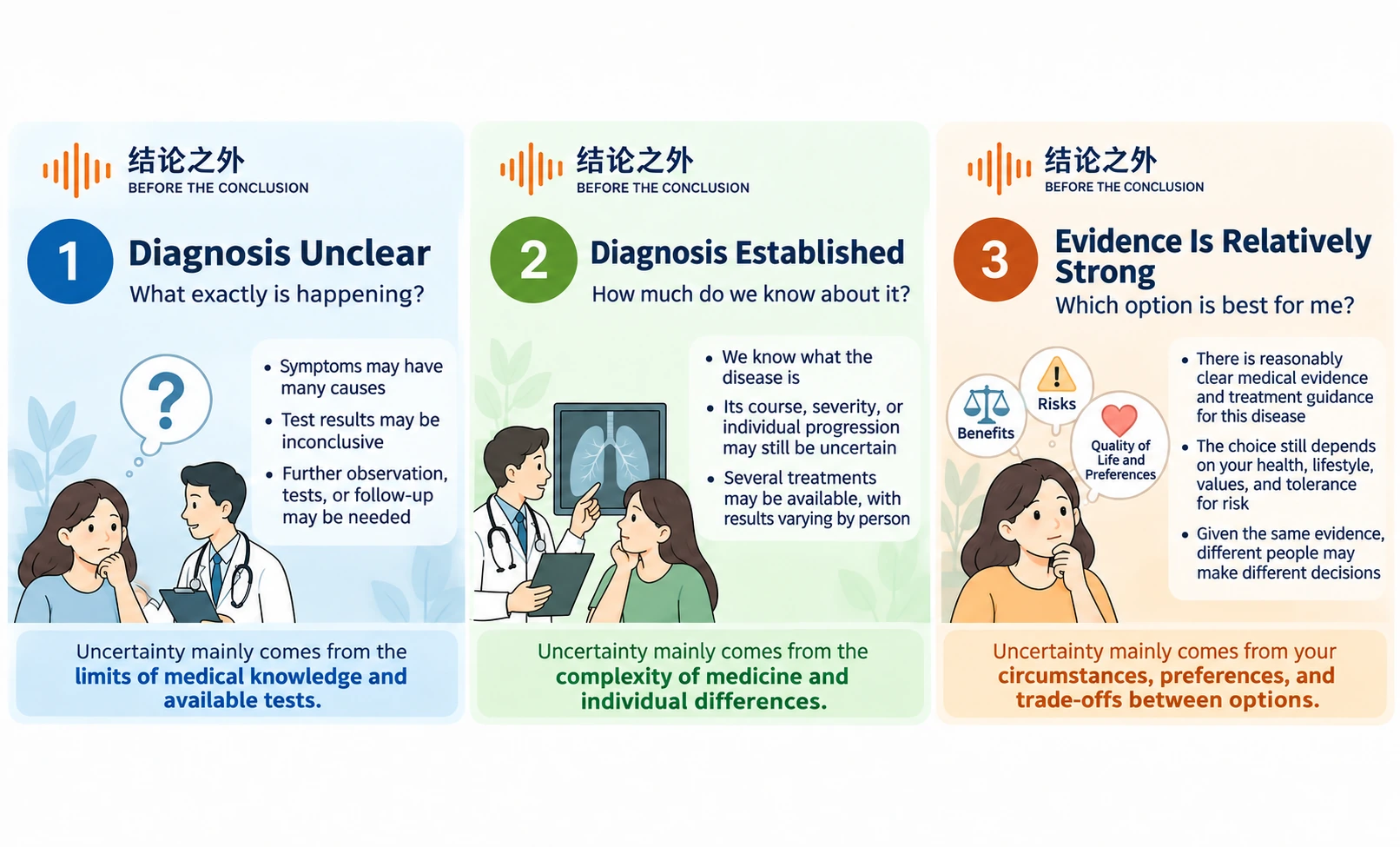
Figure 1 | Three unknowns in medicine: from diagnosis and disease course to personal choice. Understanding the source of uncertainty helps us participate more effectively in medical decisions. The original illustration uses English labels.
© Before the Conclusion | No republication, copying, or commercial use without permission.
These three levels also suggest a change in roles. At the first, we especially need doctors to identify warning signs and organize diagnosis. At the second, we need them to explain the evidence and help us understand risk. At the third, medical knowledge remains important, but the patient's judgment about life goals and personal tradeoffs becomes increasingly irreplaceable.
This does not mean that doctors can take less responsibility as patients move along. Doctors retain their professional responsibilities throughout. What changes is that patients have more opportunity, and more reason, to participate in decisions.
People do not need to become half a doctor to take their health seriously. They need gradually to learn to recognize which questions require professional answers, which matters still lack sufficient evidence, and which choices ultimately must be considered in the context of their own lives.
4. “I don't know” should be a complete response
When we encourage doctors to say honestly that they do not know, we still need to ask: what comes next?
For patients, “I don't know” can be honest, but it can also leave them helpless. Its real value lies in explaining the uncertainty rather than simply handing it over to the patient: what is already known; what remains unknown; whether immediate action is needed; how uncertainty can be narrowed next; and what should be reassessed if the situation changes.
A responsible “I don't know” should come with a plan. This may involve further tests, trying a reasonable approach and observing its effects, or withholding treatment for now while establishing clear follow-up arrangements and warning signs. Doctors have no obligation to guarantee outcomes, but they do have a responsibility to explain the basis of their recommendations, their limits, and a course of action.
Even when a doctor has explained the information clearly, however, a patient may not be ready to decide.
Someone who has just received a serious diagnosis may still be frightened and shocked. Some people do not want every number. Others find choosing harder the more they learn about the advantages and disadvantages of different options. Some ask directly: “Doctor, what would you do if it were you?”
We should not casually regard these responses as signs of immaturity. Vulnerability in the face of illness does not automatically disappear with more education. Needing more guidance for a time does not mean a patient has lost autonomy.
This tests another clinical skill: judging how much this person understands, how much they want to know, and how they wish to participate. Some want to compare every detail themselves; others prefer a clear professional recommendation from their doctor before deciding whether to accept it. Offering an appropriately clear recommendation does not necessarily conflict with shared decision-making. Conversely, listing many options and telling a frightened patient to “choose for yourself” does not necessarily show real respect.
Hesitation or fear, of course, does not mean someone lacks decision-making capacity. Only when a patient truly cannot make a particular medical decision should a legally authorized surrogate and the patient's previously expressed wishes be considered under applicable law and ethical standards. Even when capacity is impaired, patients should be involved as much as possible in the aspects they can understand.
The responsibilities of doctors and patients are not a simple seesaw. Doctors are responsible for professional knowledge, reasonable recommendations, necessary care, and continuing support. Patients have an important voice regarding their goals, preferences, and informed choices. How the two participate can adjust with the illness and the patient's psychological state, but neither can entirely replace the other.
Having the right to decide does not mean having to bear the decision alone.
A good doctor therefore needs more than the courage to say “I don't know.” They also need to know when to give a clear recommendation, when to explain more, when to give the patient some time, and when to invite other professionals or people the patient trusts to offer support.
5. When medical knowledge is no longer held only by doctors
In the past, patients had limited access to medical information. Today, publicly available research, patient-education resources, and artificial-intelligence tools are lowering the barriers to professional knowledge.
This undoubtedly creates more opportunities for active participation. Before a follow-up appointment, someone can learn unfamiliar terms, organize questions, and even consult guidelines and studies. But access to information does not equal sufficient judgment. Reading a treatment-effect percentage does not tell you whether the study participants resemble you. Receiving a seemingly clear AI explanation does not guarantee freedom from omissions or errors.
Technology brings answers to us ever faster, but it cannot remove the need to check evidence, judge applicability, and consider personal circumstances. Fluent expression can also create an illusion of certainty: the more a system sounds like an expert, the more likely we are to forget to ask where its evidence comes from.
AI can therefore assist doctors and patients, but it should not become another unquestionable authority. A better use is to help organize questions, explain concepts, identify sources that warrant further verification, and bring those questions back into conversations with professionals. A chat alone cannot replace necessary examinations, clinical judgment, or an assessment of specific risks.
If technology lowers barriers to knowledge, the worthwhile goal goes beyond “everyone can search for an answer.” It is for more people to develop the ability to recognize whether an answer is reliable, whether it applies to them, and when they should seek help.
Here we return to an older question: when someone no longer needs to depend entirely on external authority, have they already learned to think independently?
Tools can expand a person's understanding of the world without automatically supplying independent judgment. The same holds for patients. Autonomy does not mean deciding everything oneself, still less rejecting doctors. It means entering the consulting room with questions and, after hearing professional advice, thinking seriously about what matters most in one's own life.
When answers are incomplete, how do we go forward together?
Perhaps we can return once more to the three levels in medicine.
Faced with diagnostic uncertainty, ask: what do we actually know about what is happening, and what tests or observation are still needed? Faced with outcome uncertainty, ask: how much do we know about the course of the disease and the benefits and risks of treatment? Faced with uncertainty about choice, ask: given the evidence we have, which choice better fits my life and values?
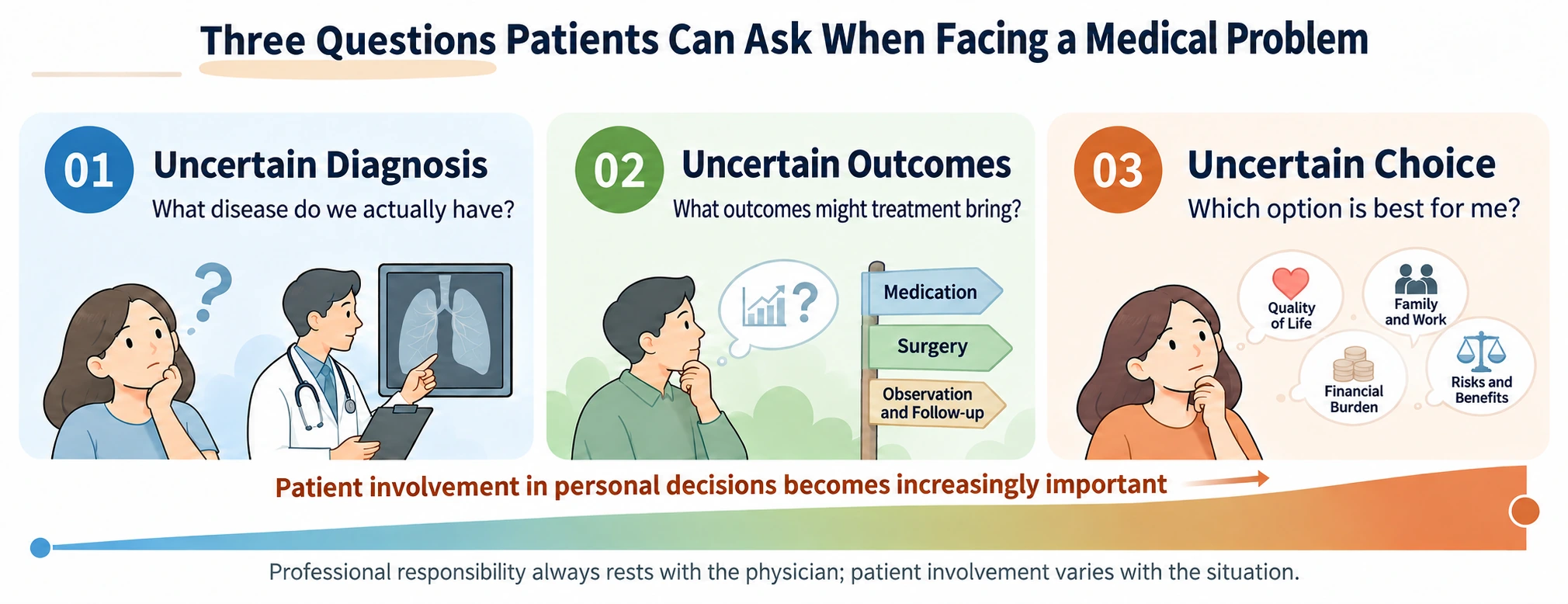
Figure 2 | Three questions patients can ask themselves when facing medical issues. The widening colored band below represents the increasing importance of patient participation in decisions involving personal values and life tradeoffs. It does not indicate a reduction in the doctor's professional responsibilities. The original illustration uses English labels.
© Before the Conclusion | No republication, copying, or commercial use without permission.
This figure does not place doctors on one side and patients on the other, nor does it require patients to make the final decision alone every time. It simply reminds us that the more a medical question reaches into personal life, the more indispensable the patient's voice becomes. Doctors must continue to provide professional advice and support in light of the evidence, the illness, and the patient's readiness.
Doctors need not know every answer, and patients need not bear every unknown alone. What matters is that both can honestly acknowledge what is known now, what remains unknown, and which paths are open next.
A good doctor is someone who, even when answers remain incomplete, can help a patient make responsible decisions.
A patient who is growing in understanding likewise does not need to know all of medicine. They learn to understand their situation, seek help when needed, and participate in deciding the direction of their life.
Medicine can help illuminate the road. When it forks, doctor and patient need to work out the direction together. The person who must walk it is the one whose life it is.
Beyond the conclusion, there are still questions worth asking.
Medicine · Science · Ideas and reading
Follow Before the Conclusion to stay curious and think independently together.
Text and image usage
The text of this article was originally written by Before the Conclusion. Its illustrations were conceived by Before the Conclusion and created with the assistance of AI tools. You are welcome to share the article's webpage link. Without separate permission, do not republish or excerpt the text by copying, reposting, redistributing screenshots, or similar means, or use the images separately. Commercial use is also prohibited. Relevant rights are governed by applicable law.