On her third birthday, Mariah Forster Olson and her family celebrated with a cake. She thought it was simply for her birthday. Only later did she learn that the adults were celebrating something more.
It was the 1980s. Diagnosed with neuroblastoma at one year old, she had no detectable tumor by her third birthday, and treatment had finally ended. She continued to have follow-up examinations and was officially declared cancer-free at eight. Yet as she grew up, she developed scoliosis, wore a brace in high school, and later underwent multiple spinal operations. Persistent back pain sometimes left her needing a cane or wheelchair. Her story was told in an Undark report published on October 30, 2026.[1]
It is easy to frame such a story around a reversal: the cancer disappeared, but the suffering did not end. Stopping there, however, would still miss its deeper significance. The difficulties she encountered later do not erase the value of her treatment. The treatment's success does not make those later difficulties unworthy of attention. Both can be true at once.
This forces us to ask again: where, exactly, does medical progress take place?
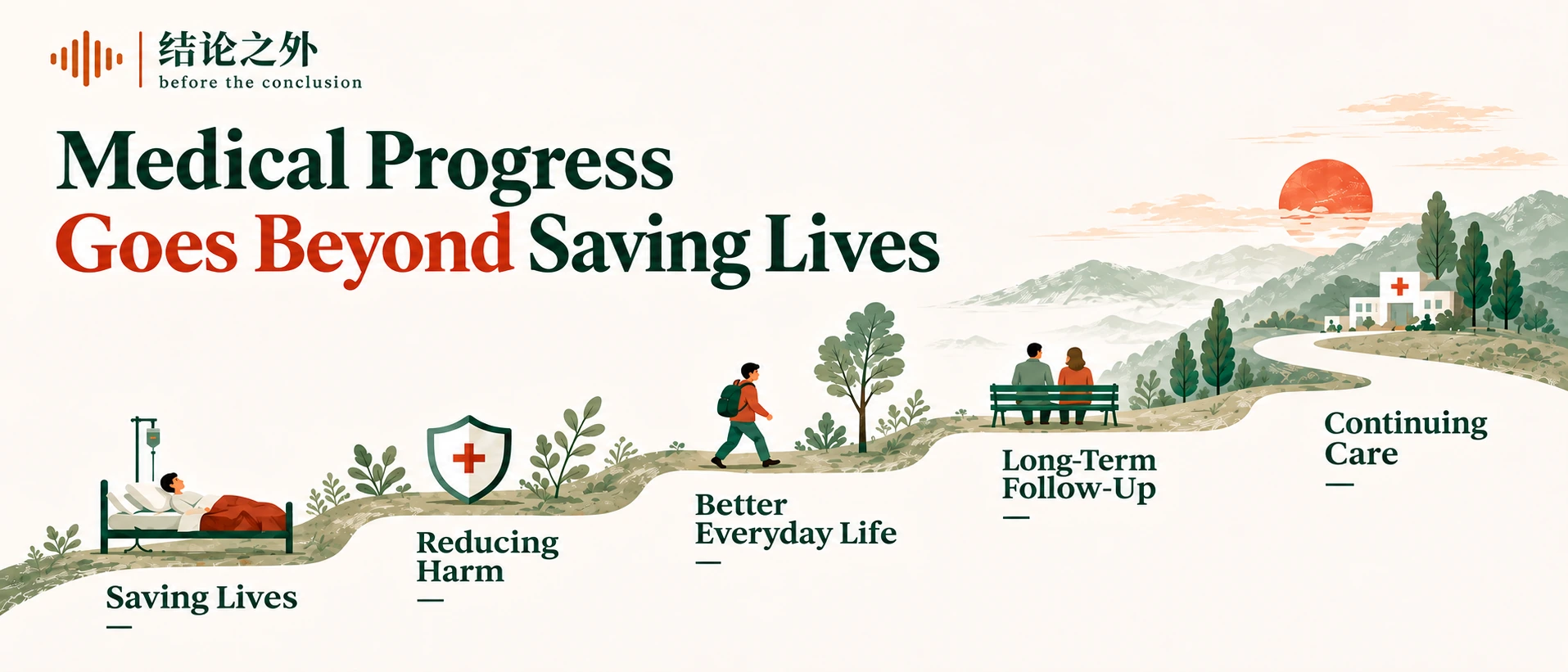
It happens, of course, when a new drug enters a ward, an operation becomes possible, or a life that might have been lost is saved. But we should also look for it in less conspicuous places: whether researchers extend their attention to health twenty years later; whether doctors can reduce harm while preserving effectiveness; whether patients' everyday experiences enter formal systems of evaluation; and whether someone who left oncology care years ago can still obtain care informed by their medical history.
Medical progress has more than one dimension beyond “can we treat it?” It also includes what we know, how we judge success, and how we care for a life changed by treatment.
1. Survival is progress we must not take lightly
Before discussing long-term health, one thing needs to be clear: saving a life is itself an enormous achievement.
For a family facing the threat of death, survival is no abstract statistical outcome. It means a child has a chance to grow up, an adult has more time with their family, and there will be ordinary days that might never otherwise have happened.
Discovering the costs of treatment later does not justify recasting all earlier efforts to save lives as mistakes. Evaluating past choices requires returning to the threat posed by the disease, the treatments available, and the evidence known at the time, rather than assuming that doctors and patients already possessed knowledge accumulated only decades later. But recognizing the value of saving a life is entirely compatible with continuing to ask about life afterward.
Whether cancer is controlled, whether the body has regained health, and whether a person has recovered a life they value are related questions, but they are not the same question. The US National Cancer Institute's information on post-treatment care includes follow-up examinations, late effects of treatment, and physical and emotional problems, rather than focusing solely on whether the tumor returns.[9]
The question, then, is whether, after celebrating medicine's victories, we are still willing to keep our attention on the person.
“You survived” should be a blessing, not a reason to end every other discussion.
2. Time changes our understanding of “success”
A course of treatment has its timetable. A person's body has a much longer one.
Some problems are visible during treatment, some persist after it ends, and others may appear months or even years later. The risk of late effects depends on factors including the treatments received and their doses. Today's examination results cannot answer every question about future health.[9][10]
This is why long-term follow-up matters. It means more than repeatedly asking, “Are you still alive?” It means continuing to observe how an earlier disease and its treatment intersect with growth, aging, and the rest of a person's life.
A St. Jude Lifetime Cohort study published in The Lancet in 2017 estimated that, by age fifty, long-term survivors of childhood cancer had experienced an average cumulative total of 17.1 chronic health events, compared with 9.2 among age- and sex-matched community controls. Events classified by the study as severe, disabling, life-threatening, or fatal totaled 4.7 and 2.3, respectively.[2]
These numbers measure the cumulative burden of health events over time, and some events can be counted more than once. They do not mean that every person has 17 diseases simultaneously at age fifty. They come from particular treatment eras and populations. They are neither a prediction of an individual child's future today nor directly applicable to all adult cancer patients.[2]
Likewise, finding a greater health burden among long-term survivors does not mean that every later problem can be directly attributed to their earlier treatment. Individual risk assessment must also consider age, other diseases, lifestyle, and other factors. Moving from a population study to an explanation of one person's illness still requires care.[2][10]
What these studies truly change is how medicine asks questions. Researchers ask not only whether patients made it out of the ward, but also what happened later, which risks relate to prior treatment, which may be preventable, and which can be recognized earlier.
This does not mean early evidence has no value. It means that every body of evidence has its own limits of observation.
Progress in medical knowledge sometimes means making the statement “this treatment works” more complete, rather than overturning it.
3. Real progress sometimes means less harm
If long-term research merely tells survivors, “You may have many problems in the future,” its value remains limited. The more important question is whether that knowledge can return to the point of treatment and change the care later patients receive.
A study published in the New England Journal of Medicine in 2016 analyzed 34,033 cancer patients who had been younger than twenty-one at diagnosis and had survived at least five years. They began treatment between 1970 and 1999.[3]
Among people who had already passed the five-year survival mark, cumulative mortality between years five and fifteen after diagnosis was 12.4% for those diagnosed in 1970–1974 and 6.0% for those diagnosed in 1990–1994. Health-related mortality, excluding recurrence or progression of the original cancer and external causes such as accidents, also fell from 3.5% to 2.1%. Patients who died within the first five years after diagnosis were not included in these calculations. These figures cannot be interpreted as fifteen-year mortality for all children with cancer.[3]
Reduced treatment exposure in some cancer types was associated with lower late mortality. However, this was an observational study across different eras. Improvements in supportive care and in detecting and treating subsequent illnesses may also have contributed. The entire improvement cannot be attributed to reductions in radiotherapy or chemotherapy.[3]
“Less” here does not mean reducing medication on intuition. Could less treatment increase recurrence? Who can receive less treatment, and who cannot? These questions all require evidence. The aim is to match treatment intensity more closely to patients' actual needs.
The study also suggests that not every cancer type followed the same direction. In this historical cohort, neuroblastoma survivors treated in later eras had a higher risk of late death. The authors suggested that more intensive treatment might have improved five-year survival while leaving late injuries and later recurrence or progression. This is an interpretation of historical data. It cannot be presented as a recent treatment trend, nor does it establish that the harms of intensive treatment outweigh its benefits overall.[3]
Sometimes, harm is reduced by adding protection rather than reducing medication.
The SIOPEL 6 randomized trial, published in 2018, studied children receiving cisplatin for standard-risk hepatoblastoma without distant metastases. Among 101 children with evaluable hearing results, hearing loss as defined in the study occurred in 18 of 55 children receiving added sodium thiosulfate, approximately 33%, compared with 29 of 46 receiving cisplatin alone, approximately 63%. This included milder hearing loss; these children were not all deaf.[4]
The trial did not observe worse survival outcomes after the protective drug was added. But its size, population, and follow-up period had limits. It cannot be understood as ruling out every survival risk, still less as establishing suitability for all cancer patients.[4]
The study sought to preserve children's hearing as much as possible while treating their cancer, rather than to produce a little more tumor shrinkage. Such progress may attract fewer striking headlines than “conquering cancer,” but it reminds us that treatment goals should include how children will learn, communicate, and live after leaving the ward.
Long-term benefit should be considered from the initial design of treatment, rather than only once treatment ends.
4. Patients should also be allowed to describe success
Another person featured in the Undark report, physician and former Hodgkin lymphoma patient Samantha Siegel, pointed out that being declared in remission or cancer-free does not mean being physically healthy or feeling well.[1]
Imagine two people who live for similar lengths of time after treatment. One can organize daily life fairly freely; the other remains troubled by pain, fatigue, or functional limitations. If we look only at how long they live, their outcomes may seem very close. If we ask how they spend that time, their experiences begin to differ.
Survival measures are important, but they cannot answer every important question.
In October 2024, the US Food and Drug Administration issued its final guidance on core patient-reported outcomes in cancer clinical trials. It recommends systematically collecting patients' reports of symptoms, treatment burden, physical function, and related domains. This nonbinding guidance for trial sponsors mainly concerns anticancer treatment trials intended to demonstrate benefits in survival, tumor response, or delayed progression.[5]
Patient experience should not appear only as a personal reflection at the end of a paper. It can also become evidence requiring serious measurement. And when this information enters everyday care, its significance extends beyond simply “knowing more.”
The PRO-TECT study published in 2025 offers an example. It randomized 52 oncology practices and enrolled 1,191 patients receiving treatment for metastatic cancer. Patients in the intervention group reported symptoms weekly. Severe or worsening symptoms triggered alerts to their care teams for assessment and action. The study therefore tested a way of incorporating patient reports into care, rather than merely “filling in questionnaires.”[6]
The study did not establish that this approach extended overall survival. However, analyses of prespecified secondary outcomes found that median time to clinically meaningful deterioration in physical function was 12.6 months in the intervention group and 8.5 months with usual care. Deterioration in symptom control and health-related quality of life was also delayed. Within twelve months, emergency-department visits averaged 1.02 and 1.30 per patient, respectively.[6]
These figures come from patients undergoing treatment. They cannot serve as evidence that “long-term follow-up after cure has been proven effective.” They show that a model of care can have value across different outcomes without having all of its value forced into a single measure.
We cannot package an improvement in quality of life as an unproven survival benefit. Nor should a failure to establish longer survival negate the significance of preserved function or symptom control.
Different forms of benefit cannot stand in for one another, and should not cancel one another out.
At the same time, the patient in “patient benefit” is more than a person waiting to be measured. Discussions of success should leave room for patients' own goals: which burdens they can accept, which abilities matter especially to them, and how they hope to spend their time beyond treatment.
Medicine offers evidence, but it cannot decide for everyone which kind of life is most worth pursuing.
5. Knowing what to do and actually doing it are two kinds of progress
Once research has identified risks and guidelines have made recommendations, the problem might seem solved. But the existence of knowledge and patients' access to care are two different things.
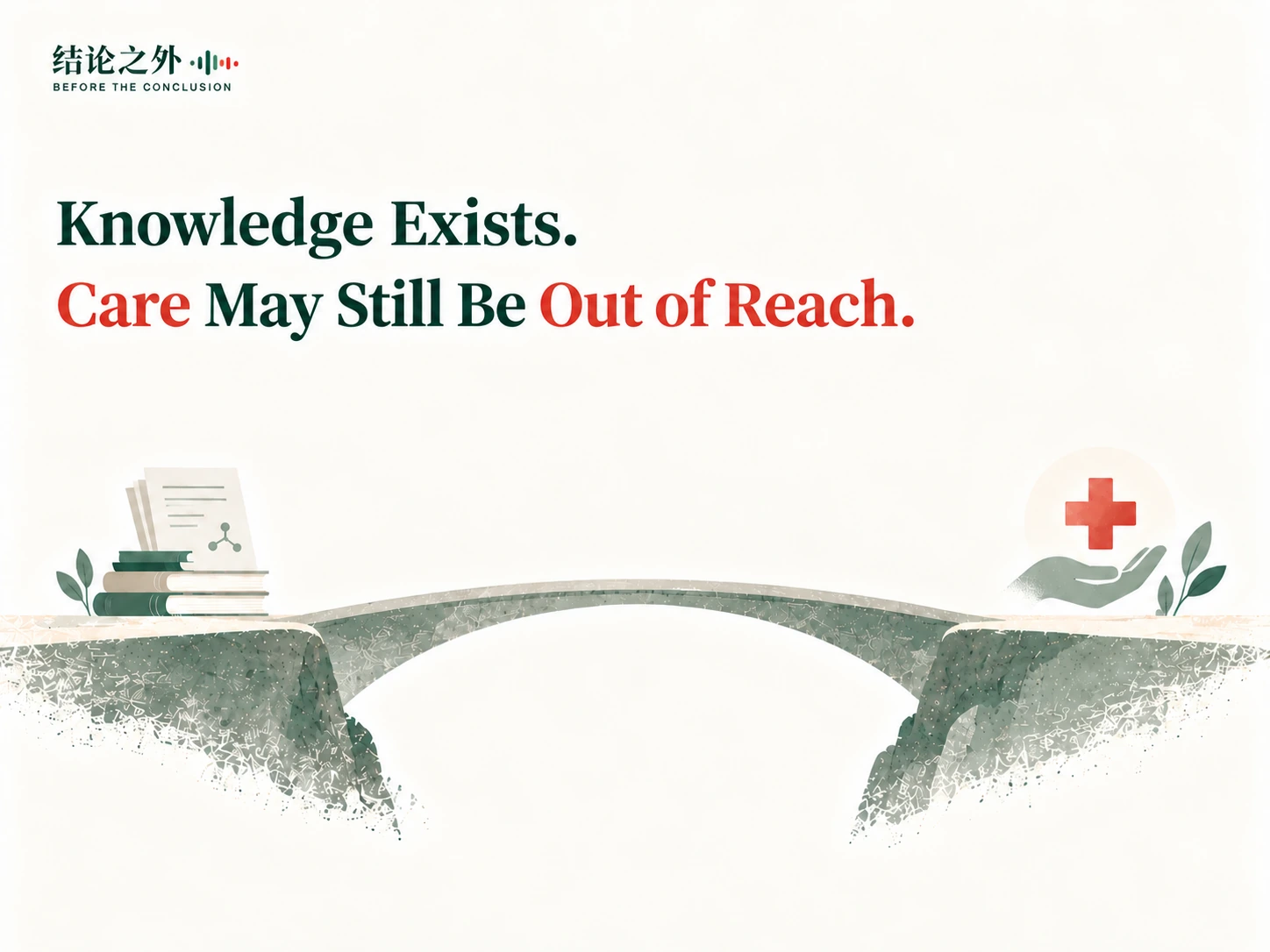
As early as the 2006 report From Cancer Patient to Cancer Survivor: Lost in Transition, the US Institute of Medicine and National Research Council identified continuity of care after treatment as an important issue. The 2018 Long-Term Survivorship Care After Cancer Treatment: Proceedings of a Workshop was still discussing how to improve the planning, management, and provision of long-term care.[7][8]
“Transition” sounds like a management term. In a person's life, it is very concrete.
Someone who had cancer in childhood may move to another city to study or work as an adult and receive care at another hospital. To a new doctor, “had cancer as a child” may be just one line in the medical history. Yet assessing long-term risk may require knowing which drugs were used, how much radiation was given, and which parts of the body were irradiated. The Children's Oncology Group's long-term follow-up guidelines make recommendations based on prior treatment rather than giving everyone the same checklist of tests.[10]
A useful treatment summary is therefore more than an archive. The next doctor must be able to see it, understand it, and translate it into appropriate care for the individual. The US National Cancer Institute likewise emphasizes that treatment summaries, follow-up care plans, and information sharing among doctors are important components of post-treatment management.[9]
Applied to a handover, these requirements can be expressed as four practical questions: can the medical history travel with the patient? Can the risks be clearly explained? Who is responsible for subsequent care? Is there a reminder when follow-up is due? These are not a separate set of guideline standards, but several ways to examine whether care has truly connected.
We must then ask: who receives a referral when a problem is found? Can the patient afford the services needed? Does the person coordinating care have time to do the work? Doctors interviewed by Undark pointed out that this care takes time and may lack corresponding payment support. The report also noted that some pediatric cancer centers have established relatively mature survivorship clinics, while care for adult patients remains more fragmented. Specialist clinics alone cannot cover everyone.[1]
A new drug trial cannot answer all these questions, yet they determine whether existing knowledge can actually have an effect. We cannot require every primary care doctor to remember every rare post-treatment risk. Nor should we assume that every patient can preserve decades of records, understand complex guidelines, and repeatedly explain their history across departments.
A medical capability's existence and an ordinary person's reliable access to it are different dimensions of medical progress.
The former requires research and professional expertise. The latter also requires information transfer, allocation of responsibilities, service arrangements, and payment support. These are among the issues the reports above continue to discuss.[7][8]
This discussion of service coordination and payment draws mainly on US experience. Health systems are organized differently, so specific practices cannot simply be transplanted. But the gap between existing knowledge and accessible services deserves examination in any system.
6. A longer horizon does not mean an unlimited promise
Looking farther ahead first requires acknowledging that follow-up itself has costs.
The Children's Oncology Group guidelines explicitly caution that follow-up may increase anxiety, false-positive screening results may lead to unnecessary further investigations, and costs may become a burden. Knowing that a treatment carries long-term risks is still different from demonstrating that a particular screening schedule improves long-term outcomes. The guidelines themselves acknowledge the need for further research on the actual benefits of screening and how best to implement it.[10]
More complete care therefore means arranging follow-up that is justified, explainable, and practical, based on prior treatment and individual risk. It should help people live, rather than keeping the rest of their lives organized around disease.[10]
More complete care also does not promise the absence of every lasting effect. Nor does long-term benefit mean that someone must return to their pre-illness condition for treatment to count as a success.
A person living with chronic illness, or one who needs assistive devices or support from others, has a saved life that is no less worthwhile. Quality-of-life research aims to identify and reduce burdens, not to rank the value of lives in different states.
We should likewise avoid placing all responsibility on patients, as though sufficient optimism and self-discipline should guarantee a good recovery. Calling for long-term care recognizes that some difficulties require medical and social support. It should not give patients another assignment to “recover successfully.”
These dimensions are not steps that must be completed in order. We do not have to solve survival first and wait until everyone can be cured before discussing function, suffering, and dignity. People still undergoing treatment and those living with cancer over the long term need such support too. The National Cancer Institute's definition of a “cancer survivor” begins at diagnosis; it does not refer only to people who no longer have cancer.[9]
We can set more distant goals for medicine while recognizing its continuing limitations. We can call for ongoing improvement without attributing every unavoidable difficulty to someone's failure to do their job.
What we must guard against is treating one kind of success as proof that the entire task is finished.
7. After one birthday, there are many more
Return to that third-birthday cake.
There is no need to take back what it celebrated. Later difficulties cannot take away the real joy of that moment. But if medicine's story ends there, it leaves decades of subsequent life outside the story.
Long-term survivors show us the many forms medical progress can take: a treatment keeps someone alive; a long-term study makes risks visible; a change in a regimen reduces harm; an assessment method brings patients' experiences into the evidence; a successful handover of care puts existing knowledge to use.
These forms of progress do not necessarily advance at the same speed. Treatment capabilities may move ahead while long-term evidence is still accumulating. Guidelines may exist while services have yet to connect. Recognizing these distances helps identify where to go next while acknowledging how far medicine has already come.
We do not have to wait until medicine can eliminate all suffering to recognize its greatness. Nor should the fact that it has saved a life stop us from asking more of it.
Saving a life is a real and precious achievement. Providing that extended life with continuing understanding, care, and support is also medical progress.
One birthday is worth celebrating. The many birthdays that follow also deserve a serious place in medicine's field of view.
Main references
[1] Madhusoodanan J. After Cancer, a Complex Aftermath for Survivors. Undark, October 30, 2026. Reporting source for the personal experiences and care-transition issues. Original source
[2] Bhakta N et al. The Cumulative Burden of Surviving Childhood Cancer: An Initial Report from the St. Jude Lifetime Cohort Study. Lancet. 2017;390(10112):2569–2582. DOI: 10.1016/S0140-6736(17)31610-0. Original source
[3] Armstrong GT et al. Reduction in Late Mortality among 5-Year Survivors of Childhood Cancer. N Engl J Med. 2016;374(9):833–842. DOI: 10.1056/NEJMoa1510795. Mortality proportions in the text follow Table 2: cumulative deaths between years five and fifteen after diagnosis among five-year survivors. Original source
[4] Brock PR et al. Sodium Thiosulfate for Protection from Cisplatin-Induced Hearing Loss. N Engl J Med. 2018;378(25):2376–2385. DOI: 10.1056/NEJMoa1801109. Original source
[5] US Food and Drug Administration. Core Patient-Reported Outcomes in Cancer Clinical Trials: Guidance for Industry. Final version, October 2024. Original source
[6] Basch E et al. Symptom Monitoring with Electronic Patient-Reported Outcomes During Cancer Treatment: Final Results of the PRO-TECT Cluster-Randomized Trial. Nat Med. 2025;31(4):1225–1232. DOI: 10.1038/s41591-025-03507-y. Original source
[7] Institute of Medicine and National Research Council. From Cancer Patient to Cancer Survivor: Lost in Transition. National Academies Press, 2006. DOI: 10.17226/11468. Original source
[8] National Academies of Sciences, Engineering, and Medicine. Long-Term Survivorship Care After Cancer Treatment: Proceedings of a Workshop. National Academies Press, 2018. DOI: 10.17226/25043. Original source
[9] US National Cancer Institute. Follow-Up Medical Care; Cancer Survivorship. Used to verify the components of post-treatment care and the definition of “cancer survivor,” respectively. Original source 1 Original source 2
[10] Children's Oncology Group. Long-Term Follow-Up Guidelines for Survivors of Childhood, Adolescent, and Young Adult Cancers. Version 6.0, October 2023. For risk-based follow-up and its potential benefits, burdens, and evidence limitations, see the guidelines' introduction. Original source
Sources checked through October 31, 2026. This article discusses research evidence and approaches to medical care. It does not provide an individual treatment or follow-up plan.
Beyond the conclusion, there are still questions worth asking.
Medicine · Science · Ideas and reading
Follow Before the Conclusion to stay curious and think independently together.
© Before the Conclusion | Original concept; AI-assisted production. Sources for the personal stories and research are listed in the references. No republication, copying, modification, or commercial use without permission.