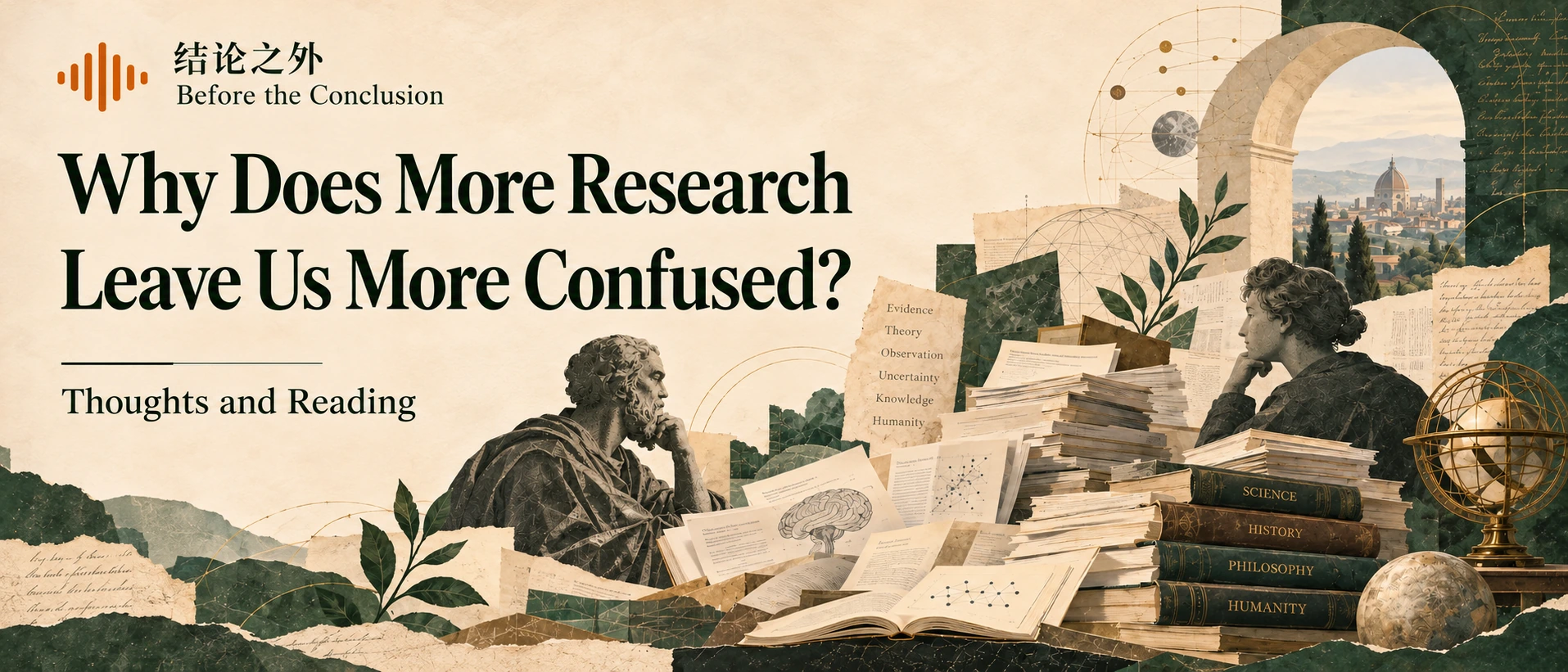
Today, a medical paper can travel around the world in a matter of hours.
A food is found to benefit health, a drug shows encouraging effects, or a new test seems able to detect disease earlier.
Before long, though, we may see another study reaching a different result.
Is coffee good or bad for us? Does a particular supplement actually work? If a new drug succeeds in a clinical trial, does that mean it really helps patients live longer and better?
We seem to live in an age of unprecedented scientific knowledge, yet find it increasingly difficult to judge what deserves our trust.
Is the problem really that science keeps overturning itself? Or have we been understanding science in an incomplete way?
1. Science produces knowledge every day, but knowledge is not the same as an answer
In October 2026, Helen Pearson, a science journalist and senior editor at Nature, published an essay in Aeon titled “How to assemble science.”
It raised a seemingly simple but increasingly important question: as humanity produces vast amounts of new scientific knowledge every day, how should we make sense of it?
According to an estimate cited in the essay, approximately 7 million academic articles were published worldwide in 2025.
Although that number varies with the definition used, it still reveals a reality: no individual today can read, understand and evaluate every relevant study alone.
But a greater quantity of information does not automatically mean better knowledge.
© Before the Conclusion | Original concept · Created with AI assistance. Reposting, copying, modification and commercial use are prohibited without permission.
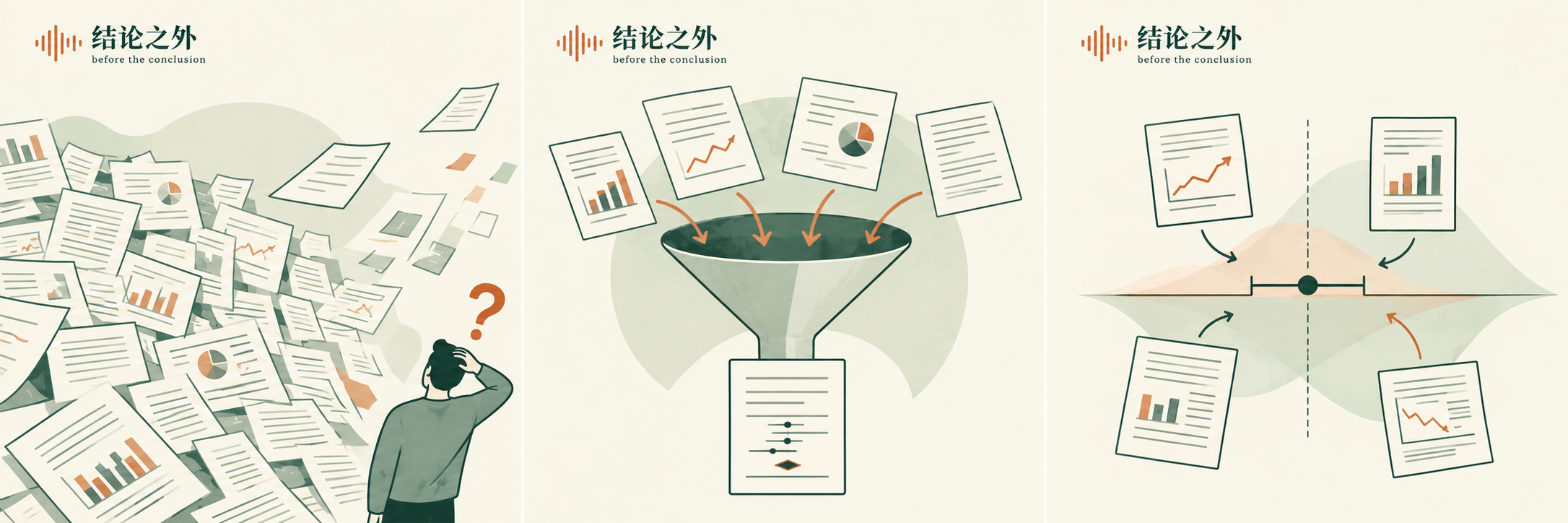
One study may find a treatment effective while another finds no significant difference. This does not necessarily mean that one of them is wrong.
The populations and sample sizes may differ, as may the interventions, observation periods and outcome measures.
Even the same treatment can have very different value for different patients. A study might, for example, find that a drug lowers a blood biomarker.
Does that show the drug works? In one sense, it may show that the drug has altered a biological process.
But if what really matters is whether patients have fewer hospital admissions, less disability or longer lives, this finding cannot yet answer the whole question.
A study can provide evidence, but rarely supplies a complete answer on its own.
The difficulty in science lies in more than discovering new facts. It also lies in understanding how those facts relate to one another.
2. In 1976, a statistician asked a different question
This story goes back to the 1970s. At the time, the effectiveness of psychotherapy was disputed in academia. Some studies reported positive findings; others found no clear effect.
The American statistician Gene Glass began to ask: if studies give different answers, how should we judge whether psychotherapy works?
One traditional approach was to count how many studies supported an effect and how many found none.
But there was a problem: research is not a vote in which every paper simply counts as one ballot.
A small study of a few dozen people and a rigorous trial of several thousand do not necessarily carry the same evidential weight.
And whether a study reaches statistical significance is a different question from how large the treatment effect is.
Glass tried a different way of organizing studies.
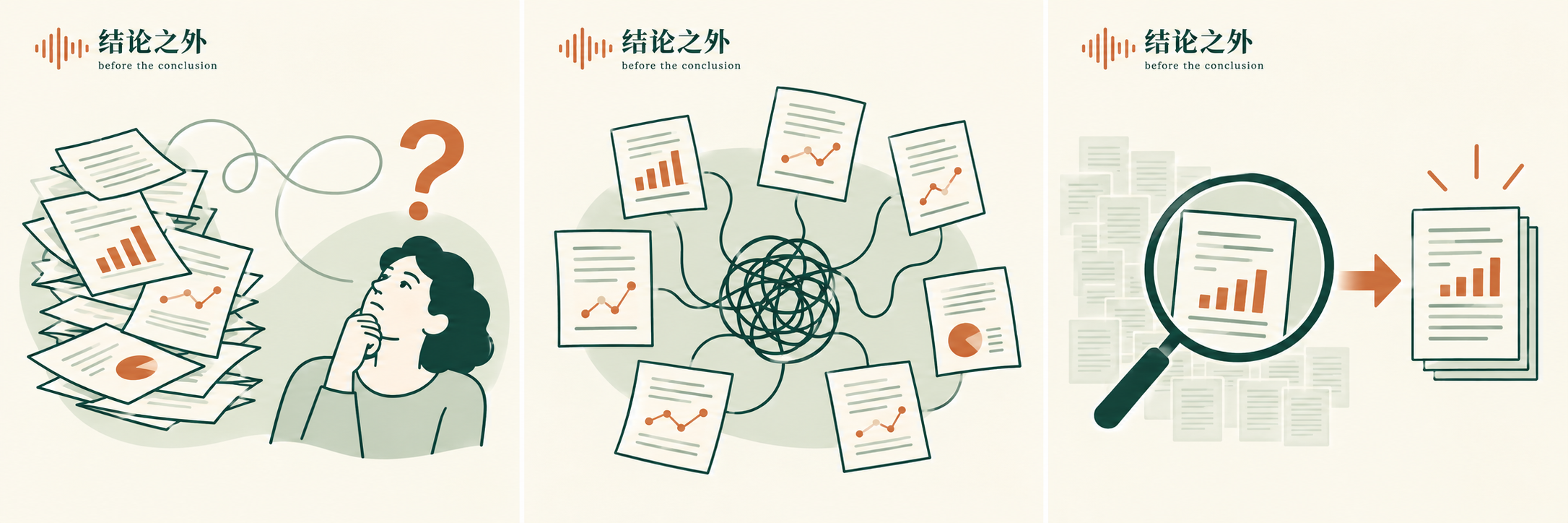
Rather than simply dividing papers into those for and against a treatment, he wanted to express treatment effects from different studies as numbers that could be compared.
In 1976, he presented this method of synthesizing evidence at the annual meeting of the American Educational Research Association.
In 1977, he and the psychologist Mary Lee Smith published a landmark study.
They brought together 375 controlled evaluations of psychotherapy and counseling, using statistical methods to synthesize the effects across studies.
The approach became widely known as meta-analysis.
Its significance went beyond creating a statistical technique. It changed the way researchers asked questions.
Previously, people may have been more accustomed to asking: which study is right?
Now, they could ask a further question: when all the relevant studies are considered together, what does the body of evidence tell us?
© Before the Conclusion | Original concept · Created with AI assistance. Reposting, copying, modification and commercial use are prohibited without permission.
Of course, meta-analysis does not guarantee a correct conclusion.
If the original studies have serious biases, or if differences between studies cannot be reasonably explained, statistically pooling them may still fail to yield a reliable answer.
But it at least provides a more systematic approach, allowing scientific findings to become more than isolated results.
3. Infant sleep advice reveals the cost of overlooking the whole body of evidence
Bringing scientific evidence together is more than an advance in research methods.
Sometimes real lives are at stake.
In the middle of the twentieth century, some parenting guides recommended putting babies to sleep prone: on their stomachs.
Today, we know that placing healthy babies on their backs is important safe-sleep advice that helps reduce the risk of sudden infant death syndrome.
But this understanding did not emerge overnight.
In 2005, researchers published a systematic review in the International Journal of Epidemiology, reexamining studies of infant sleeping position and related recommendations from previous decades.
They found that, had the research available by 1970 been synthesized, the association between prone sleeping and a higher risk of sudden infant death syndrome could already have been recognized.
Yet some parenting guides continued to recommend prone sleeping for many years afterward.
It was not until the 1990s that advice to avoid prone sleeping and encourage sleeping on the back gradually became widespread in several countries.
The unsettling part of this history is more than the fact that medicine once gave inappropriate advice.
Evidence capable of changing decisions may already have existed, without being promptly organized, recognized and translated into action.
Looking back today, we may see this simply as a change in medical understanding several decades ago.
But parents living then wanted to care for their children just as parents do today, and were willing to trust the professional advice they received.
Ten or twenty years in the history of science may look like a stretch of time to those who come later. For people living through it, it may be a lifetime.
Of course, medicine should not immediately change its advice in response to every preliminary finding. Adopting incorrect evidence too early can also harm patients.
The real difficulty is judging when evidence is reliable enough to change practice.
Infant sleeping position is just one example.
Medical history includes other treatments that were widely accepted before new clinical trials prompted a reassessment. For some diseases, the arrival of crucial evidence changed the entire direction of treatment.
Our other long read, “When Medicine Changes Its Mind: Treatment Advice Rewritten by Evidence,” explores seven stories in detail: infant sleeping position, oxygen after a heart attack, breast cancer surgery, the CAST arrhythmia trial, Helicobacter pylori, aspirin and menopausal hormone therapy.
Together, they raise a more complex question: as evidence accumulates, when should medicine change its mind?
4. Why do we prefer new discoveries to summaries of evidence?
There is a tension here worth considering:
A paper announcing the discovery of a new treatment target may receive enormous attention.
But a team that spends years carefully reading, selecting and assessing decades of research, only to find that a common treatment lacks reliable supporting evidence, may not receive the same attention.
The former offers novelty. The latter may have a more direct effect on practice.
Modern academia prizes innovation and encourages researchers to keep publishing. The media favor breakthroughs because they more readily become news. Companies also find positive results easier to promote because they can attract funding and market interest.
Yet reliable scientific knowledge depends on another kind of work: slower and less conspicuous. It means finding studies, comparing methods, identifying biases, understanding differences and then judging whether results apply in the real world.
This is an important foundation of systematic reviews and evidence-based medicine.
The Cochrane Collaboration, established in 1993, is an important representative of this tradition. It works to organize medical research systematically, helping doctors, patients and policymakers understand the overall evidence for a treatment.
Two concepts often mentioned together need to be distinguished. A systematic review is a set of methods for systematically finding, selecting, assessing and synthesizing research evidence. Meta-analysis is a technique for statistically combining results from different studies when appropriate.
© Before the Conclusion | Original concept · Created with AI assistance. Reposting, copying, modification and commercial use are prohibited without permission.
A systematic review need not include a meta-analysis. Equally, statistical pooling does not mean that the overall evaluation of evidence was sufficiently rigorous.
Combining poor-quality studies does not automatically produce high-quality evidence. If the patients and treatments studied differ too much, an average effect may conceal important information. A systematic review also reflects only the evidence available at a particular time. New, high-quality research may require its conclusions to be updated.
Mature evidence-based thinking therefore involves more than finding a meta-analysis and stopping there.
It means continuing to ask: which studies did this review include? Which did it exclude? Were the results consistent? How reliable is the evidence? And to whom do the conclusions apply?
5. More data does not necessarily bring better judgment
Today, a new change is under way. Artificial intelligence can help researchers search the literature, extract data, identify themes and even assist with evidence synthesis. Some work that once took a research team months may now be considerably faster.
This seems to suggest that scientific judgment will become easier.
But one distinction is easy to miss: the speed of organizing information is not the same as the ability to understand it.
If a system can quickly summarize thousands of papers but cannot accurately assess study quality, or fails to recognize important differences in research designs, it may simply produce apparently certain conclusions more efficiently.
Conversely, if technology can help researchers uncover missing evidence, identify contradictions and improve the efficiency of review, it may become a truly valuable tool.
The key is less the degree of automation than whether evidence sources are complete, the reasoning can be traced and researchers can audit the results.
© Before the Conclusion | Original concept · Created with AI assistance. Reposting, copying, modification and commercial use are prohibited without permission.
This shift may also redefine scientific literacy in the future.
We need to learn more than how to understand what a study says. We also need to judge where it belongs within the overall body of evidence.
6. Scientific progress may require a different kind of patience
We live in an age that prizes the latest news.
The latest paper, newly approved drug or newest technological breakthrough can quickly capture our attention.
But sometimes the question most worth asking is more than: what was discovered today?
It is: what do we already know from the vast amount of research accumulated over decades? Which conclusions have been repeatedly tested? Where does disagreement remain? Which findings are reliable enough to change practice? Which exciting results still need more evidence before they can truly help patients?
Returning to the question at the beginning: why do we feel more confused as scientific research grows?
Perhaps science itself has not become less reliable. Perhaps we are too accustomed to treating each new study as an answer, forgetting how scientific knowledge is actually built.
It is a continuing process of comparison, questioning, revision and synthesis, rather than an accumulation of news stories.
Science worthy of our trust need not be the first to offer an answer. It must be able to keep testing its answers.
As new studies appear every day, perhaps we need to develop a particular ability: to resist rushing to believe the latest conclusion, and first examine what all the evidence tells us.
Main references
Helen Pearson. How to assemble science. Aeon, October 2026.
https://aeon.co/essays/the-life-saving-scientific-knowledge-hiding-in-plain-sight
Smith ML, Glass GV. Meta-analysis of psychotherapy outcome studies. American Psychologist. 1977;32(9):752–760.
https://doi.org/10.1037/0003-066X.32.9.752
Gilbert R, Salanti G, Harden M, See S. Infant sleeping position and the sudden infant death syndrome: systematic review of observational studies and historical review of recommendations from 1940 to 2002. International Journal of Epidemiology. 2005;34(4):874–887.
https://doi.org/10.1093/ije/dyi088
This article was independently written by Before the Conclusion, taking Aeon's essay on scientific thinking as a starting point and drawing on original research and material from medical history. It is not a translation of that essay.
Beyond the conclusion, there are still questions worth pursuing.
Medicine · Science · Ideas and Reading
Follow Before the Conclusion to stay curious and think independently together.
Text and image usage statement
The text of this article is original work by Before the Conclusion. Research material and related sources are listed at the end. The illustrations were conceived by Before the Conclusion and created with AI assistance as conceptual illustrations; further information appears in the captions. You are welcome to share a link to this webpage. Without separate permission, please do not copy, repost, republish screenshots or use the images separately. Commercial use is prohibited.