Some lines we learn by heart when we are very young.
At the time, we know how a character should be explained, which passages describe scenery and which develop an argument, and which words to use when summing up the author's feelings. Years later, the words remain in our memory. A bright moon, a gathering, or a farewell to a friend may bring a familiar line to mind just when it seems to fit.
Sometimes, though, a stretch of living still seems to separate reading from understanding. We know passages about the uncertainty of meetings and partings, yet postpone seeing someone until next month or next year, as though there will always be another chance. We can recite lines about life's brevity, yet rarely pause when arranging our days to consider what deserves to be kept and what we can let go.
These gaps do not make reading useless, nor need they become grounds for blaming readers. They simply invite a question: what else needs to happen between remembering a passage and using it to understand a person or an event anew?
This article considers the habits of seeing that reading may leave with us. They may appear less as a sudden revelation than as the ability to notice a little more before we judge.
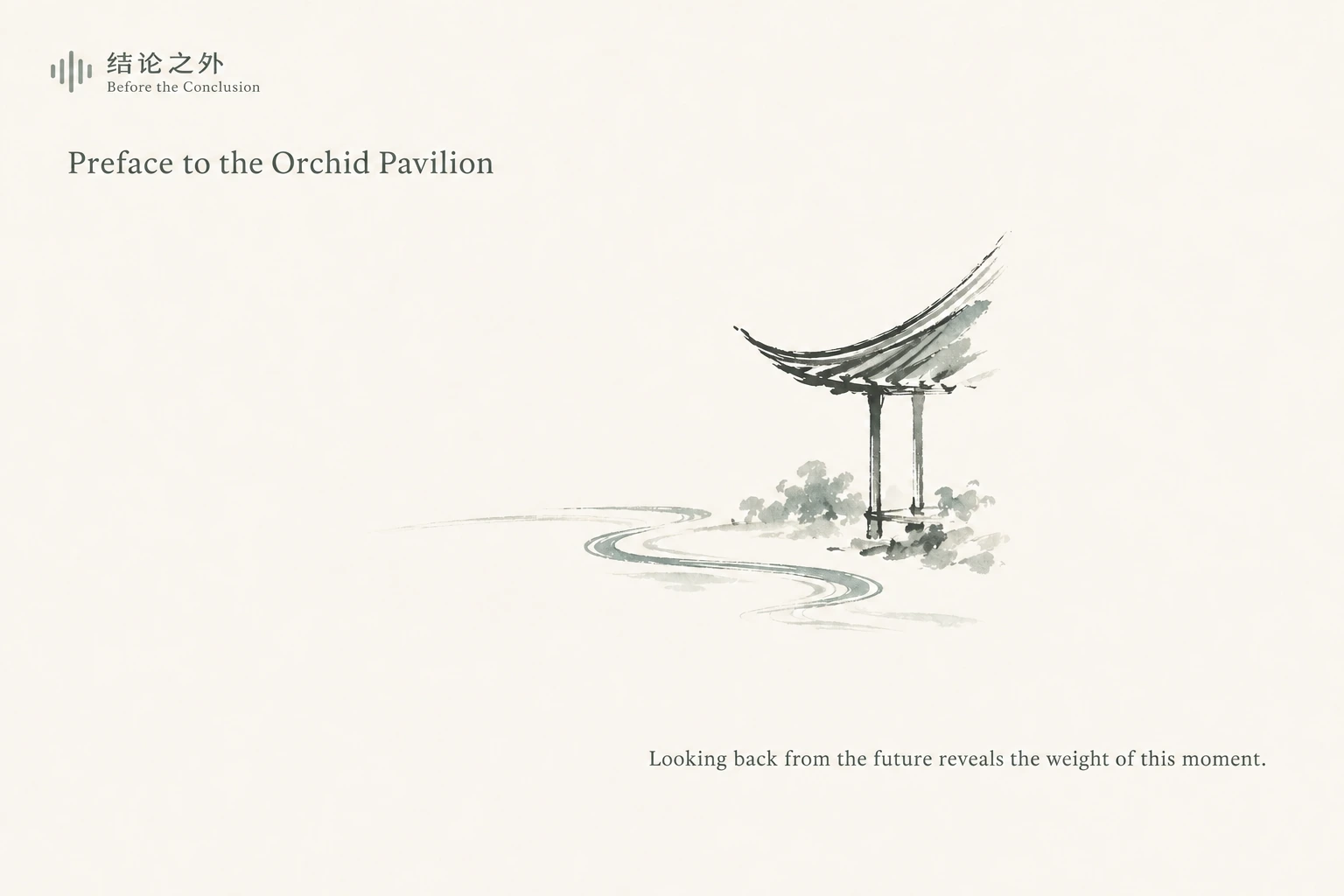
Why does the gathering at the Orchid Pavilion lead to thoughts of later generations?
The opening of the Preface to the Orchid Pavilion Collection offers almost a complete picture of the elegant literary gathering we imagine: mountains and water, bamboo groves, wine cups floating down a winding stream, fine weather, and friends together. We can appreciate the beauty of the scene without knowing any of those present.
But Wang Xizhi does not leave the essay within that beauty. He goes on to describe how people find temporary satisfaction in their present circumstances, even forgetting that old age is approaching. Circumstances change, feelings change with them, and what delighted us only a moment ago has already become the past. [1]
It is an intensely familiar process, though one we seldom recognize while we are happy. A family dinner once taken for granted, a daily route for picking someone up and dropping them off, friends we assumed we could see whenever we liked: later, only scattered photographs may remain. Life does not always mark the end of an ordinary routine with an unmistakable farewell.
There is therefore a seriousness to his reflections on life and death. His rejection of treating life and death as one, or treating a long life and an early death as equivalent, questions the ease with which such differences can be erased. The gathering does not yield a ready-made consolation, and the essay does not flatten all distinctions. [1]
Then the vantage point shifts again: “后之视今”—later generations looking upon our present—will be like our looking upon the past. He imagines people who will come after him; as we read, we occupy precisely the position he once imagined.
We can follow that movement and look back at our own present. How much weight will today's urgent gains and losses retain over a longer span of time? Might the people and things that seem less pressing now, and are therefore repeatedly postponed, become what we most miss later?
Consider a small hypothetical scene. A friend messages to say they will be passing through your city this weekend. You are about to reply, “Maybe next time.” As you type those three words, you remember that you have both been saying this for two years. Literature will not decide whether you meet, but it may stop “next time” from being an answer that needs no thought.
This does not ask us to abandon ambition. It adds another scale of observation, so that an event need not be judged entirely by our present busyness and emotions.
Whom does the moon over the river illuminate?
A Moonlit Night on the Spring River also tends to reach readers first through its beauty. River water, flowering woods, moonlight, and white sand: sound and image answer one another. Lingering over language like this is already a rich reading experience.
Yet Zhang Ruoxu gradually moves the poem from a spring night into a larger sweep of time: who first saw the moon beside the river, and in what year did the moon first shine upon a human being? Generation after generation passes away, while the river moon looks much the same each year. [2]
This movement does not make particular people disappear. The poem returns to the traveler in a small boat, the person longing for someone from an upstairs room, and moonlight whose associations cannot be dispelled. “相望不相闻”—looking toward one another, unable to hear one another—connects people under the same moon who care for each other but cannot meet. At the end, the poet wonders how many have returned home by moonlight, as the setting moon stirs feeling through the trees along the river. The poem does not tell us who has returned. Reading the homeward journey as “unfinished” is an interpretation: the moon descends and feeling moves, while the wish to return remains unsettled. [2] The immensity of the universe and one person's attachment remain within the same poem.
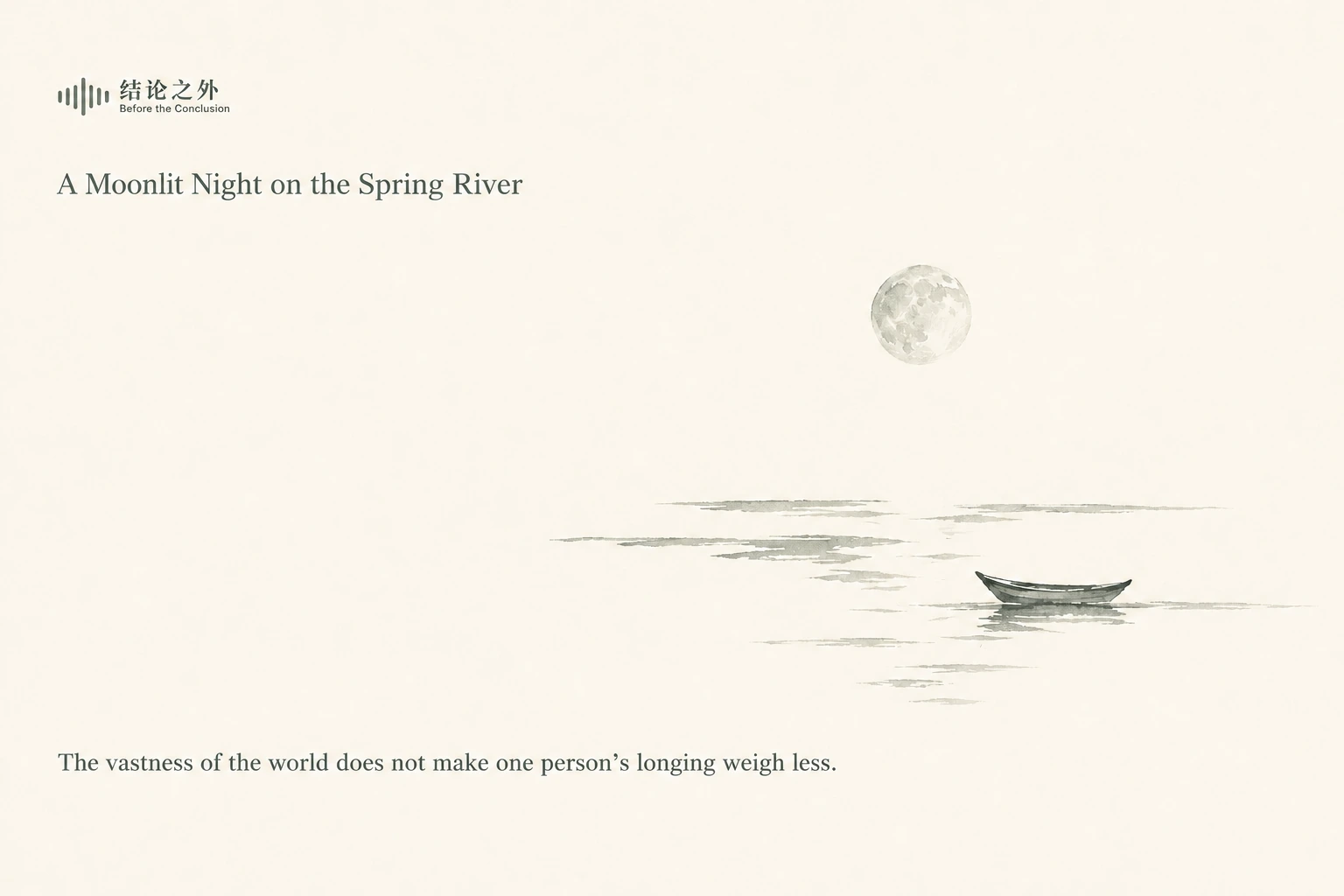
This may be one of literature's valuable exercises: learning to hold things of different scales together. We know how brief life is within the sweep of time, and still take seriously why a particular person cannot sleep tonight. The universe's immensity does not cancel the weight of a phone call or a meeting in someone's life.
It is natural at this point to think of our own partings. A further step may bring someone else's parting to mind. Under the same moon, one person is going home; another remains caught in arrangements that prevent a journey; another does not know when the news they await will arrive. Their circumstances may differ from those in the poem, but the attempt to turn our gaze toward another person may make us less quick to explain and more willing to understand.
Of course, we do not know the specific origin of every feeling Zhang Ruoxu expressed while writing. Feeling the sorrow of separation in the poem is not the same as knowing the author's life. Closeness to a text also needs to leave room for what we do not know.
Why can we read about a solution yet fail to use it elsewhere?
Moving from the gathering at the Orchid Pavilion to our own meetings, or from people separated under the river moon to someone waiting in our lives, already involves carrying an understanding from one situation into another. Why does such a connection sometimes occur, while at other times it never comes to mind? Modern psychological research on analogical transfer can help us examine the question in parts.
First, a boundary: experiments can assess transfer against a predefined target solution, whereas literary understanding is far more open. The research below cannot prove that reading poetry makes people kinder. It addresses a narrower question: why does something we already know not necessarily come to mind when we need it?
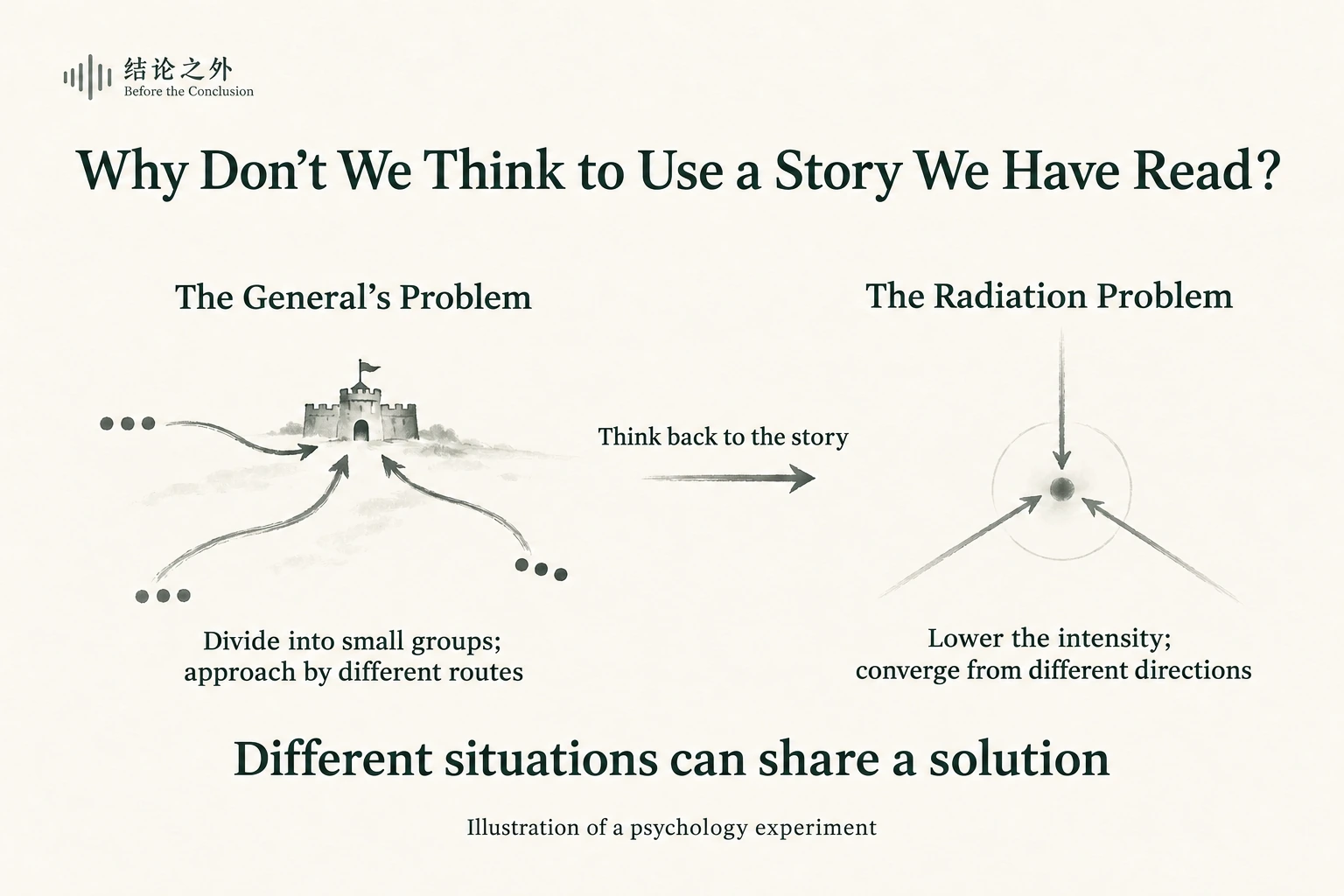
In 1980, Mary Gick and Keith Holyoak studied how people solve problems by analogy. Participants first read a military story: the roads leading to a fortress are mined. A large force would trigger explosions, but small groups can pass safely. A general therefore divides his army into small groups that approach the fortress simultaneously from different directions. Participants then face a hypothetical medical problem: strong rays can destroy a tumor but damage the tissues along their path; weak rays spare those tissues but cannot destroy the tumor. What should be done? [3]
The solution of interest to the researchers was to direct several weak rays toward the tumor simultaneously from different directions, converging at the target. The two problems have little surface resemblance, but their solutions share a structure: travel separately along the routes, then converge at the target. The studies found that around 10% could solve the problem directly without a hint; around 30% could do so after reading the general's story; and around 75% could solve it after a hint that the story could help. Figures varied across experiments, but the pattern was consistent: people who read the story did not always make the connection spontaneously, and a prompt to use the earlier material made transfer easier. [3][4] The radiation problem here is an experimental task, rather than clinical treatment advice.
In 1983, the two researchers further studied “schema induction”: participants compared two analogous stories, described their similarities, and tried to extract a shared relational structure from the concrete details. The quality of the schemas they produced was associated with later transfer performance: people who grasped the shared structure were more likely to use the idea in a new problem. That association alone, however, cannot prove that schema quality was the sole cause of differences in transfer. [4]
These studies make “I learned it, but it did not occur to me” a problem that can be studied in parts. People need to remember the material and notice relevant connections in a new setting. Once knowledge enters memory, it still needs to be recalled, recognized, and organized before it can contribute to new thought.
Returning to reading, this offers a direction worth pursuing: do we remember an expression of feeling, or do we also see how the author arrived at it? Removed from the circumstances it addresses, a conclusion can easily become a phrase that can be applied anywhere without necessarily being understood.
In the First Rhapsody on the Red Cliffs, the process deserves our attention
If the experiments help explain why familiarity does not guarantee use, Su Shi's First Rhapsody on the Red Cliffs, often simply called the Rhapsody on the Red Cliffs, lets us ask a further question: what is worth taking with us from a work into life? It is not a literary validation of the experiments above. It is a different kind of material, allowing us to see how a response takes shape. [5]
If all we remember is “open-minded acceptance,” the rhapsody can easily become a maxim telling people to take things less to heart. But the essay devotes considerable space to giving sorrow a voice. The guest moves from Cao Cao's grand achievements to his own present life, from the passing of a great hero to life's brevity and personal insignificance. He longs for permanence while knowing it is unattainable; faced with immensity, he feels his own limits. These feelings are all allowed to be spoken seriously. [5]
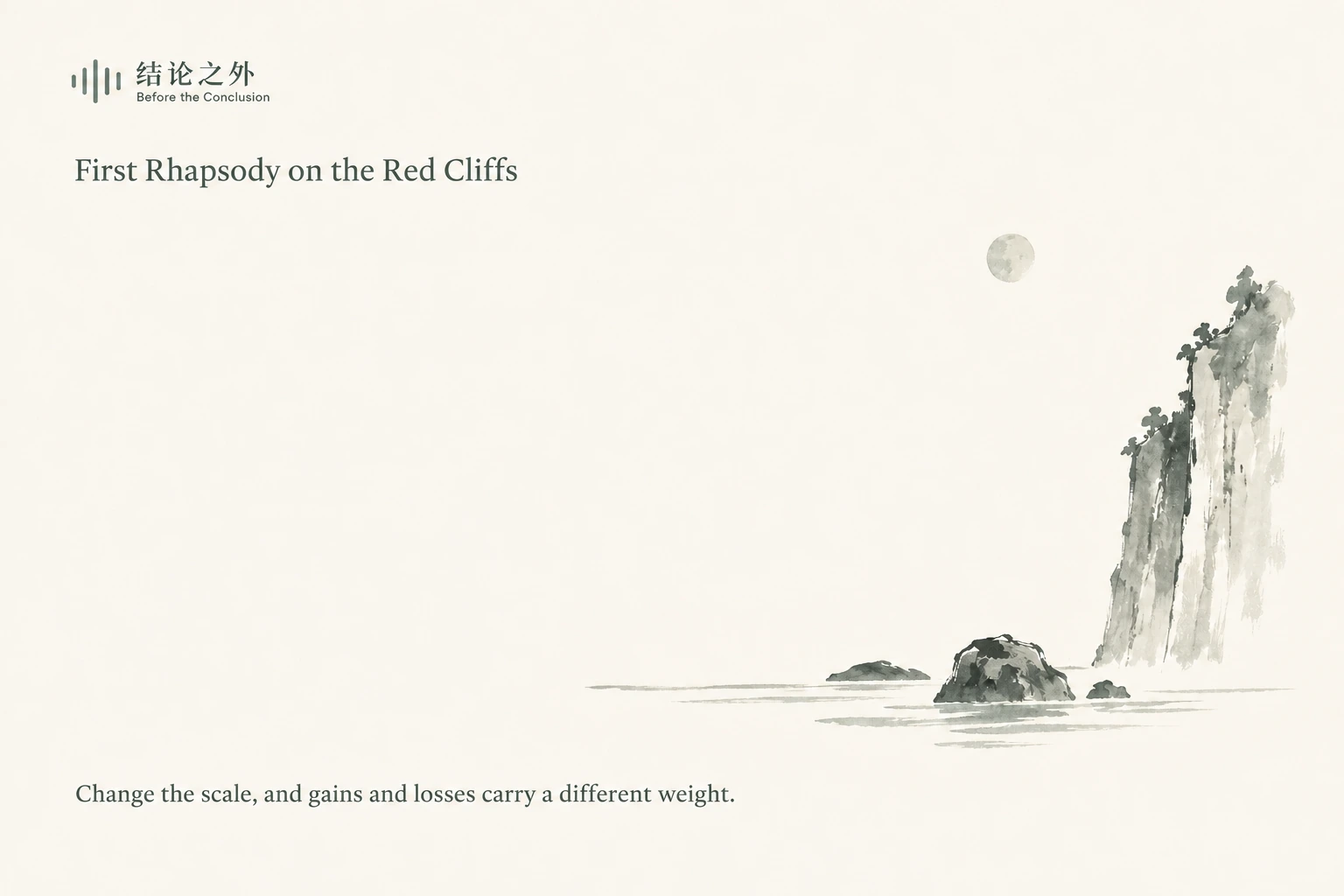
Master Su's reply begins again with the river and the moon. The water before him flows away, yet the river continues to exist; the moon waxes and wanes, yet does not truly increase or diminish. He then extends the reflection to the world and the self: from the perspective of change, heaven and earth cannot remain still for even an instant; from the perspective of constancy, all things and the self alike are inexhaustible. On a different scale of observation, the original opposition between brief human life and the enduring river ceases to be the only understanding available. The essay then turns toward the clear breeze and bright moon that can be experienced together. [5]
Is this response sufficient to address disappointments in real life? Readers may judge for themselves. What deserves closer attention is that it does not begin by saying, “Do not be sad.” It first unfolds the reasons for sadness, then tries shifting the vantage point.
We need not accept its entire view of the universe to find something useful here. Someone may be temporarily unable to change their position at work, illness, or relationships. Yet there may still be room to rearrange their understanding of what they have lost, what remains, and what they can do next. This is an extension we propose in moving from the work into life, rather than an answer Su Shi supplied for every circumstance.
Nor can the dialogue between host and guest be treated as a complete record of the author's state of mind. An essay reaching a moment of exhilaration does not establish that he never felt sorrow afterward. Understanding a response and requiring ourselves to maintain it permanently are different things.
Transfer also means noticing what is different
It is easy to seek consolation in classical writing; allowing reading to change our habits of judgment is somewhat harder. After reading about a gathering becoming the past, are we more willing to take seriously a meeting that seems postponable? After reading about someone's frustrated ambitions, are we more willing to understand another person's circumstances before judging their setback?
Imagine that a friend says a project they worked on for a long time has been canceled. We could first ask what they had hoped to achieve, where the work became stuck, and what constraints they faced, instead of immediately offering, “Nothing lasts forever.” The explanation may not be wrong, but if it arrives too quickly, it can take the place of understanding.
Such connections can also be mistaken. An ancient writer's disappointment and a person's difficulty today may feel alike while having different causes and possible ways forward. The person may need company, or practical help. A familiar line of poetry, arriving too quickly, can obscure the person in front of us.
Bringing reading into life therefore also requires patience in recognizing differences. Sometimes deeper reading means understanding more clearly why we cannot accept an author's judgment. Sometimes it means suspending judgment, acknowledging that the stories we know do not yet explain this person's experience.
We should also be wary of reducing every work to an actionable piece of life advice. Poetry can allow a feeling to linger and give unresolved contradictions somewhere to reside. Reading whose use we cannot immediately name may be expanding our capacity to hold complex experiences. But that influence needs to be tested in later life; being moved at the end of a work is not enough to declare it complete.
Some words wait for us to reach them later
The first time we read the Preface to the Orchid Pavilion Collection, we may remember its characters. Reading again, we remember a gathering. Only on some later day do we read the people who have already become the past. Each understanding carries the self we were at the time. No single reading can do all the reading required by the life that follows.
This gives recitation a gentle possibility: it lets us carry words with us before we fully understand them. When understanding arrives, we do not have to begin from nothing.
Looking back at these three works, we have tried to take away three ways of seeing. The Preface to the Orchid Pavilion Collection invites us to look back at today through the eyes of those who come later. A Moonlit Night on the Spring River reminds us that different people under the same moon have their own attachments. The First Rhapsody on the Red Cliffs lets us follow the host and guest's dialogue and try viewing the same world at a different scale. This is the reading path chosen in this article; it does not exhaust the works' meanings.
A moon can still be simply beautiful, and a rhythm can simply bring pleasure. After a rereading, we may also ask one more question: if we looked back from later, stood in someone else's position, or changed the scale, might the matter before us reveal something we previously overlooked?
What we take away after recitation may be just such a pause: before the familiar answer appears, one more chance to see the person and the life in front of us anew.
References and original texts
[1] Wang Xizhi, Preface to the Orchid Pavilion Collection. Classical quotations were checked against the electronic text of Guwen Guanzhi on Shidian Guji, with traditional characters converted to simplified Chinese. The Chinese quotation was checked with the wording “固知” (“I firmly know”) retained. Read the original.
[2] Zhang Ruoxu, A Moonlit Night on the Spring River, in Complete Tang Poems, volume 117. Checked against the full text on Wikisource; the page lists the collections containing the poem and some variant readings. Read the original; Electronic text of Complete Tang Poems, volume 117. The description of an “unfinished homeward journey” is this article's interpretation.
[3] Gick, M. L., & Holyoak, K. J. (1980). Analogical problem solving. Cognitive Psychology, 12(3), 306–355. DOI; Full paper supplied by the authors' laboratory. The radiation problem allowed multiple proposed solutions; this article discusses the target “convergence” solution of interest to the researchers. For the distinction between prompted and spontaneous transfer, see Experiment V, original journal pages 344–345.
[4] Gick, M. L., & Holyoak, K. J. (1983). Schema induction and analogical transfer. Cognitive Psychology, 15(1), 1–38. DOI; Full paper supplied by the authors' laboratory. The approximate 10%, 30%, and 75% figures in the body follow this paper's account of earlier research; see original journal pages 4 and 11. They should not be treated as one three-group experiment, and 75% should not be interpreted as an additional percentage following the hint. For comparing stories, describing similarities, and the relationship between schema quality and transfer, see Experiment 4, pages 21–24.
[5] Su Shi, First Rhapsody on the Red Cliffs. Checked against the electronic Dongpo Collection on Shidian Guji, where the work is titled Rhapsody on the Red Cliffs. This article adds “First” to distinguish it from the Second Rhapsody on the Red Cliffs, written in the same year. Read the original.
The classical-text links above identify the electronic texts used to check quotations; they do not represent conclusions from a critical comparison of editions. Connections between ancient texts and modern life are interpretations offered by this article. Experiments in analogical problem solving support discussion of the transfer process; they do not directly establish that literary reading improves empathy, morality, or personality.
Beyond the conclusion, there are still questions worth asking.
Medicine · Science · Ideas and Reading
Follow Before the Conclusion, and keep exploring with curiosity and independent thought.
Text and image use
The text of this article was originally written by Before the Conclusion. Sources for the works and research cited are identified, and their rights status is unaffected by this statement. You are welcome to share this article's link. Without separate permission, please do not reproduce or excerpt the original writing by copying, republishing, or reposting screenshots. The illustrations were conceived by Before the Conclusion and created using AI tools. They evoke reading imagery and illustrate experiments; please do not separately republish, copy, or use them commercially without permission.