
From a clinical result to approval, revenue, and value per share.
Biopharmaceutical investment analysis | Information current to October 25, 2026
On October 19, 2026, Disc Medicine (Nasdaq: IRON) announced that the phase III APOLLO trial of its oral investigational drug bitopertin had met both prespecified co-primary endpoints. On October 22, the company completed a stock offering with gross proceeds of $450 million. [1,3]
The two developments affect, respectively, the drug's evidence base and the company's financial resources.
Incorporating them into an investment judgment requires explaining which valuation assumptions have changed, the basis for those changes, and which outcomes still need to be awaited.
1. First, what exactly did “phase III success” measure?
Bitopertin is being studied for erythropoietic protoporphyria (EPP) and X-linked protoporphyria (XLP). These diseases involve abnormal heme synthesis; accumulation of protoporphyrin IX (PPIX) can cause severe light-related pain. [1,4]
The drug inhibits glycine transporter 1 (GlyT1), modulating the heme synthesis pathway to reduce PPIX production. [1]
APOLLO enrolled 183 patients aged 12 years and older. It was a randomized, double-blind, placebo-controlled trial comparing oral bitopertin at 60 mg daily with placebo over approximately 6 months. [1]
The company reported two co-primary endpoints: [5]
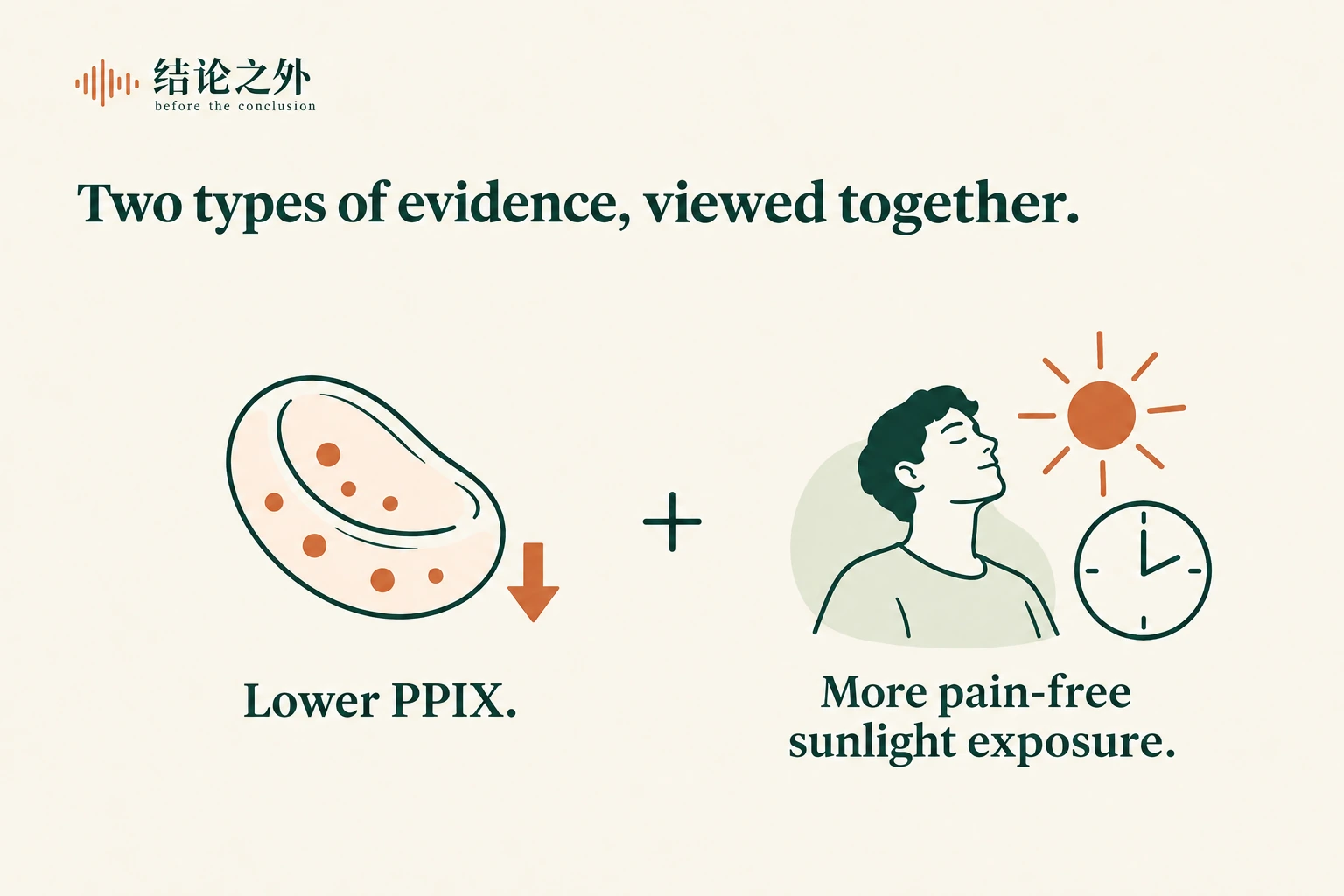
- Change in PPIX from baseline at month 6: a 45.8% reduction with bitopertin versus a 4.4% reduction with placebo; a difference in reduction of 41.4 percentage points, p < 0.0001.
- Pain-free light exposure at month 6: 41.1 hours with bitopertin versus 28.9 hours with placebo; a between-group difference of 12.2 hours, p = 0.0010.
The “41.4 percentage points” is the subtraction of the two percentage reductions. It cannot be described as a 41.4% reduction relative to placebo.
The “12.2 hours” is a between-group difference within a 28-day assessment window at month 6. Under the trial's rules, light-exposure time was recorded between 10 a.m. and 6 p.m. on days without phototoxic-reaction pain, and a statistical model compared the groups. The figure does not mean an extra 12.2 hours every day, or the same additional time for every patient. [5]
These results address different questions: whether the drug changed a relevant biological measure, and whether patients' light-exposure experience improved under the trial's definition.
© Before the Conclusion | Original concept; created with AI assistance. Please do not republish, copy, modify, or use commercially without permission.
2. Why can these results address the FDA's earlier questions?
The FDA's complete response letter of February 13, 2026 stated that earlier studies supported a reduction in PPIX with bitopertin, but questions remained about whether the observed reduction predicted clinical benefit. Previous trials had not adequately demonstrated an association between percentage change in PPIX and the measured light-exposure endpoints. [2]
The regulatory question therefore concerned how far the evidence supported a judgment about patient benefit.
APOLLO adds clinical evidence that directly measures patient experience. This is an important part of the new result's significance.
At the same time, improvement in both endpoints must be assessed separately from the question of how reliable PPIX is as a surrogate endpoint. Establishing that a particular reduction in PPIX reliably predicts a particular clinical benefit requires further analysis and validation.
The FDA Type A meeting disclosed by the company in June should also be understood in this context. These formal meetings address problems that impede development. According to the company's account, a successful APOLLO trial could form the basis of a response to the complete response letter and potentially support traditional approval. The meeting discussion itself was not a commitment to approve the drug. [7,8]
The company currently plans to resubmit the application before the end of 2026 and anticipates a possible FDA decision by mid-2027. These are company expectations; the outcome ultimately depends on review of the complete application. [1]
3. After statistical success, examine the size of benefit and its costs
Meeting the prespecified endpoints provides important support for efficacy. Assessing treatment value also requires examining the magnitude of change, uncertainty in the estimates, and whether patients can stay on treatment.
Items to examine in the full analysis include confidence intervals, handling of missing diary data, adjustment for seasonal and regional differences in light exposure, and results at different stages of follow-up. These are analyses to review; the fact that an initial announcement does not describe each one is not grounds for concluding that the study handled them improperly.
Safety belongs in the same assessment. The company reported dizziness in approximately 50% of patients receiving bitopertin versus approximately 11% receiving placebo, all mild or moderate. No patients in either group withdrew from the trial because of an adverse event. [5]
Longer-term efficacy and safety require further observation. The materials available at this stage are company-disclosed preliminary results and presentation slides. Their evidentiary status must be distinguished from a peer-reviewed full paper and the FDA's final review conclusions.
4. Break the “potential market” into testable assumptions
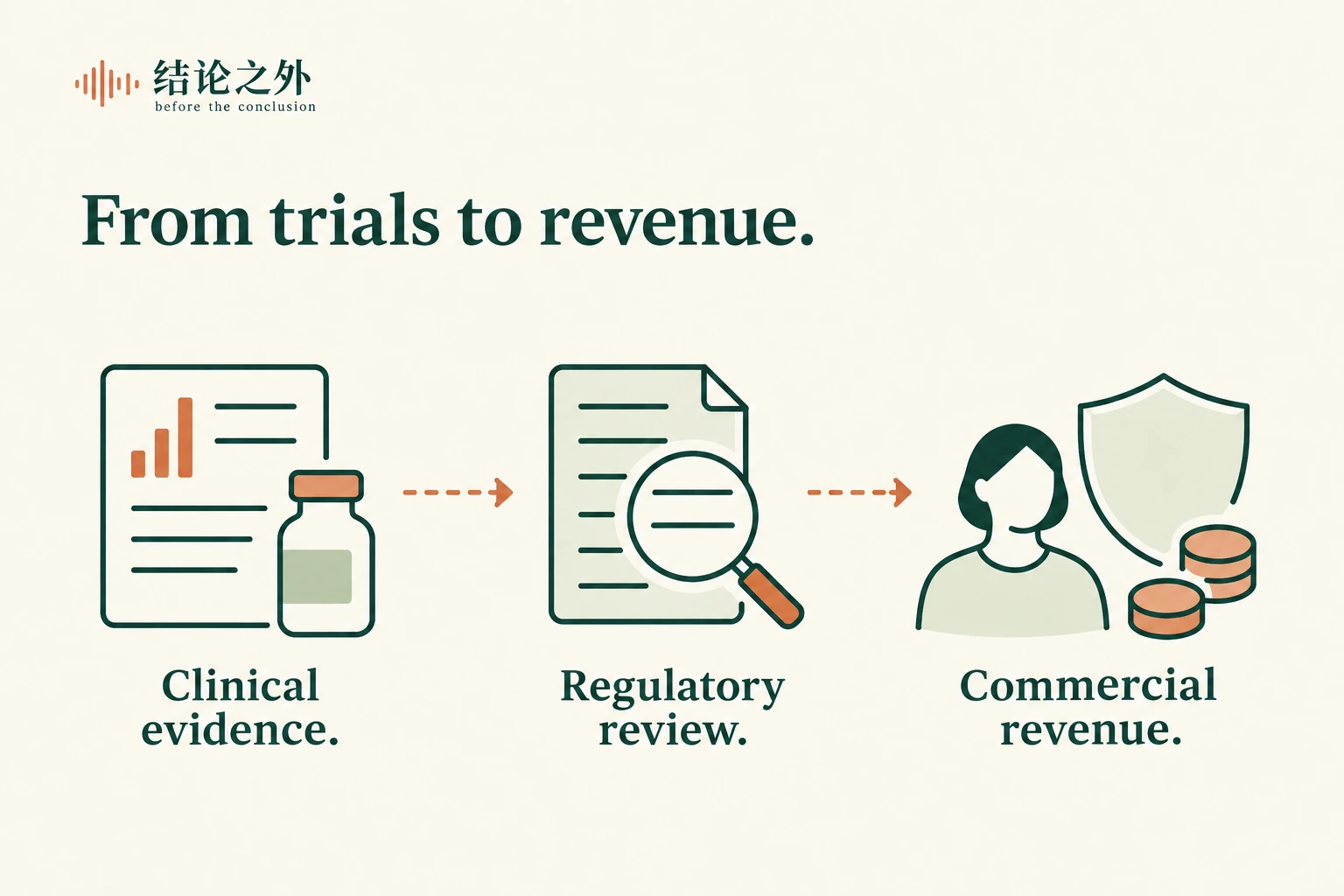
After approval, revenue must pass through diagnosis, prescribing, payment coverage, treatment initiation, and continued use.
A commercial scenario therefore needs to explain at least the following:
- Patient population: Who will the final label permit to use the drug? How many of those people are already diagnosed and able to access treatment?
- Adoption and continued use: Will physicians and patients choose it? How long will patients remain on treatment on average?
- Net revenue: After payment terms, discounts, and other adjustments, how much revenue can the company actually realize?
- Costs: What will the commercial team, manufacturing and supply, follow-up research, and continuing operations cost?
EPP already has an approved treatment, Scenesse. Oral administration may influence treatment choices, but APOLLO used a placebo comparator and cannot directly demonstrate superiority to existing treatment. [6]
Multiplying the total number of people with the disease by an assumed drug price can begin a scenario. Turning it into a revenue forecast requires the assumptions above; turning revenue into company value also requires time, costs, and risks.
© Before the Conclusion | Original concept; created with AI assistance. Please do not republish, copy, modify, or use commercially without permission.
5. After financing, how do the numerator and denominator change together?
On October 22, the company completed an offering of 6 million new shares at $75 per share, raising $450 million gross. Estimated net proceeds from the base offering were approximately $422.4 million, excluding exercise of the underwriters' option to purchase additional shares. [3]
Management expects existing resources plus the proceeds to fund current operating and capital-expenditure plans and debt service into 2030. This forecast assumes no net cash inflows from possible future approved products and depends on business and spending plans. [3]
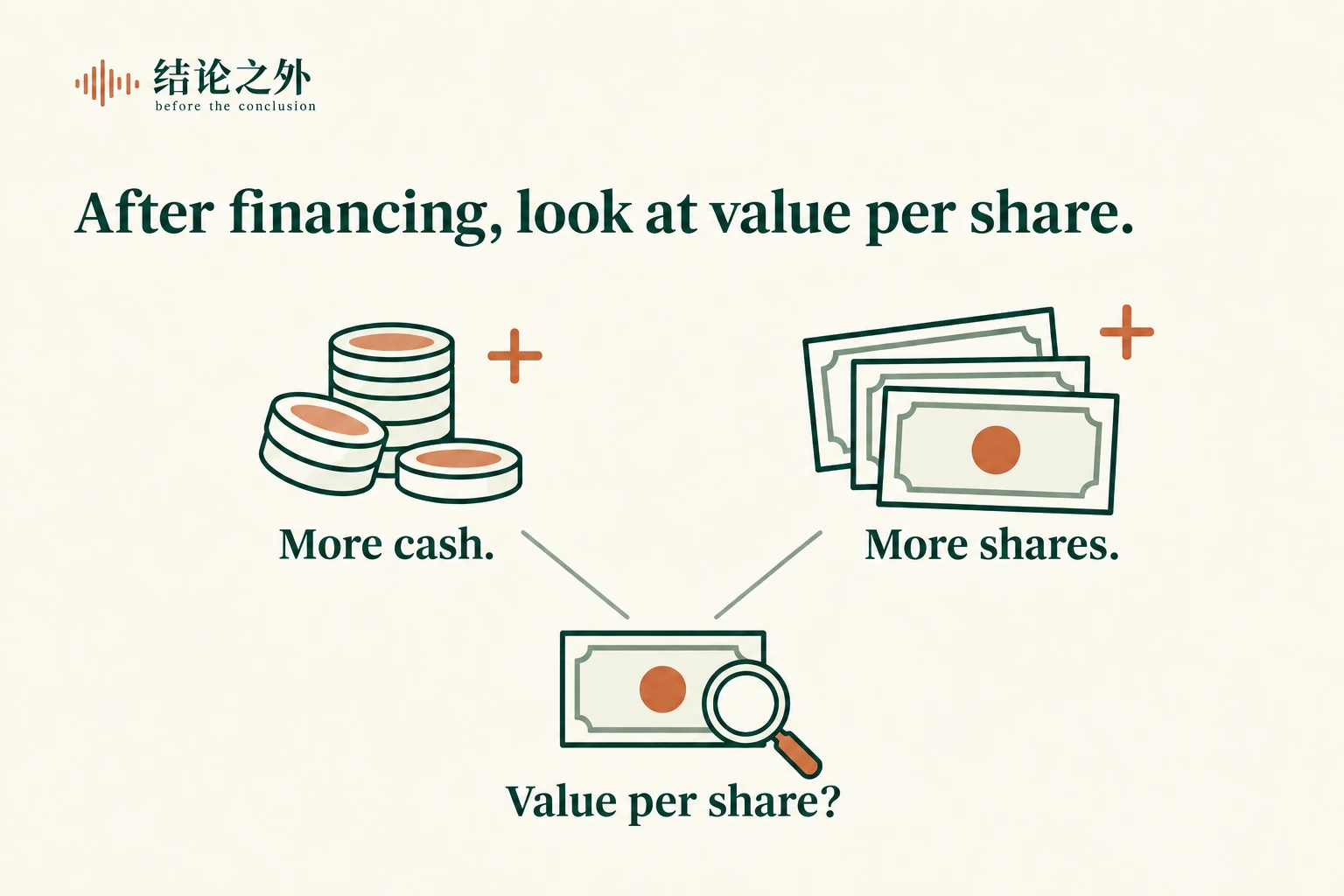
Financing brings cash and additional shares. The former increases the resources available to execute plans; the latter changes the ownership interest represented by each share.
A hypothetical example unrelated to Disc Medicine makes the arithmetic clear:
Suppose a company's total equity value is RMB 1 billion, with 100 million shares, or RMB 10 per share. It issues 10 million shares at RMB 10 each and receives RMB 100 million in cash. Counting only the new cash and ignoring fees and other changes, equity value becomes RMB 1.1 billion and the share count becomes 110 million. Value per share remains RMB 10.
Existing shareholders own a smaller percentage of the company, but value per share has not changed in this simplified example.
The actual outcome depends on the issue price, offering costs, use of funds, future returns, and other factors. The example establishes only that changes in ownership percentage and changes in economic value per share need to be calculated separately. The RMB 10 figure is for illustration and has no connection to Disc Medicine's share price or a price target.
An actual valuation must also include the company's other assets and liabilities and consistently account for equity instruments that may become shares.
© Before the Conclusion | Original concept; created with AI assistance. Please do not republish, copy, modify, or use commercially without permission.
6. Translate the news into valuation assumptions
A probability-weighted valuation can separately examine the likelihood of approval, launch timing, patient adoption, net revenue, expenditure, and share count.
APOLLO's new evidence may give some assumptions a firmer basis. Each adjustment still needs an explanation, so that the same development is not counted repeatedly in different places.
Events to follow include:
- The full clinical analysis, durability of efficacy, and long-term safety results.
- Resubmission, subsequent regulatory discussions, and the final label.
- Actual cash use, launch-preparation spending, and the share count following financing.
- If approved, payment coverage, patient treatment starts, and continued use.
Finally, the estimated value must be compared with the price paid to invest. Even when a drug's prospects improve, expected investment returns remain affected by the purchase price.
The value of good clinical news is that it gives certain judgments a stronger basis. Investment analysis must continue to ask how many assumptions that basis warrants changing, and how much the price already reflects.
This article uses public information to discuss biopharmaceutical evidence and company valuation. It does not recommend buying or selling any individual security. Clinical results come from company disclosures; the analysis and judgments are the author's.
Main sources
[1] Disc Medicine, APOLLO topline results and expected application timing, October 19, 2026.
https://ir.discmedicine.com/news-releases/news-release-details/disc-medicine-announces-success-all-primary-and-secondary
[2] FDA complete response letter, February 13, 2026, disclosed with redactions as an exhibit to a company SEC filing.
https://www.sec.gov/Archives/edgar/data/1816736/000119312526051504/iron-ex99_2.htm
[3] Disc Medicine, Form 8-K, October 22, 2026: completion of the offering, estimated net proceeds, and expected use of funds.
https://www.sec.gov/Archives/edgar/data/1816736/000119312526429105/d457786d8k.htm
[4] US National Library of Medicine, MedlinePlus Genetics: the FECH gene and EPP disease background.
https://medlineplus.gov/genetics/gene/fech/
[5] APOLLO results presentation, October 19, 2026, SEC Exhibit 99.2, particularly pages 8, 10, and 14. Preliminary company disclosure, rather than a peer-reviewed full paper or the FDA's review conclusions on this trial.
https://www.sec.gov/Archives/edgar/data/1816736/000119312526424649/d156263dex992.htm
[6] FDA, Scenesse orphan-drug approval record and indication.
https://www.accessdata.fda.gov/scripts/opdlisting/oopd/detailedIndex.cfm?cfgridkey=263208
[7] Disc Medicine, FDA Type A meeting update, June 9, 2026.
https://ir.discmedicine.com/news-releases/news-release-details/disc-medicine-provides-update-fda-type-meeting-bitopertin
[8] FDA, Formal Meetings Between the FDA and Sponsors or Applicants of PDUFA Products, section on Type A meetings.
https://www.fda.gov/media/172311/download
Beyond the conclusion, there are still questions worth asking.
Medicine · Science · Ideas and Reading
Follow Before the Conclusion, and keep exploring with curiosity and independent thought.
Text use
The text of this article was originally written by Before the Conclusion. You are welcome to share its link. Without separate permission, please do not reproduce or excerpt it by copying, republishing, or reposting screenshots, or use it commercially. Relevant rights are subject to applicable law.