Complete response
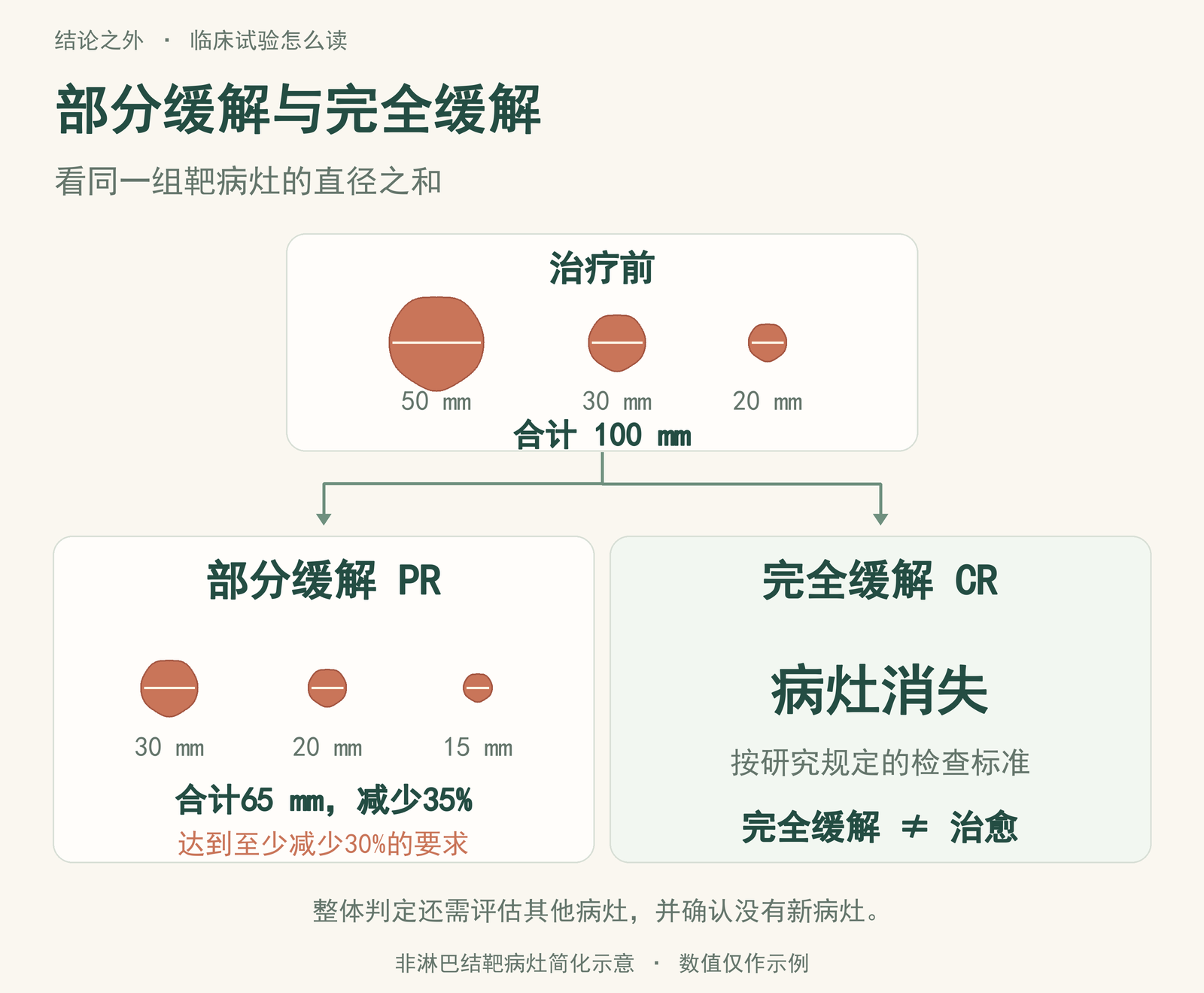
Complete response · CR
Disappearance of all target lesions under the prespecified criteria. RECIST 1.1 also requires pathological lymph nodes to have a short axis below 10 mm; overall CR depends on non-target and new-lesion assessment.
How to read it
Check the criteria, assessment methods, other lesions and new lesions, plus any confirmation and duration requirements in the protocol.
A common pitfall
Complete response is not cure and alone does not determine when to stop treatment. The diagram illustrates the assessment concept.
Disappearance is assessed under the study criteria, including other lesions and the absence of new lesions. Complete response is not cure; numbers are illustrative.
 View full-size diagram ↗