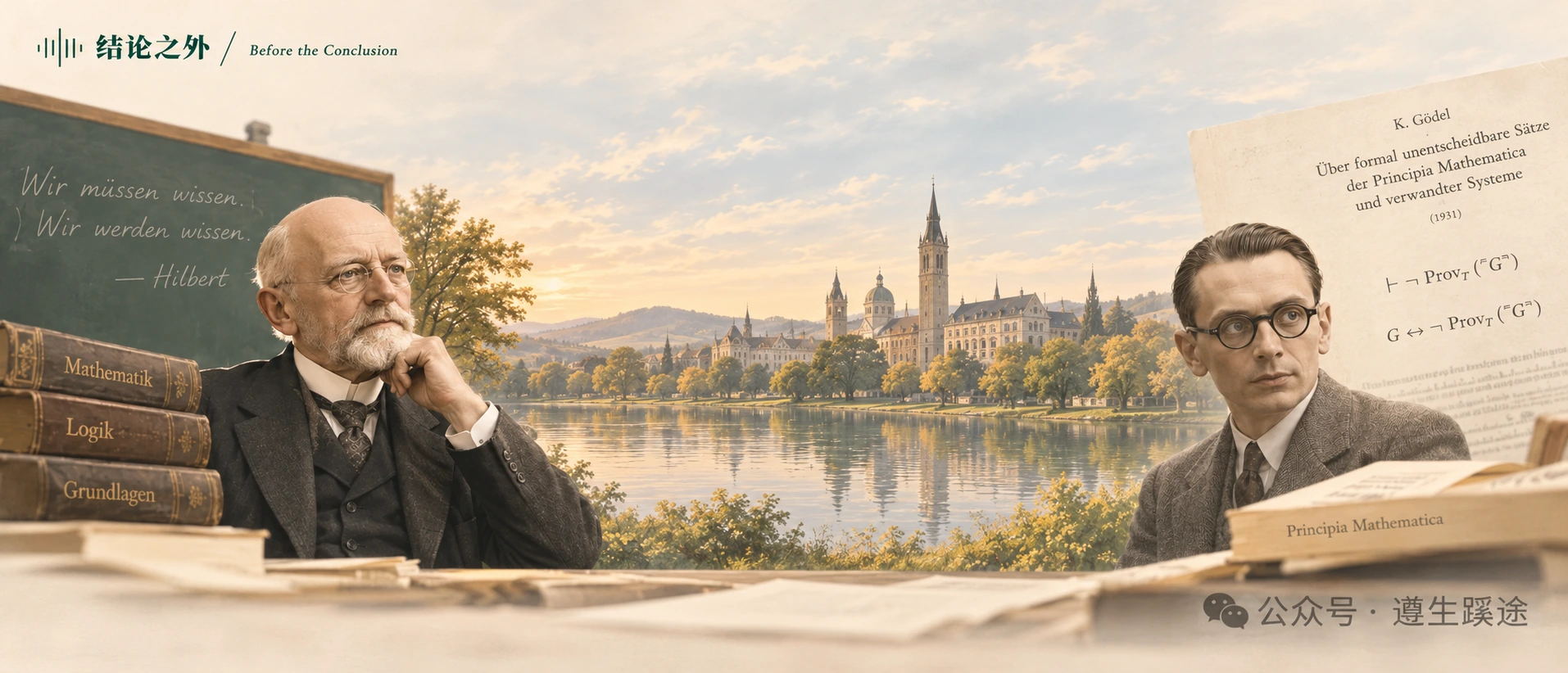
In September 1930, the German mathematician David Hilbert gave a lecture in Königsberg.
He was 68 that year, and one of the world's most influential mathematicians.
At the end of the lecture, he offered words that would become famous:
“We must know. We shall know.”
They expressed Hilbert's firm confidence in human reason.
He believed that, at least in mathematics, finding the right axioms and rules of inference should make mathematical problems solvable in principle.
Yet just one day before that lecture, a young mathematician of only 24 had announced a discovery at an academic meeting in the same city that would profoundly change research on the foundations of mathematics.
His name was Kurt Gödel.
The “incompleteness theorems” he subsequently presented changed mathematics and raised a question that remains worth considering:
Does human knowledge have boundaries it can never cross?
1. Can mathematics explain everything?
We usually think of mathematics as the form of knowledge closest to certainty.
Historians may interpret the same event differently. Medical research may change its conclusions when new evidence appears. Economists frequently disagree about the future.
But mathematics seems different.
If a proof is correct, its conclusion should not change with time, place, or personal opinion.
For example, why do the interior angles of a triangle add up to 180 degrees?
In Euclidean geometry, this is not an empirical conclusion reached by repeatedly measuring many triangles. It is a result that can be proved through logical deduction from a set of basic axioms.
Of course, the situation changes in a non-Euclidean space such as the surface of a sphere.
That distinction shows precisely that the validity of a mathematical conclusion depends on the axiomatic system we adopt.
A natural question follows.
If we could find sufficiently comprehensive axioms, could we build all of mathematics on a rigorous, contradiction-free set of rules?
This was the goal Hilbert hoped to achieve.
He wanted not only rigorous proofs of important mathematical propositions, but also a proof that the mathematical system itself would not generate logical contradictions.
This became central to the famous “Hilbert program.”
Behind it was an exhilarating idea:
Human reason might face temporary difficulties, but there should be no mathematical problems unsolvable in principle.
2. What did Gödel discover?
In 1931, Gödel formally published his incompleteness theorems.
In accessible terms, their central conclusion is this:
For any formal system meeting certain conditions and capable of expressing basic integer arithmetic, if the system is consistent, there are arithmetical propositions that cannot be proved using only its internal rules.
Yes, that still sounds abstract.
Start by imagining a mathematical system as a board game with clearly defined rules.
The rules specify which moves are allowed and which deductions are valid.
If a system is complete, we would like to be able to prove every proposition it can express, or prove that proposition's negation.
But Gödel found that for sufficiently strong formal systems meeting particular conditions, this aspiration cannot be fulfilled.
His proof used an ingenious technique: numerical encoding enabled a mathematical system to express statements about its own proof procedures.
This makes it possible to construct a special proposition. Roughly speaking, it asserts that it cannot be proved within this system.
If the system could prove it, the system would encounter a contradiction. Under the theorem's conditions, it indeed cannot be proved internally.
This is one central idea of incompleteness.
Another way to think about it | The melon seller
An everyday example may help explain why we sometimes need to step outside our original framework of judgment.
A Chinese saying describes “Old Lady Wang selling melons and praising her own goods.”
Suppose she says, “My melons are the tastiest on this street.”
We cannot, of course, accept the conclusion on her assessment alone. To find out whether her melons really taste best, we might compare stalls and sample other sellers' melons.
But suppose she goes further: “My melons are the most nutritious food in the market.”
The question has changed.
Comparing melons from different stalls is no longer enough. We may also need to compare vegetables, fruit, and even other categories of food. First, we need to clarify the standard by which “most nutritious” should be judged.
Moving from “whose melons taste best?” to “which food is most nutritious?” expands the comparison and changes how the question is framed.
Of course, this is not a proof of Gödel's incompleteness theorems. Everyday comparisons depend on experience and evaluative standards, whereas Gödel addressed rigorously defined mathematical formal systems.
But the analogy can help us understand a more general point:
Sometimes, when existing methods cannot answer a question, exploration need not stop. We may need to broaden the inquiry or even reexamine our standards of judgment.
In mathematics, introducing new axioms can sometimes create a stronger formal system and resolve questions the original system could not answer.
Yet Gödel tells us that as long as the new formal system still meets the conditions of the incompleteness theorems, it too cannot escape incompleteness altogether.
Gödel also proved another important result: a consistent formal system meeting the relevant conditions cannot establish its own consistency using only its internal methods of proof.
The complete and self-guaranteeing mathematical foundation Hilbert had hoped to establish thus encountered a fundamental limitation.
But something must be made clear here.
Gödel did not prove that human beings can never acquire new mathematical knowledge, much less that all truth is unknowable.
His theorems concern formal systems under specific conditions, rather than the entirety of human thought.
This distinction matters a great deal.

3. What does it mean when a system cannot prove a proposition?
When a proposition cannot be proved within our current system, must we simply admit defeat?
Not necessarily.
Mathematicians can sometimes introduce new axioms and construct a stronger system that resolves questions the original system could not settle.
But the new system may still encounter incompleteness of its own.
This gives the development of mathematical knowledge an interesting character.
We can continually expand the scope of proof, but we cannot expect a final set of rules that meets the conditions above and also settles every relevant proposition.
Does this mean mathematical truth exists independently, while human beings can never reach it in full?
Or is our understanding of truth also connected to the ways of reasoning that we continue to develop and refine?
Here we move beyond mathematics into philosophy.
4. Is truth discovered, or continually understood anew?
The German philosopher Immanuel Kant proposed that human beings do not simply receive the external world without conditions; we understand experience through our own cognitive structures.
Later, thinkers including Frege, Russell, and Wittgenstein explored the relationships among logic, language, and mathematics in trying to explain how knowledge is possible.
There are different philosophical positions on mathematical truth.
One holds that mathematical truths exist independently of human knowledge.
For example, mathematical facts about prime numbers do not change depending on whether anyone studies them.
The mathematician's work is to keep discovering truths that already exist.
Gödel himself leaned toward this understanding.
Another philosophical approach places greater emphasis on how people come to understand mathematical concepts through language, proof, and practices of reasoning.
The British philosopher Michael Dummett is an important representative of this approach.
From this perspective, understanding mathematics means more than accepting particular conclusions as true. It also involves understanding what counts as a proof and why a form of reasoning is acceptable.
The incompleteness theorems did not finally decide between these positions.
But they offer very different pictures of knowledge.
In the first picture, truth resembles a mountain that already exists, while humanity searches for a route to its summit.
The second reminds us that developing knowledge may also involve continually expanding our concepts, proof methods, and ways of understanding.
Another way to think about it | A journey
Imagine the search for truth as a journey.
If truth is a mountain already standing there, our goal seems clear: find the route to the summit and eventually reach the destination.
But another understanding reminds us that the meaning of a journey may extend beyond arrival.
How we plan the route, choose our transport, encounter people and things along the way, and even change direction after setbacks can all reshape our understanding of the destination and the world as a whole.
Sometimes we return to our starting point. The scene before us seems unchanged, but our way of seeing it is different.
Truth and the process through which we know it are not exactly the same thing. Yet progress in knowledge may concern more than where we arrive: it may also concern how exploration changes our ability to understand the world.
This does not mean we can make any claim true by changing the rules at will.
Whether new rules are reasonable still requires rigorous argument and examination.
What deserves thought is this:
A system of knowledge need not only add answers within an existing framework. By developing new methods, it may also expand the questions we can formulate and solve.

5. Another question prompted by reading The Great Influenza
This brings to mind a work of medical history I read several years ago: John Barry's The Great Influenza.
Set against the 1918 influenza pandemic, the book describes the gradual development of modern medicine through scientific discovery, institutional reform, and public-health crisis.
One particularly interesting aspect concerns more than the influenza virus itself: Barry devotes considerable space to the establishment of the modern medical research system.
In the late nineteenth century, medicine was still far less dependent than it is today on systematic experimental research and scientific training.
Many doctors drew their knowledge primarily from experience, tradition, and clinical observation.
With the development of German research universities and reforms at institutions such as the Johns Hopkins University School of Medicine in the United States, laboratory research, basic science education, and clinical training became more closely linked.
William Welch, William Osler, and later Abraham Flexner, who advanced medical education reform, all played important roles in this transition.
Progress in modern medicine no longer depended solely on an individual brilliant doctor discovering a new treatment.
It began to depend on a scientific system capable of continually training researchers, accumulating evidence, testing hypotheses, and correcting errors.
At the time, I found myself asking:
Has medicine progressed so dramatically because we have discovered more and more knowledge, or because we have changed our methods of discovering it?
Perhaps the answer is both.
But we can ask one more question: without the latter, how would we have obtained the former?
Before reaching an undiscovered destination, after all, we first need a path of exploration. Science often makes previously unanswerable questions answerable by continually improving its methods.
New discoveries, of course, can change those methods in return. Knowledge and methods move forward by advancing each other.
But The Great Influenza shows how often the importance of the latter is underestimated.
During the 1918 pandemic, many outstanding doctors and scientists devoted enormous effort to finding the pathogen and effective treatments.
They lacked neither courage, diligence, nor a desire to know.
Yet the technical conditions and conceptual frameworks of their time still prevented them from adequately understanding the disease.
The influenza virus had not yet been successfully isolated, and knowledge of viruses was far less developed than it is today.
Only through later advances in virology, immunology, molecular biology, and medical research methods did we gradually gain new capacities to understand disease.
This brings us to a realization:
The questions scientists can answer depend not only on their intelligence and effort, but also on the concepts, tools, methods, and research systems available to them.
This observation differs from Gödel's mathematical discovery.
Gödel addressed logical limitations of formal systems under specific conditions. Medical history shows how an empirical science changes as evidence, technology, and research institutions develop.
Yet thinking about them together can help us reconsider progress in knowledge.
Sometimes, despite our efforts to find answers, the original question remains unresolved.
The real breakthrough may involve more than one new piece of evidence.
It may be the recognition that we need a new method, or even a new understanding of what we are asking.

6. Does scientific progress approach truth, or change how we understand?
Many important advances in the history of science have changed how people understand a problem rather than merely adding a piece of knowledge.
Newtonian mechanics enabled humanity to describe many celestial and terrestrial motions with unified mathematical laws.
Einstein's relativity did not make Newtonian mechanics useless in every situation, but it changed our understanding of space, time, and gravity.
Medicine shows a similar pattern.
In the past, doctors primarily described disease through symptoms and observable bodily changes.
Later developments in microbiology, molecular biology, and genetics allowed us to understand the mechanisms of some diseases at new levels.
New knowledge does more than refine existing answers.
Sometimes, it reveals limitations in the way the original question was posed.
Mathematical theorems, scientific theories, and medical evidence of course have different standards of judgment and cannot simply be equated.
But together they remind us:
Progress in knowledge depends not only on how many answers we find, but also on whether we learn to ask better questions.
7. Does acknowledging limits mean abandoning the search?
Return to Königsberg in 1930.
Hilbert believed that humanity would eventually know.
Gödel proved that the program for mathematical foundations envisaged by Hilbert faced limitations that could not be removed.
At first glance, this looks like a defeat for rational optimism.
But we can see it another way.
Precisely because Gödel identified the boundaries of existing systems, mathematicians and philosophers could distinguish more clearly among proof, truth, and knowledge.
A limitation in a method does not mean exploration has ended.
Recognizing that limitation may instead become an important starting point for further knowledge.
Perhaps mature reason does not consist in believing that every question must be solvable in the way we expect.
Perhaps it means pursuing answers while acknowledging the inadequacy of current methods, and trusting that knowledge can progress without treating any theory as the final explanation.
Hilbert said:
“We must know. We shall know.”
Nearly a century later, these words retain their power.
After Gödel, however, we might give them another layer of meaning.
We may be unable to obtain every answer within one fixed set of rules.
But we can continue developing new concepts and methods, expanding our ability to understand the world.
One question, then, is worth leaving open:
Does scientific progress mean moving closer to a complete truth that already exists, or continually creating concepts, methods, and systems better able to understand the world?
Reading that inspired this article
This article was inspired by Alexander V Gheorghiu's The Ladder of Knowledge, published in Aeon on October 15, 2026. Drawing also on the medical history discussed in John Barry's The Great Influenza, it explores the boundaries of knowledge and the meaning of scientific progress.
Original English article: The Ladder of Knowledge
Before the Conclusion: there are still questions worth pursuing.
Medicine · Science · Ideas and Reading
Follow Before the Conclusion to stay curious and think independently together.
Text and image use statement
The text of this article was written originally by Before the Conclusion. Its illustrations were planned by Before the Conclusion and produced with the assistance of AI tools. You are welcome to share the article's web link. Without separate permission, please do not republish or excerpt its text by copying, reposting, publishing screenshots, or similar means, or use its images separately. Neither text nor images may be used commercially. Relevant rights are subject to applicable law.