Imagine that one day you are invited to donate a small blood or skin sample for medical research.
The researchers explain that the samples will help them understand disease and look for treatments. You think this is something worth supporting.
Then they describe another step: your cells can be reprogrammed and grown into neural tissue. Some will form three-dimensional clusters that model certain processes in human brain development. With the appropriate consent and review, they may also be stored for a long time or shared with other laboratories. These research pathways are already part of discussions about brain organoids and informed consent. [11]
At that point, might you pause before putting your signature on the page?
A moment ago, you thought you were simply donating some cells. Now other questions begin to surface: those cells came from me. Might the neural tissue grown from them carry something of me too? Could it remember my family, retain an experience, or somehow become another me?
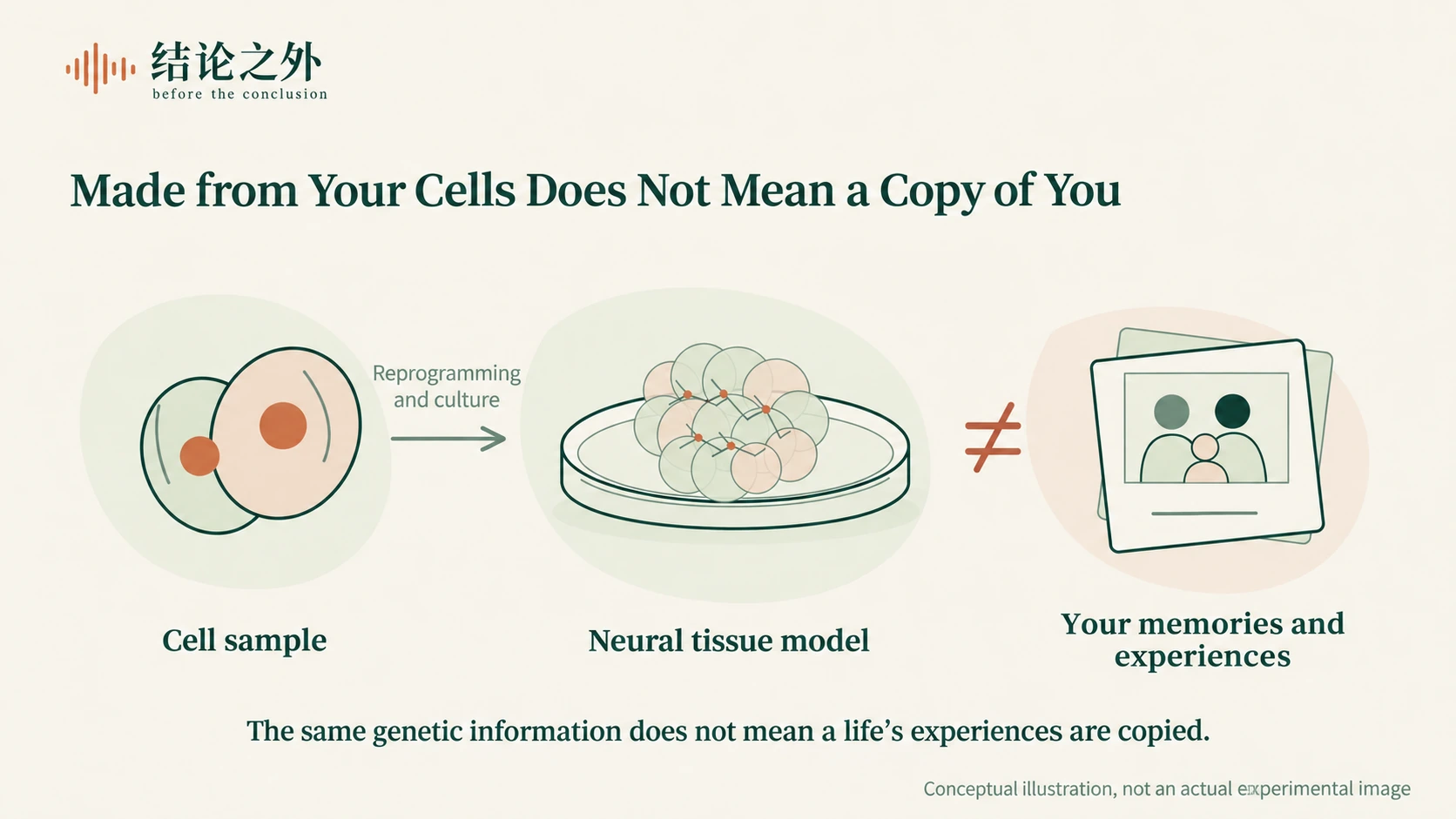
First, the most important point: growing neural tissue from your cells does not copy your memories into a dish. The technology redirects cell development; it does not copy the brain connections and patterns of activity formed over the course of your life. Carrying genetic information related to you is not the same as preserving your life experiences. [2]
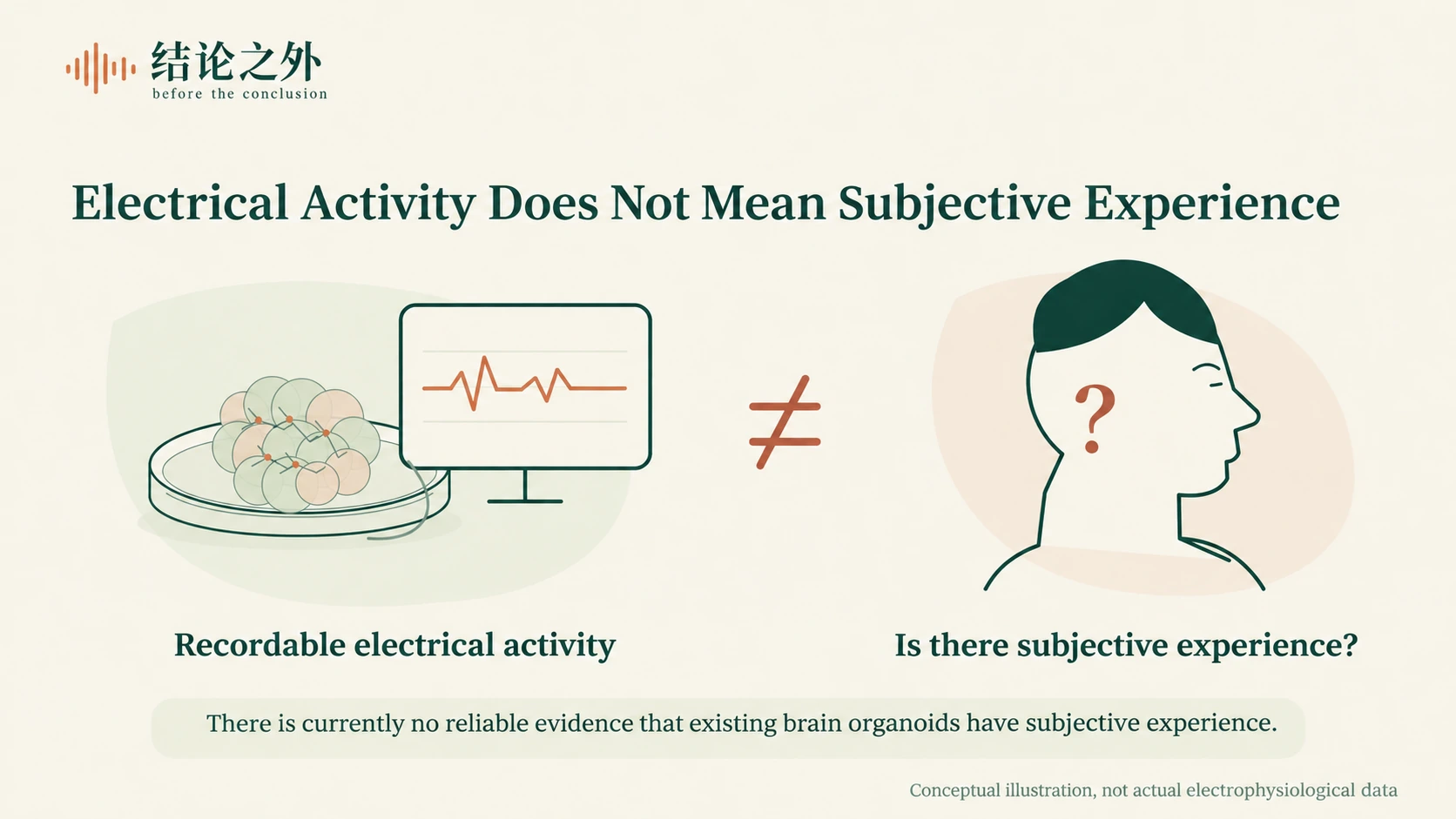
There is also currently no reliable evidence that existing brain organoids have subjective experiences such as pain or pleasure. A 2026 report from the UK's Nuffield Council on Bioethics concluded that current models do not yet have the biological complexity associated with this capacity for feeling. [12]
Even knowing this, however, may not answer all your questions.
If the cells are kept for many years, will I be able to find out what research they are used for later? If their use changes, will someone explain it to me again? And if these models one day become far more complex than they are today, what will my original consent mean?
You may still be willing to donate.
But you want that willingness to rest on understanding, rather than a vague assurance that it is “for science.”
At this point, the neural cells in the dish are no longer just a distant experimental object.
They bring questions of bodies, memory, trust, and choice into our lives.
1. It comes from me. Why is it not me?
A song you have not heard for years may remind you of a place where you once lived. You recall more than the melody: the people who were there, the light in the room, and how you felt at the time.
When we speak of “my memories,” these are often the things we care about: not an abstract body of information, but the way we have lived.
Neuroscience shows that encoding and recalling experiences involves activity in the brain's neural networks. In one study of human memory, researchers observed that some sequences of neuronal activity present when a memory formed reappeared during successful recall. This is not a complete account of memory, but it shows that personal experience is related to specific patterns of activity established in the nervous system. [3]
Growing neural tissue from skin or blood cells does not extract these activity patterns and transfer them somewhere else.
Researchers are doing something different: they give mature cells the characteristics of pluripotent stem cells again, then use culture conditions to guide their development toward neural tissue. The resulting models can have some of the cellular and structural features of the nervous system, but they are not miniature copies of their donors' brains. [2]
That is why “mini-brain” in the title needs quotation marks.
The name spreads easily, but it also invites misunderstanding. A nomenclature consensus published in Nature in 2022 explicitly recommended avoiding expressions such as “mini-brains” and “brains in a dish” in place of scientific descriptions of neural organoids. [2]
It comes from your cells, but it is not a smaller version of you.
This distinction deserves a moment's thought in everyday life too. What we value about ourselves is not only the material our bodies are made of, but the places we have been, the relationships we have built, and moments that no one else could live through for us.
Understanding this can remove one unnecessary worry.
But it raises another question: if these cells cannot preserve my memories, why do scientists grow them?
2. The aim is to understand why brains go wrong, rather than preserve your life
Imagine a family member with Alzheimer's disease who is gradually finding it harder to remember things that have just happened.
You start putting notes on the refrigerator, explaining the next day's plans again and again, and worrying that he may go out alone and lose his way on familiar streets. For a family like this, memory is never an abstract object of research. It shapes how a person lives, and how family members can continue to be there for him.
What you most want to know may not be the name of a particular protein, but why these changes happen, and whether there is any way to slow the disease.
To answer these questions, researchers cannot freely alter a gene in a human brain, add an experimental drug, and observe the results repeatedly. Human-derived neural cells and brain organoids offer a different route: study parts of a disease process in a model, then identify interventions worth investigating further. [2]
This research is not limited to rare diseases.
Researchers have, for example, used brain organoids grown from human cells to model some changes associated with Alzheimer's disease. In a 2021 study, they exposed organoids to serum to model one environmental change following damage to the blood–brain barrier, and observed related protein pathology and changes in neural function. But the model reproduced only parts of the disease; it cannot be treated as a complete patient's brain. [4]
This also means that an improvement in a measurement in the model does not establish that a patient's memory can be restored.
These models do not preserve people's lives for them. They help researchers understand why the nervous system that sustains everyday life can go wrong.
The same reasoning applies to rare-disease research.
In 2024, researchers used patient-derived neural models to test an experimental treatment for Timothy syndrome, and observed the correction of some cellular abnormalities. This illustrates an important research pathway: start with a patient's cells, observe a problem in a model, and test possible solutions. The results remain preclinical evidence, however, and cannot be equated directly with effective treatment in patients. [5]
A closer look | Optional research detail
Read on if you are interested in the experiment. Skipping this box will not interrupt the main argument.
Timothy syndrome type 1 involves a specific pathogenic variant in the CACNA1C gene. Chen and colleagues designed antisense oligonucleotides to modulate RNA splicing, reducing the use of exon 8A, which carries the pathogenic variant, and increasing the use of exon 8 in the resulting transcripts.
This does not directly rewrite DNA; it changes how cells assemble RNA. The study improved abnormalities in calcium signaling and neuronal migration in patient-derived cortical organoids and forebrain assembloids. Some cellular defects were also corrected in models transplanted into rat brains. These findings support further research, but cannot replace assessments of safety and efficacy in humans. [5]
End of research detail | Return to the main article
For patients' families, these experiments represent hope.
For donors, they mean that their cells might help others understand a disease.
Yet just as we begin to accept the idea that this is a research model, other news can make us hesitate: it not only produces electrical activity; it can even “play a game.”
Is it really just research material, then?
3. It produces electrical activity—and “plays a game”?
In 2019, a study reported that human cortical organoids developed increasingly complex network activity during culture. Some features of this activity resembled certain features in EEG recordings from premature infants. [6]
It is easy to make a leap on reading this: has it already acquired some kind of experience, like a baby?
But similarities in certain features of electrical activity do not mean that two systems have the same structure and functions, still less the same subjective experiences. The original study explicitly cautioned that electrical signals in organoids and scalp EEG were not measured under the same conditions and could not be equated directly. [6]
Another widely reported experiment was DishBrain, published in 2022.
Researchers connected cultured neural cells to a virtual ball-and-paddle game resembling Pong. Under specific feedback conditions, the network's activity changed adaptively and its ball-hitting performance improved. This experiment, however, used a two-dimensional cultured neuronal network, rather than three-dimensional brain organoids. [8]
“Cells can play a game” is a vivid description, but it may lead us to fill in a story the experiment did not establish: the cells saw the ball, understood the rules, and wanted to win.
The experiment did not demonstrate any of these things.
The paper's title also used the word sentience, but the authors defined it in terms of adaptive responses to stimuli. It should not be read as proof of subjective experiences such as pain or pleasure. [8]
A closer look | What did the electrical recordings and game feedback actually measure?
This box adds detail about the methods. You can also skip it and continue reading.
Trujillo and colleagues recorded extracellular signals, including local field potentials, from organoids using multielectrode arrays, then compared some statistical features with scalp EEG from premature infants. The spatial filtering produced by the scalp and skull, and the arrangement of neurons relative to electrodes, make the biophysical conditions of the two measurements substantially different. [6]
Low-frequency activity is not unique to conscious experience either. Pronounced low-frequency EEG activity can also occur during propofol anesthesia, for example. A particular waveform alone therefore cannot establish whether subjective experience is present. [7]
DishBrain used 8 input stimulation sites to encode information such as the ball's position, and converted neural activity in designated output regions into paddle movements. Predictable or random feedback stimulation formed a closed loop designed by the researchers. The experiment demonstrated adaptive changes under specific conditions; it did not directly measure whether the cells “felt” the game. [8]
End of research detail | Return to the main article
Making these distinctions does not diminish the experiments.
Growing neural tissue, recording its activity, and studying how it responds to feedback have scientific value in their own right. We do not need to add an interpretation that it “can already think” to recognize that value.
But two questions now need to be kept separate:
“Could it become me?” and “Could it develop feelings of its own in the future?” are different questions.
The source of the cells does not establish the answer to the first.
Electrical activity or adaptive changes alone cannot answer the second.
4. Why discuss feelings when there is no evidence of them?
We need to define what “feeling” means here.
In this article, sentience means having subjective experiences, such as pain or pleasure, rather than merely receiving signals and producing responses. We are not asking whether a system possesses language, personality, or a complex sense of self. We are asking whether there is any state that the system itself experiences.
According to the Nuffield Council's 2026 report, current neural organoids do not yet possess the biological complexity associated with this capacity. But the report also called for shared definitions and research into which model characteristics should trigger closer ethical scrutiny. This indicates that the methods and boundaries of the discussion still need development. [12]
We therefore cannot find a single number and declare the question settled: days in culture, cell numbers, and numbers of electrical discharges cannot individually serve as universally applicable criteria.
A distinction from everyday life may help.
Responding to something and finding it painful are two different levels of description. The first can be observed from outside; the second also concerns your own experience. With people who can communicate, we can listen to what they say. With cultured neural tissue, researchers face a much greater difficulty.
This does not mean that we can imagine feelings into existence.
Nor does it mean that, because we cannot ask the tissue directly, we can set the question aside forever.
The current absence of evidence is not an invitation to create fear. It calls for judgments grounded in current evidence, alongside a clear account of what new evidence would warrant reconsideration.
There is also a more immediate change: these tissues do not necessarily stay in a dish.
5. The questions change if it enters an animal's brain
Return to the consent form at the beginning.
If the researchers added that your cells might be grown into neural tissue and then transplanted into a laboratory animal, would you still be willing?
This is not merely a distant hypothetical. Human-derived neural organoid transplantation research already exists, with the aim of studying how these cells develop, connect, and function in a living environment. In 2026, one study observed that human-derived cortical organoids could grow and establish connections with the host nervous system in a specialized mouse model. [9]
This is not “putting a person's thoughts into a mouse,” and it did not show that the animals acquired the donor's memories.
What changes is that previously relatively isolated cellular tissue enters a living environment with a blood supply, other neural cells, and connections to a body. The conditions of the research object have changed, so the assessment must change accordingly.
A closer look | What exactly did this transplantation study do?
Read this box if you are interested in the experimental design.
In a study published in Nature on September 16, 2026, Kaganovsky and colleagues used a genetic strategy to remove large numbers of excitatory neurons from the mouse neocortex and hippocampus, then transplanted human-derived cortical organoids into the brains of young mice. They observed graft growth, the formation of different human cortical cell types, and integration with the host nervous system.
The study also assessed host-animal behavior and incorporated ethical consultation and animal welfare monitoring. The findings provide a new platform for studying human-derived neural tissue, but do not establish the presence of human subjective experience or that the graft formed an independent subject capable of feeling. [9]
End of research detail | Return to the main article
For donors, the question is whether they understand and agree to this use.
For researchers, the questions are why the experiment requires this design, whether a simpler model would suffice, and how possible risks will be monitored.
For laboratory animals, welfare protections certainly need not wait until the human-derived tissue is proven to be sentient. The host animals already need protection in their own right.
The ethics here therefore cannot be reduced to the isolated question of whether consciousness is present. Even if we temporarily set that unresolved issue aside, many concrete responsibilities remain.
6. I am willing to support research, and I want to know its boundaries
A person may fully understand that the cultured neural tissue is not another version of themselves, yet still care how it will be used.
They may support disease research but want to know whether commercial partnerships are involved; agree to donate a sample but want to understand how long it will be kept; accept sharing with other laboratories but want to know what withdrawing consent can actually accomplish after sharing has taken place.
These questions do not necessarily express mistrust of science.
They may show that a person is taking their consent seriously.
In 2021, Bollinger and colleagues reported 60 in-depth interviews with adult patients and parents of pediatric patients at a US academic medical center. Participants broadly supported organoid research, while tending to regard brain organoids as having particular moral significance. They emphasized legitimate research purposes, ethical oversight, and adequate informed consent. [10]
This was not a representative survey of the general public and cannot establish what everyone thinks.
But it illustrates that supporting research and asking for boundaries can coexist.
A 2025 interdisciplinary consensus further proposed that researchers explain how cells and data will be shared, and what sharing arrangements mean for withdrawal of consent. Stopping future distribution, for example, is different from retrieving samples already provided to other institutions. Researchers cannot make a blanket promise that “everything can be withdrawn at any time.” The specifics need to be explained in light of the research arrangements and consent documents. [11]
This is a very practical matter.
If, when signing, someone believes their samples will always remain in one laboratory and can be retrieved at any time, while the actual research arrangements say otherwise, the issue is not simply how much neuroscience they understand.
It is also whether they truly understand what they have agreed to.
Oversight, too, must extend beyond the initial signature.
The Nuffield report recommended that research institutions register relevant projects and update their records when research plans change; that consent materials describe reasonably foreseeable uses of neural organoids; and that animal studies involving human tissue transplantation also receive updated welfare review. These are the report's governance recommendations, rather than uniform international regulations already in force. [12]
International discussion is also moving forward. Researchers, ethicists, patient advocates, and others met at Asilomar in November 2025. A resulting report, released in September 2026, proposed an ongoing global oversight mechanism that could adapt as research develops. It did not declare that current models are sentient. It asked who should watch for change and how that change should be addressed. [13]
Ethics then moves from a general call to “be cautious” to questions we can actually ask:
Is the research documented? What have donors been told? Who reassesses a project when its protocol changes? Who is responsible for acting if concerning changes emerge?
These questions are closer to present reality than waiting for a sensational “moment of awakening.”
7. Finally, back to the pen that has not yet touched the page
Now return to the beginning of the article.
You are sitting at a table with a cell-donation consent form in front of you.
You know that growing neural tissue from your cells does not mean copying your memories or creating another you in the laboratory. You also know that electrical activity and adaptation to feedback are insufficient to establish that a model has subjective experiences.
At the same time, you are beginning to understand why people want this research to continue.
They may be searching for the cause of a child's illness, caring for a family member who is gradually losing their memory, or simply hoping that people facing similar difficulties in the future will have more options than they do today.
These hopes deserve serious attention, but cannot justify skipping explanations or oversight.
You may eventually sign, or you may still need more information.
What matters is not that this article decides for you, but that you have the opportunity to understand what you are supporting.
Cells in a dish do not automatically become another you because they came from you. But research connected to you still deserves a careful explanation to you.
And patients waiting for new treatments should not appear only in the background section of a paper. Their needs should be part of discussions of research and ethics, while they are protected from unproven promises.
This science matters to ordinary people for more than the possibility that it may one day treat a particular disease. It also asks whether, as our bodies become sources of ever more complex research materials, we can still understand, participate in, and trust the process.
We do not have to become neuroscientists before we have a right to care about this question.
Science, likewise, does not need to present every advance as a miracle for us to recognize its value.
Sometimes the most trustworthy explanation is the one that distinguishes several things clearly: what has been achieved and what remains unknown; which risks belong to the present and which are possibilities that need continued observation in the future.
Bringing science closer to everyday life means helping us see what these findings actually change, and what choices they place in our hands, rather than offering ever more astonishing assertions.
There can be different answers to whether that pen finally touches the page.
But understanding should always be part of the decision.
Main references
1. Belblidia N. As Brain Organoid Science Grows More Complex, So Do the Questions. Undark, February 26, 2026. The reporting that served as the starting point for this article. https://undark.org/2026/02/26/brain-organoids-big-questions/
2. Pașca SP, et al. A nomenclature consensus for nervous system organoids and assembloids. Nature. 2022;609:907–910. DOI: 10.1038/s41586-022-05219-6. https://doi.org/10.1038/s41586-022-05219-6
3. Vaz AP, Wittig JH Jr, Inati SK, Zaghloul KA. Replay of cortical spiking sequences during human memory retrieval. Science. 2020;367:1131–1134. DOI: 10.1126/science.aba0672. https://doi.org/10.1126/science.aba0672
4. Chen X, Sun G, Tian E, et al. Modeling Sporadic Alzheimer’s Disease in Human Brain Organoids under Serum Exposure. Advanced Science. 2021;8:2101462. DOI: 10.1002/advs.202101462. https://doi.org/10.1002/advs.202101462
5. Chen X, Birey F, Li MY, et al. Antisense oligonucleotide therapeutic approach for Timothy syndrome. Nature. 2024;628:818–825. DOI: 10.1038/s41586-024-07310-6. https://doi.org/10.1038/s41586-024-07310-6
6. Trujillo CA, et al. Complex Oscillatory Waves Emerging from Cortical Organoids Model Early Human Brain Network Development. Cell Stem Cell. 2019;25:558–569.e7. DOI: 10.1016/j.stem.2019.08.002. https://doi.org/10.1016/j.stem.2019.08.002
7. Purdon PL, et al. Electroencephalogram signatures of loss and recovery of consciousness from propofol. PNAS. 2013;110:E1142–E1151. DOI: 10.1073/pnas.1221180110. https://doi.org/10.1073/pnas.1221180110
8. Kagan BJ, et al. In vitro neurons learn and exhibit sentience when embodied in a simulated game-world. Neuron. 2022;110:3952–3969.e8. DOI: 10.1016/j.neuron.2022.09.001. This article retains the paper's original title but does not interpret its use of “sentience” as proof of subjective experience. https://doi.org/10.1016/j.neuron.2022.09.001
9. Kaganovsky K, Kelley KW, Gschwind T, et al. Developmental xenocortication using human-derived organoids in mice. Nature. 2026;658:430–441. Published online September 16, 2026. DOI: 10.1038/s41586-026-11032-2. https://doi.org/10.1038/s41586-026-11032-2
10. Bollinger J, May E, Mathews D, Donowitz M, Sugarman J. Patients’ perspectives on the derivation and use of organoids. Stem Cell Reports. 2021;16:1874–1883. DOI: 10.1016/j.stemcr.2021.07.004. https://doi.org/10.1016/j.stemcr.2021.07.004
11. Cohn B, et al. Transparency and ongoing communication with participants in brain organoid research: Consensus of an interdisciplinary working group. Stem Cell Reports. 2025;20:102546. DOI: 10.1016/j.stemcr.2025.102546. https://doi.org/10.1016/j.stemcr.2025.102546
12. Nuffield Council on Bioethics. Neural organoids: Ethical and governance considerations. May 12, 2026. https://www.nuffieldbioethics.org/publication/neural-organoids-ethical-and-governance-considerations/
13. Toward Global Oversight of Human Neural Organoid and Assembloid Research. Released in 2026, following the Asilomar meeting of November 10–12, 2025. The meeting was convened by Sergiu Pașca and Henry (Hank) Greely, with support from Stanford University's Wu Tsai Neurosciences Institute and the Dana Foundation. https://dana.org/resources/toward-global-oversight-of-human-neural-organoid-and-assembloid-research/
This article was conceived and written by Before the Conclusion, taking Undark's in-depth reporting as a starting point and drawing on original research, professional consensus statements, and ethics reports. It is not a translation of that report. The opening donation scenario and everyday situations in the article were constructed to aid understanding and do not correspond to any particular real participant. This article does not describe existing brain organoids as individuals with subjective experience, or equate preclinical results with treatments validated in patients.
Medicine · Science · Ideas and Reading
Follow Before the Conclusion,
and keep exploring with curiosity and independent thought.
Text and image use
The text of this article was conceived and written by Before the Conclusion; sources for the research and other material are identified. The illustrations were conceived by Before the Conclusion and created with AI tools; all are conceptual illustrations. You are welcome to share the link to this article. Without separate permission, please do not copy, republish, repost screenshots, or use the images separately. Commercial use is not permitted.