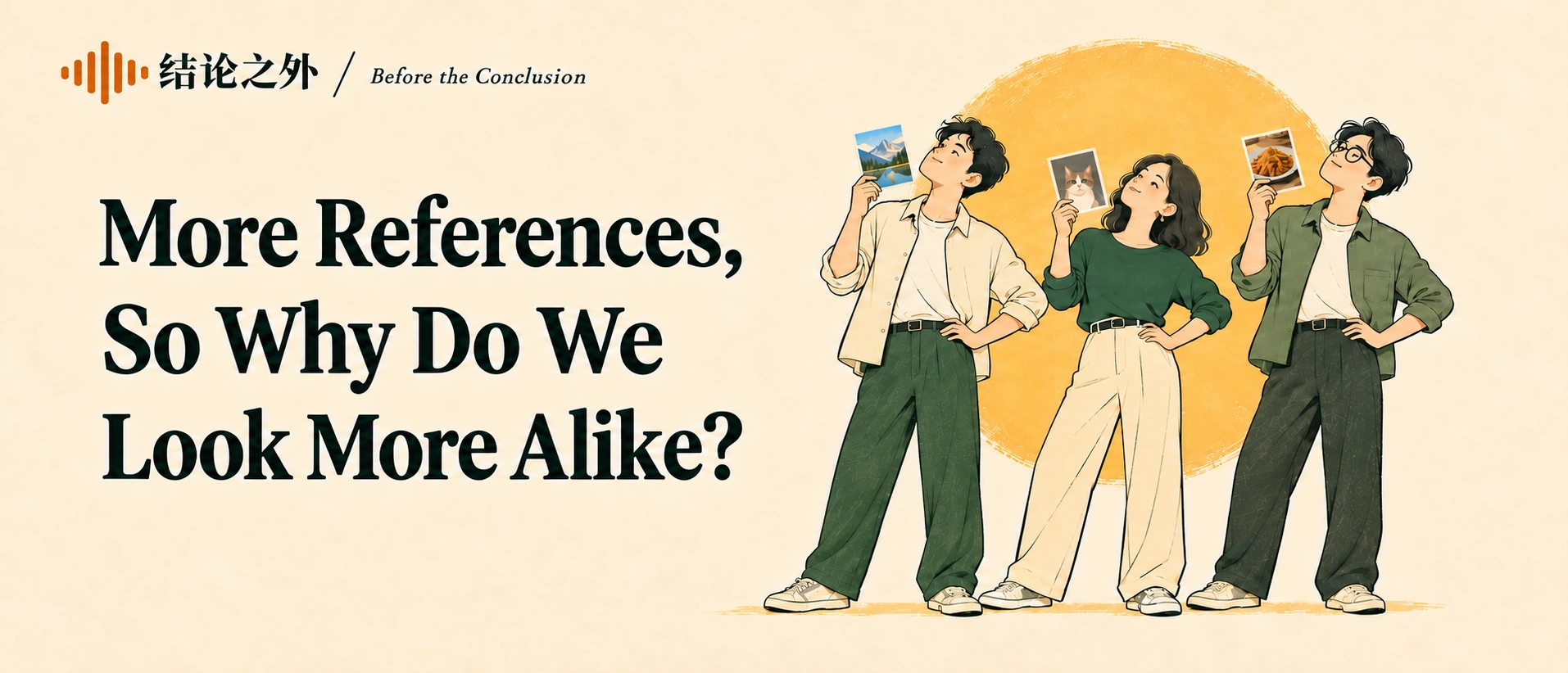
Before setting out, we have already seen the photograph.
The hillside belongs behind us. The person should stand on a particular side of the frame. There is a best hour for the light. The nine-photo grid still needs a coffee, a figure seen from behind, and a local dish. Once we arrive, we follow the guide to the spot, wait a little, and place ourselves inside that familiar picture.
These references really are useful. They save us time spent finding our way, make a rare holiday easier to organize, and help people who know little about photography take pictures they like. Yet occasionally, looking through different people's travel records produces a strange feeling: different people went, but the lives they brought back look so similar.
Something similar happens with clothes. Before we have even put them on, labels such as “effortless” or “old money” have already supplied an interpretation. These names help us find an atmosphere we like. They may also gradually lead us to check whether our lives look the part.
This does not necessarily mean we are losing our individuality. The internet also brings people together around interests that were once hard to discover, and shows us other ways to live. One question nevertheless deserves a pause: as references become easier to obtain, are we using them to explore our own lives, or growing more accustomed to letting them decide for us?
Visible choices become conditions for the next choice
We have never formed our tastes alone. A writer recommended by a friend, a brushstroke demonstrated by a teacher, or an unforgettable performance may all change our later choices. Learning needs other people, and people need a shared language.
The difficulty often arises when this process goes too smoothly. We receive an answer without going through the process that produced it. We learn to recognize a style before understanding why it suits us. Over time, familiarity can create a sense of reliability that we no longer examine.
In 2006, a study published in Science placed social influence in a setting where comparisons could be made. More than 14,000 participants listened to songs by unfamiliar bands. Some could see what other people had downloaded; others could not. Those who could see download information were divided into several independent markets, each starting with the same songs.[1]
Social influence widened the popularity gap between songs, but the songs that became hits differed across markets. Success was also only partly determined by quality: the best songs rarely finished last and the worst rarely finished first, while outcomes in the middle could vary. The popularity people saw helped shape the popularity that followed.[1]
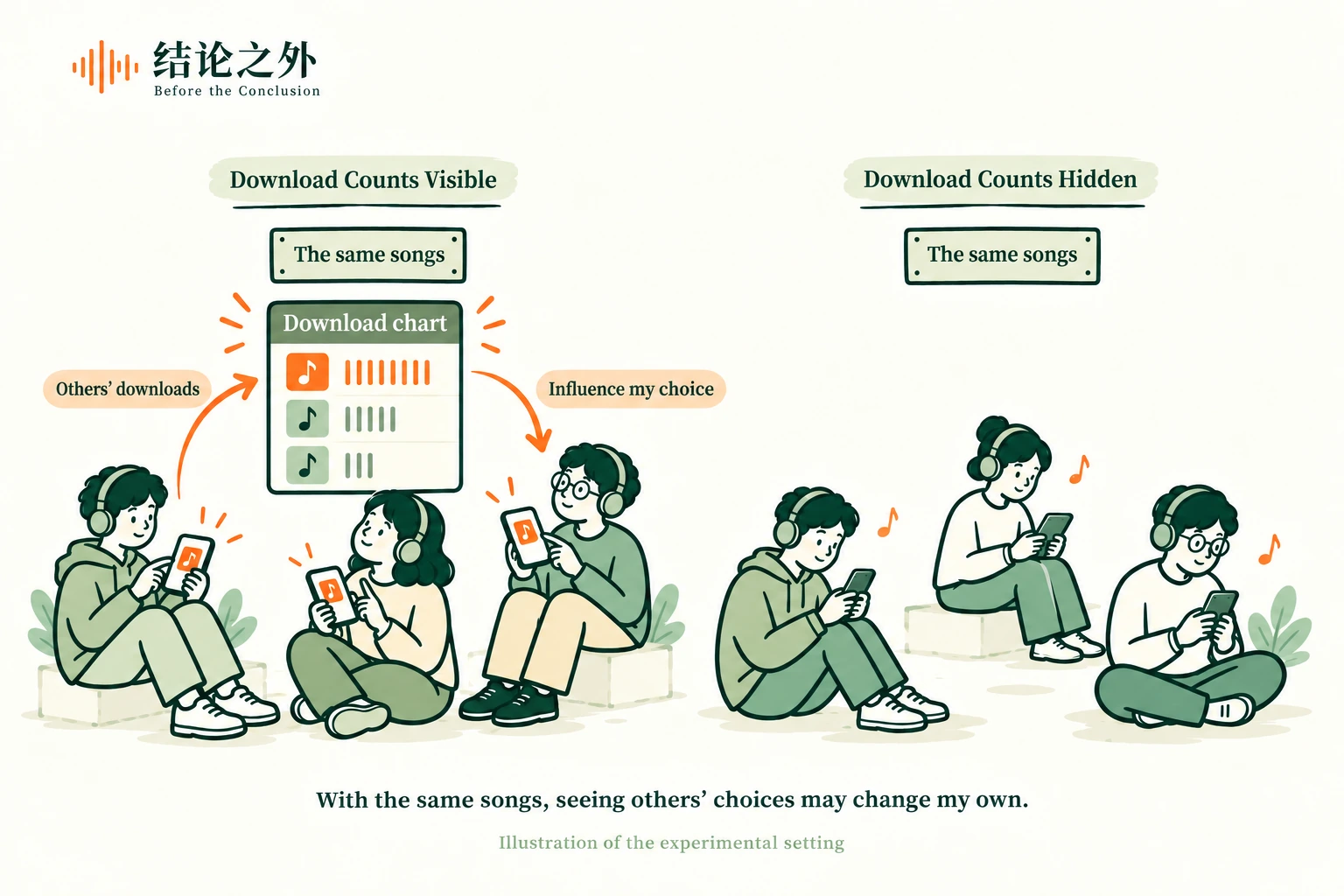
The experiment studied a music market. It cannot directly explain travel photographs, and certainly did not measure who had “lost themselves.” Its insight is that other people's choices, once visible, may become conditions influencing our own. The popularity that results may be more than the aggregation of many preferences that were identical all along.
In everyday life, a photograph may begin as one person's interpretation of a landscape. After being shared, saved, and imitated, it gradually becomes the answer to “how this place should be photographed.” Before even seeing the actual scenery, later visitors may already know which way of seeing is most likely to win approval.
Examples can also draw invisible boundaries
This influence can be subtler than following popularity.
In 1991, Jansson and Smith investigated “design fixation” through design tasks. After seeing one solution, people's new designs tended to retain its features, sometimes even carrying over problems that had already been pointed out.[2] An example can help thinking begin while also keeping it close by.
Later research makes the story more interesting. A 2020 experiment compared novice engineering designers shown an external example with others who first generated a solution themselves. The researchers examined how each group's later ideas depended on its own starting point: the external-example group was assessed against the supplied example, and the self-generated group against its own initial design. In this comparison using different reference points for each group, those who had not seen an external example showed stronger dependence on their first idea.[3]
The problem therefore cannot be reduced to “someone else influenced me.” Answers that once satisfied us can also become reasons to stop asking. The two experiments used different tasks and assessments, so they cannot be combined into a universal law. Together, however, they remind us that an original starting point does not guarantee that subsequent thinking stays open.
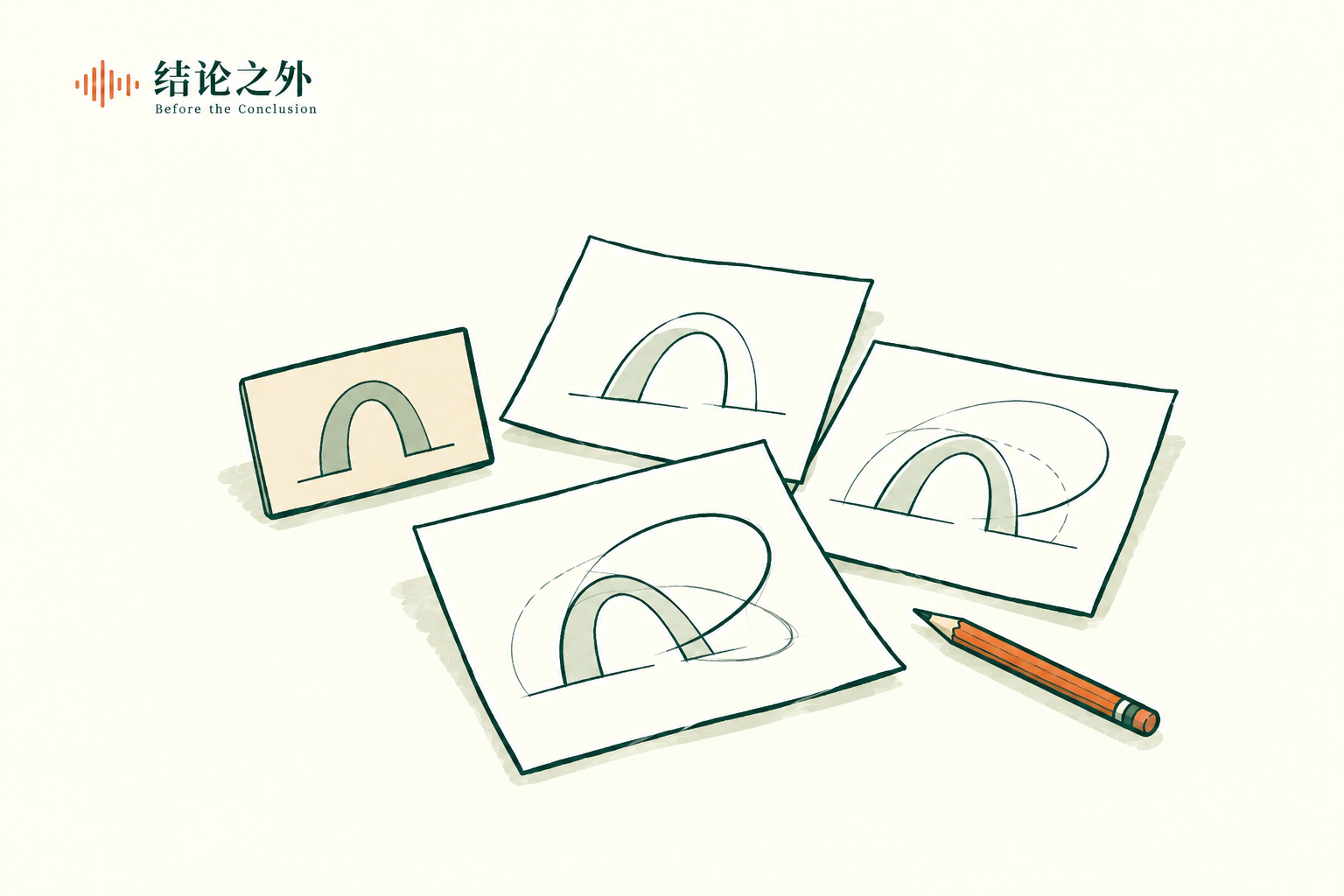
We can repeatedly imitate others, and we can repeatedly imitate our former selves. “I have always been this way” can sometimes prevent new experience from entering just as effectively as “everyone does it.”
In life, such boundaries need not appear as prohibitions. They may simply mean returning to the same imagined persona whenever we buy clothes, requiring every new book to confirm an old judgment, or first checking whether everything we say fits the person others already know.
When tradition becomes a finished image too
Learning traditional culture encounters the same problem.
Some people begin with calligraphy, drawn to paper, ink, and brushstrokes. Others wear a qipao and enjoy the relationship between its cut and the body. Others read classical prose, initially attracted by its sound and rhythm. These experiences have value in themselves. An interest does not first need to prove that it makes us morally better to deserve a place in our lives.
But there is a large step between “I like this form” and “this form proves I am cultivated.” Copying models can train brushwork, and reading can build knowledge. How someone handles disagreement, takes responsibility, or treats vulnerable people still requires separate practice in everyday life.
In On the Use and Abuse of History for Life, Nietzsche discussed reverence for the past. He understood why people cherish their origins, while warning against an excessive impulse to preserve: when age alone becomes a reason for respect, new life may be suppressed.[4] His subject was history and life. Applying that perspective to cultural learning today, we can ask whether respect for the past still allows people in the present to choose.
The poet and critic T. S. Eliot, in Tradition and the Individual Talent, likewise rejected the idea that tradition means blindly following the successes of predecessors. He argued that tradition must be acquired through the work of understanding, and that new works also change relationships among old ones.[5] This was an argument about literary creation, but it offers an open possibility: those who enter a tradition may also help shape its continuation.
It is therefore worth distinguishing when a model used in learning turns into a template for life. A model can be practiced, understood, and modified repeatedly. Once a template becomes an identity requirement, we may begin to worry that the slightest departure will mean we no longer look like someone who “understands tradition.”
An ideal life may grow through living
When reading Calvino's The Baron in the Trees, my first note was: this is a book bursting with vitality.
After a dispute with his family over a meal of snails, Cosimo climbs into the trees and spends the rest of his life among them. But what fills the novel with life is the world that gradually unfolds up there: books, friends, work, love, ideas, and involvement in public affairs.[6]
In my reading, he does not begin with a complete manual for an ideal life. He makes a choice first, then explores its possibilities through years of action. The branches do not do the living for him. He still has to discover, again and again in practice, how to relate to others and commit himself to things.
This contrasts with the life references familiar to us. A photograph usually offers an already completed instant. We see light falling on a desk, orderly bookshelves, and a quiet window. We do not see how someone slowly formed habits, grew bored, adjusted their arrangements, and chose to continue.
When we borrow these images, it is easy to mistake the outcome of sustained practice for a life we can enter simply by arranging things correctly. Furnishing a room to resemble a reader's room may then feel more urgent than finding books we want to keep reading. Trying to display ease may make us monitor every gesture more closely.
What Cosimo leaves me feeling is this: “Keeping one's feet off the ground does not mean being removed from ordinary human life.” His distance makes another kind of participation possible. It also makes me value a space that need not constantly be calibrated from outside: sometimes reading, sometimes looking at trees, sometimes speaking seriously with another person, and slowly discovering which desires deserve a lasting commitment.
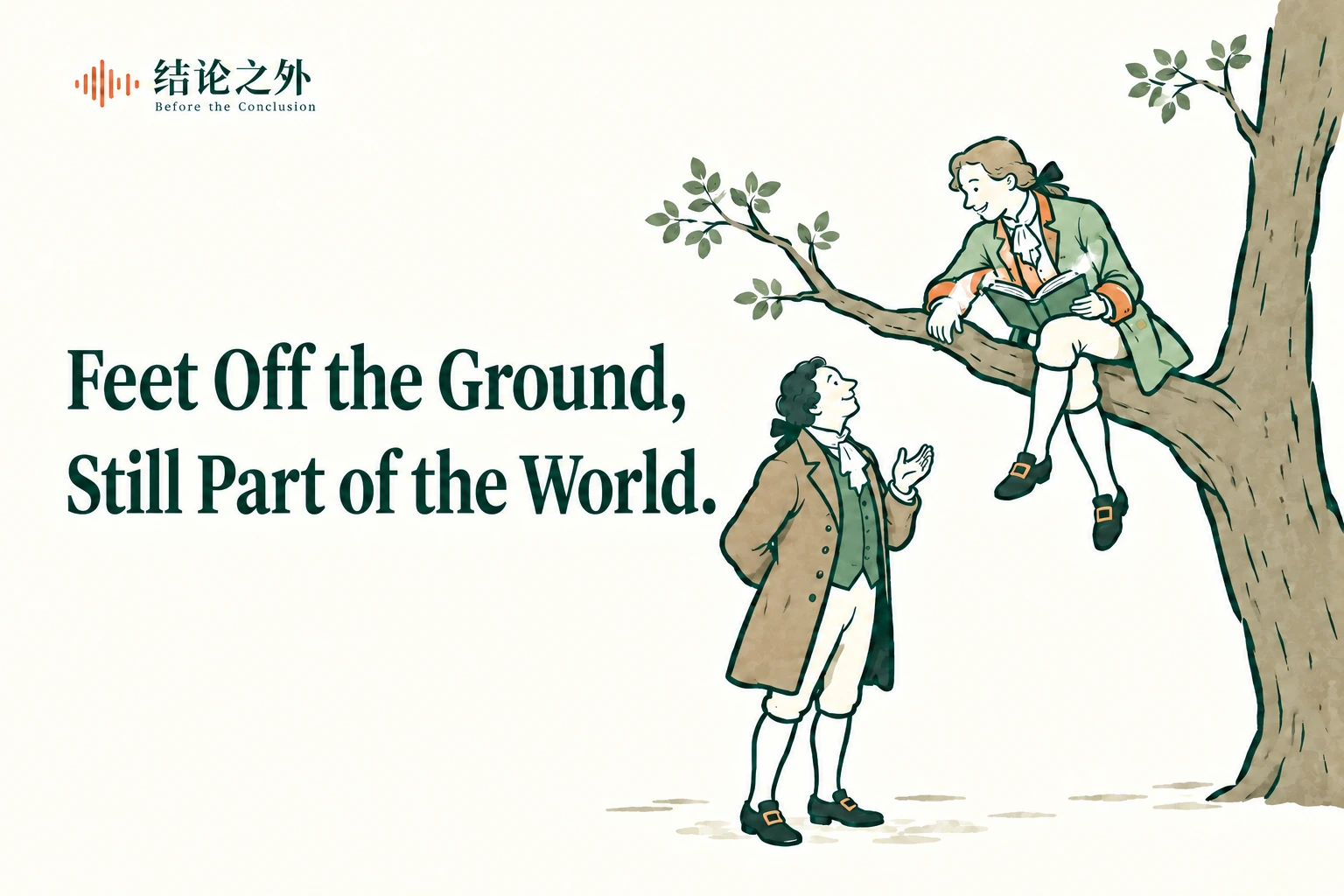
Of course, we do not need to copy his way of living. Even “insisting on being different” can become another demand. A person's freedom should allow them to change their mind later. It should also allow them, after serious reflection, to discover that they happen to like a life many other people like too.
Leave some room for the self that has not yet taken shape
Perhaps, after finding a reference, we can pause for one more step.
What attracts me to this photograph: its light, its colors, or the identity it suggests? What difficulty does this way of organizing life solve for me, and what conditions does it overlook? Do I want to keep doing this because the activity feels fulfilling, or because it brings me closer to an image worth being seen?
None of these questions can be settled by an immediate self-check. Our desires already mingle curiosity, vanity, belonging, and real enjoyment, and they change through practice. Acknowledging the mixture can spare us the rush to give ourselves a pure and correct explanation.
References can also take us somewhere else. We set out to learn a single written character, then read about the circumstances of the person who wrote it. We visit a hillside for one photograph, then discover that we want to put down the phone and walk a little farther. An action that starts in imitation may gradually develop an understanding of its own.
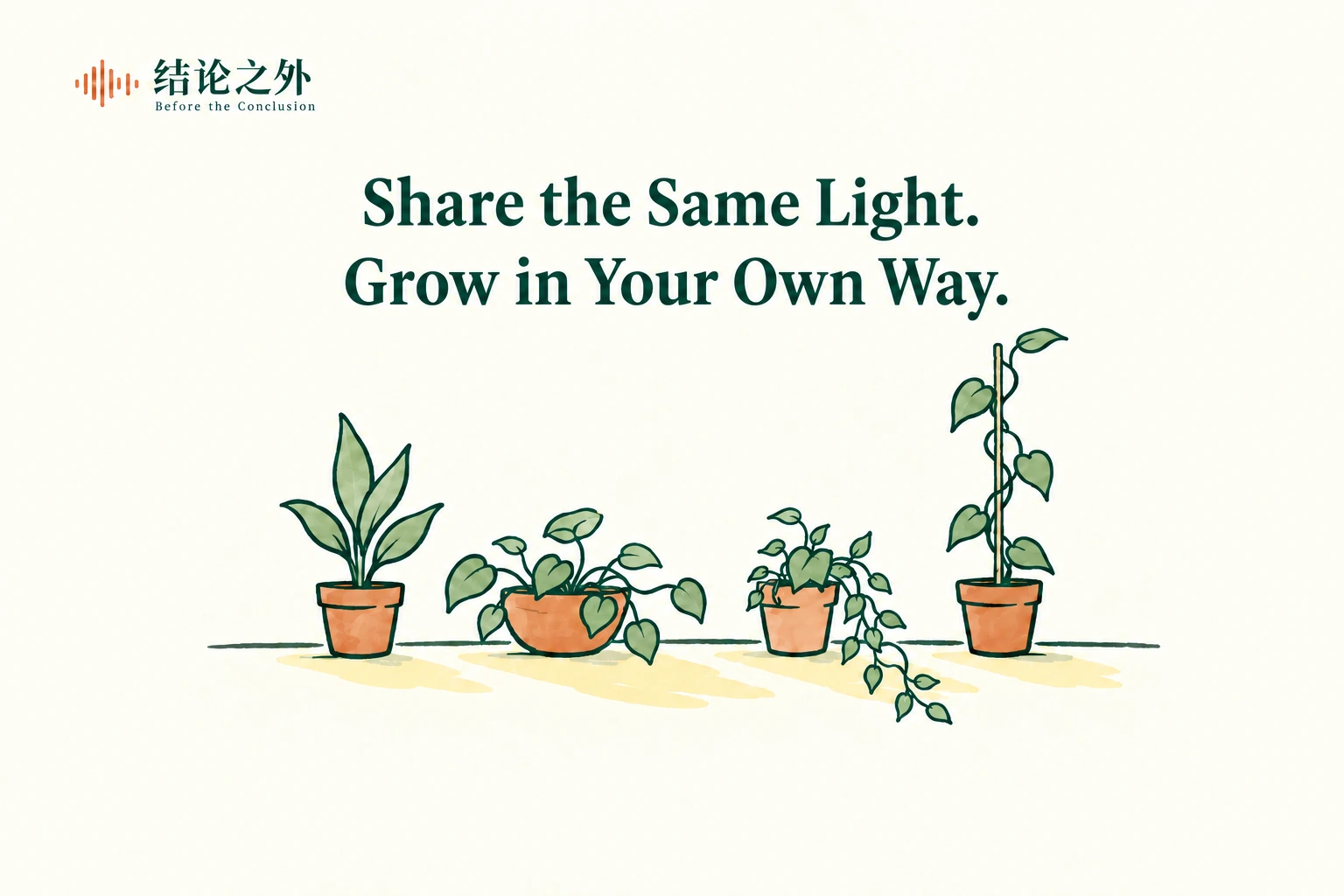
After spending time with tradition, with books, and with other people's lives, do we have more ways to understand living, while retaining the freedom to grow into ourselves?
That seems worth continuing to ask whenever we borrow.
Further reading and sources
- Matthew J. Salganik, Peter Sheridan Dodds, and Duncan J. Watts, “Experimental Study of Inequality and Unpredictability in an Artificial Cultural Market,” Science 311, no. 5762 (2006): 854–856. DOI: 10.1126/science.1121066. This article draws on the study only to discuss how visible social information affects choice, without extending its findings into a complete explanation of online life.
- David G. Jansson and Steven M. Smith, “Design fixation,” Design Studies 12, no. 1 (1991): 3–11.
- Keelin Leahy, Shanna R. Daly, Seda McKilligan, and Colleen M. Seifert, “Design Fixation from Initial Examples: Provided versus Self-Generated Ideas,” Journal of Mechanical Design 142, no. 10 (2020). DOI: 10.1115/1.4046446. The two groups were assessed against different reference points. This article does not interpret the findings as an absolute comparison of fixation on a single common scale.
- Friedrich Nietzsche, On the Use and Abuse of History for Life, the second of the Untimely Meditations, 1874. English translation.
- T. S. Eliot, Tradition and the Individual Talent, 1919. Original English text. This author is a different person from George Eliot.
- Italo Calvino, The Baron in the Trees, 1957. The reading impressions in this article come from the author's own reading notes; the discussion of the character's meaning is the article's interpretation.
Text and image use statement
The text of this article was written originally by Before the Conclusion. Copyright in the works and research cited belongs to the respective rights holders. You are welcome to share the article's web link. Without separate permission, please do not copy, repost, adapt, or commercially use the text or original illustrations. The illustrations were planned by Before the Conclusion and produced with the assistance of AI tools. Do not separately republish, copy, modify, or commercially use them without permission.