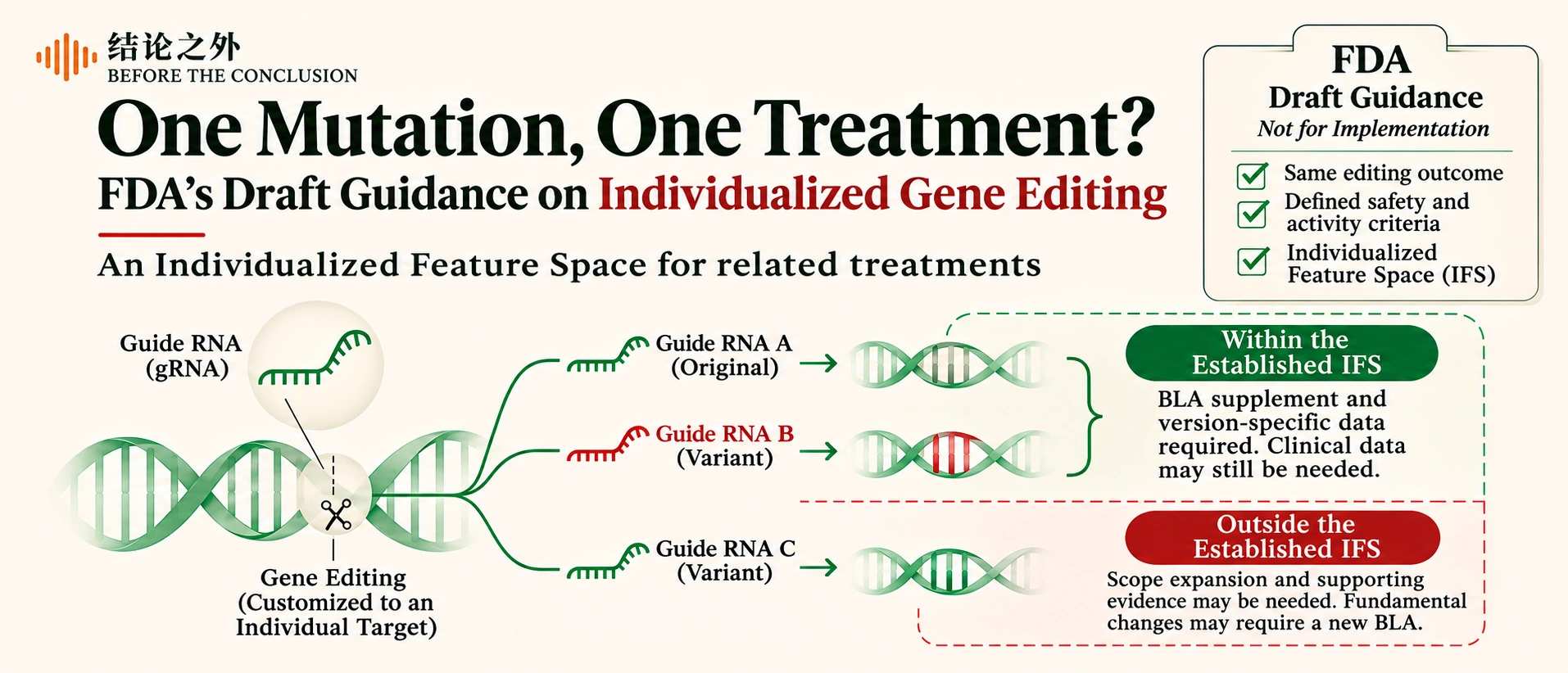
Imagine that a research institution develops a gene-editing medicine capable of correcting a disease-causing variant in a gene. The first patient’s variant is at one location, and the researchers design a guide RNA to direct the editing tool to the target DNA.
A second patient has the same disease, but the variant is at a different location. The researchers retain the same editing technology and delivery system and redesign the guide RNA.
Now comes the question: is the second patient’s treatment a new version of the original medicine, or must it be submitted as an entirely new drug?
This is a hypothetical example to explain the issue, not a product that has already been approved.
On October 27, 2026, the FDA released draft guidance on individualized human genome editing products, seeking to explain how multiple treatment versions could be organized within one biologics license application and how new versions could be added after approval.[1][2][3]
1. The FDA has not announced that “one platform can directly approve a hundred drugs”
The draft does not say that once one product is approved, other versions can be used directly simply because they use the same gene-editing technology.
It addresses qualifying individualized gene-editing products. Its main scope includes monogenic diseases caused by known pathogenic variants, with product versions in the same application intended to achieve the same editing outcome. A scientific justification is needed to include multiple versions in one biologics license application, or BLA.[1]
The draft introduces the Individualized Feature Space, or IFS. It defines how editing components may vary and which changes remain within the established product boundaries.
This is not an “evidence space” that exists simply because it has been given a name. It requires supporting clinical data and clearly defined laboratory criteria for safety and activity. Other key features, such as product specifications, formulation, in vivo delivery vehicle, or the cell type used for ex vivo editing, should also remain consistent.[1]
Think of it as an evidence-supported boundary: which components may change, and by how much, must be described in advance. Each new version must then demonstrate that it falls within those limits, rather than merely claim to “belong to the same platform.”
2. Four situations, four different questions
| Situation | Basic approach in the draft |
|---|---|
| Initial BLA containing multiple versions | Establish clinical and product evidence sufficient to support the application’s scope. This draft itself does not provide a clinical trial design applicable to every program. |
| New version added after approval, within the established IFS | Submit a BLA supplement and experimental data for the new version. Repeating clinical studies for that version may not be necessary when the relationship between in vitro results and clinical safety and effectiveness is sufficiently clear and predictable. |
| New version outside the IFS, without a fundamental design change | Apply to expand the scope and provide evidence appropriate to the change and its risks. Whether additional clinical data are needed depends on the circumstances. |
| Fundamental design change, or introduction of significant new or unknown risks | This may constitute a different product, requiring a new BLA and corresponding clinical evidence. |
This summarizes Sections III and VI of the draft; it is not a new approval rule already in effect.[1]
Being outside the established scope does not automatically mean “everything must be done again”; being inside it does not automatically mean “no further validation is needed.” Evidence requirements depend on the nature of the change and whether existing knowledge is sufficient.
3. Which evidence can be shared, and which cannot?
Some knowledge may be reusable, such as certain characteristics of a shared delivery system, known risks of the same editing mechanism, and some experience with manufacturing processes and quality control.
But changing the guide RNA changes the DNA location recognized by the editing system. A new combination may produce different unintended edits. The draft therefore emphasizes activity and safety assessments for individual product versions, including analyses at the intended site and of off-target effects.[1]
In other words, “changing the address” is only an explanatory metaphor. It cannot justify assuming that the risks are unchanged.
In vitro experiments can help assess a new version, but do not replace human evidence in every situation. Under the draft, if the relationship between in vitro results and clinical safety and effectiveness is not sufficiently clear and predictable, the supplement should still contain adequate clinical data from people treated with that version.[1]
What must actually be demonstrated is why versions previously studied in clinical trials can represent the key differences and expected risks of versions added later. Studying a few designs likely to succeed does not justify extending the conclusions without limit.
What can be shared is evidence that can justifiably be extrapolated, not trust in every future version.
4. Planning future changes in advance
The draft recommends that developers consider submitting and obtaining approval for a postapproval change management protocol, or PACMP.[1]
Its purpose is to specify in advance which changes are planned, what studies each change will require, which criteria will be used to assess them, and the reporting category for submissions to the FDA. When a new version is developed, data can then be submitted under a previously discussed protocol rather than negotiating from scratch each time.
This makes development and review more predictable; it does not remove regulatory oversight.
As described in the draft, adding a new version still requires the appropriate BLA supplement process. Applicable manufacturing quality and release requirements should also be met before commercial distribution, and product names, labeling, and version identification must be sufficiently clear.[1]
5. Why does this matter especially to people with rare diseases?
Some pathogenic variants occur in very few patients. Even when designing a treatment is technically possible, establishing a completely separate conventional development program for every variant may be extremely difficult.[3]
The draft explores how earlier research can help later patients within defined limits. Representative clinical data, combined with experimental testing specific to a new version, may reduce unnecessary repetition.[1][3]
As an economic inference, this may make developing treatments for some ultra-rare variants more feasible. But it does not establish how much costs have already fallen, whether patients have secured coverage, or how much a particular company’s revenue will increase.
Reliable manufacturing, clinical centers’ ability to deliver treatment, long-term safety monitoring, and who will pay remain separate questions. A clearer approval pathway does not mean all of these issues have been resolved.
6. The real questions the draft leaves open
As of November 7, 2026, the document remains a draft. The FDA website explicitly labels it “Not for implementation,” with public comments due by November 27. Draft guidance is not product approval. Even when finalized, guidance recommendations cannot replace the approval requirements that a specific product must satisfy under the law.[2][4]
In addition, this draft focuses on organizing applications and managing versions after approval. It does not prescribe a single clinical study design for every program or determine whether every product should follow accelerated or traditional approval.[1]
Traditionally, a medicine generally has a relatively fixed design. Individualized gene editing raises another possibility: the core design remains consistent while some components are adjusted to a patient’s variant.
Should approval be organized around each wholly separate version, or around a family of products with an established evidentiary boundary?
The FDA draft’s direction is not to give every version a shared presumption of trust. It asks developers to explain which knowledge can be shared and which new risks must be tested.
Reducing repeated research does not begin with lowering the burden of proof. It begins with demonstrating which studies genuinely do not need to be repeated.
For patients with rare diseases, that distinction may determine whether a treatment can move beyond isolated exceptional cases to become a sustainably available medical service.
Key sources
[1] FDA, full draft guidance on individualized gene editing, particularly Sections III, V, and VI
[2] FDA, draft status and public comment page
[3] HHS, announcement of October 27, 2026
[4] Federal Register, draft guidance notice of October 28, 2026