In 2025, scientists at the University of California, Berkeley announced that they had enabled five experimental participants to see a color that ordinary light cannot produce.
They named the color olo.
People in the experiment said it looked somewhat like blue-green, or an exceptionally saturated peacock green. Yet neither description is quite right, because an ordinary screen, photograph, or printed page cannot truly reproduce the color they saw.
That seems a little extraordinary.
If a color cannot be photographed, copied, or shown to other people, what grounds do we have for believing it exists?
A further question deserves even closer attention: even when we stand in the same place and face the same object, how can we be sure that we see exactly the same world?
Reading about this research brought an old Chan Buddhist story to mind.
According to the tradition, at an assembly on Vulture Peak, the Buddha held up a flower before the gathering. All his disciples remained silent. Only Mahākāśyapa broke into a smile.
If the flower was the same, why did only Kāśyapa smile?
Did everyone see the same flower?
And if they saw the same flower, did they understand the same thing?
A twenty-first-century vision science experiment and a Chan koan passed down for a thousand years are, of course, concerned with different kinds of knowledge.
Yet both seem to bring us to a question we rarely consider carefully:
Does seeing mean understanding?
1. What exactly did the scientists enable people to see?
We tend to think of color as a property of objects themselves.
Apples are red, leaves are green, and the sky is blue. Light strikes an object and then enters our eyes, and we see the world.
In reality, the formation of color experience is much more complicated.
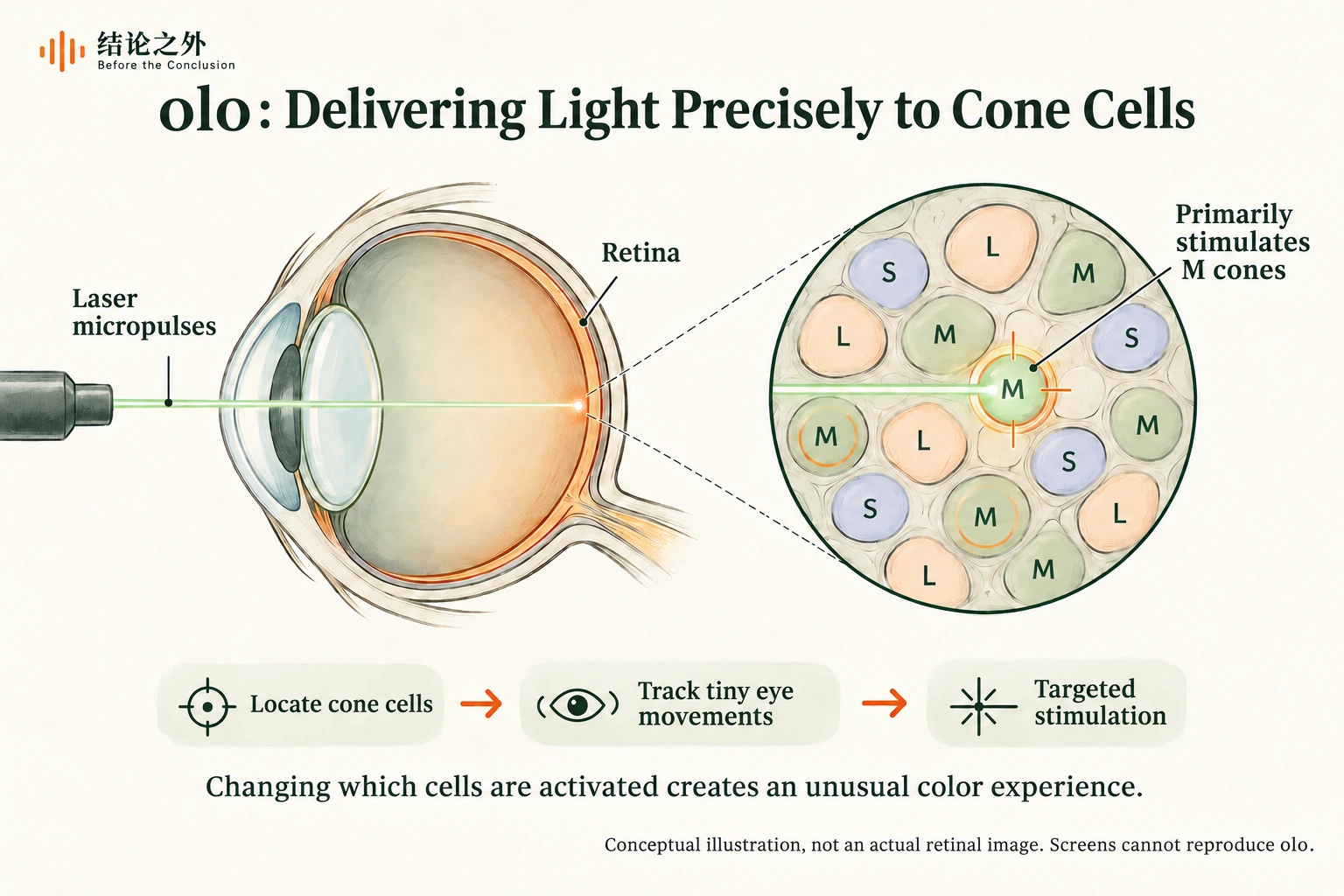
The human retina has three main types of cone cells involved in color perception, called L, M, and S, corresponding to long, medium, and short wavelength ranges. Their sensitivities differ across wavelengths, and those ranges overlap.
When we see green, a single cell devoted exclusively to green is not reporting the answer to the brain. Rather, different cones are stimulated, and the visual system produces a color experience from the relationships among their activity.
The Berkeley researchers posed an interesting question.
What would happen if, instead of relying only on ordinary light to stimulate the eye, we could deliberately control which cones were activated?
Under natural illumination, activating only M cones while leaving both other types entirely unactivated is virtually impossible.
But the research team developed an experimental system called Oz.
It uses adaptive optics imaging to locate different cells on the retina, eye tracking to compensate for the eye's natural movements, and precisely controlled lasers to stimulate selected cells.
You can think of it as a very unusual kind of visual display technology.
An ordinary screen changes the light directed into the eye to produce different retinal responses.
Oz instead attempts to determine, at the level of individual retinal cells, which stimulation the visual system receives.
Strictly speaking, this was a partial extension toward an ideal state, rather than perfectly isolated activation. The findings were nonetheless persuasive: participants experienced an unusually intense blue-green, and in color-matching tests, they could match it with ordinary colors only after first diluting it with white light. This indicates that the experience fell beyond the usual range of colors produced by ordinary light stimulation.
The researchers named it olo. The name comes from the activation combination 010 for the L, M, and S cone types: only M is activated.
Two things need to be distinguished precisely here.
The scientists did not discover a new wavelength of light, nor did they establish that humans had suddenly acquired a new type of photoreceptor.
What they did was deliberately change how visual signals enter the existing human visual system, producing a color experience unavailable under everyday conditions.
The distinction matters greatly.
It means the world we usually see is constrained not only by external objects, but also by the ways our senses receive and process information.
Of course, the research remains preliminary. Initially it had only five participants, including researchers themselves, and the experimental scope was limited. Scholars also disagree about whether olo should be called an entirely new hue or an exceptionally saturated version of an existing blue-green.
Yet it has demonstrated a valuable possibility: human visual experience can be extended by precisely changing sensory input.
A larger question follows.
If changing how the eye receives signals can change the colors people see, how much does the visual world we take for granted depend on us?
2. Do two people looking at the same red flower see the same red?
Imagine standing with a friend in a garden, with a red rose in full bloom before you.
You say, “What a vivid red.”
Your friend nods: “Yes, very red.”
You seem to have reached complete agreement.
But how do you know that the red your friend sees is exactly the same as the red you experience?
We can measure the spectrum of light reflected by the flower, examine both people's vision, and even compare cone activity and nervous-system responses.
Those data can help us judge whether their visual mechanisms are similar.
Yet one question remains: can another person directly experience someone's subjective sensation?
A classic philosophical thought experiment is known as the “inverted spectrum.”
Imagine two people who have used the same words for colors since childhood.
Both see grass and say “green.”
Both see a sunset and say “red.”
They pass the same color-discrimination tests and have never shown any obvious differences in daily life.
But could their inner subjective experiences of red and green nevertheless differ?
This is a philosophical thought experiment, not a psychological phenomenon whose existence has been established.
It asks whether identical outward behavior is sufficient to prove that inner experience is identical too.
Real differences are not merely hypothetical. People with color blindness inhabit a different color world from people with typical color vision. A small number of tetrachromats may have more types of cones. And older people's yellowing lenses can give the world a warmer cast.
In 2015, a photograph of a dress provoked an enormous internet debate.
Some people saw white and gold; others saw blue and black.
The photograph did not change with its viewer.
But the brain used lighting cues in the photograph to make different judgments about the illumination. If it judged the picture to have been taken under warm artificial light, it “subtracted” the warm color and perceived blue and black. If it judged the dress to be in daylight shadow, the result was white and gold. Different judgments ultimately produced different color perceptions.
This does not mean objects lack real physical properties, or that every interpretation is equally correct.
It shows that the world we experience is not an unprocessed copy of outside information.
The brain is always involved in interpretation.
It receives information and must organize it using previous experience, environmental cues, and perceptual mechanisms.
Two people facing the same external object may form different subjective experiences.
Language alone cannot always eliminate that difference.
But difference does not mean arbitrariness. Spectra can be measured, color matching can be repeated, and disagreements can be tested. These are the shared reference points to which we will return.
3. Why did Kāśyapa smile when the Buddha held up a flower?
Let us return to the old story.
In the Chan tradition, the flower and the smile form a deeply symbolic koan.
The Buddha holds up a flower. His disciples remain silent. Only Mahākāśyapa smiles.
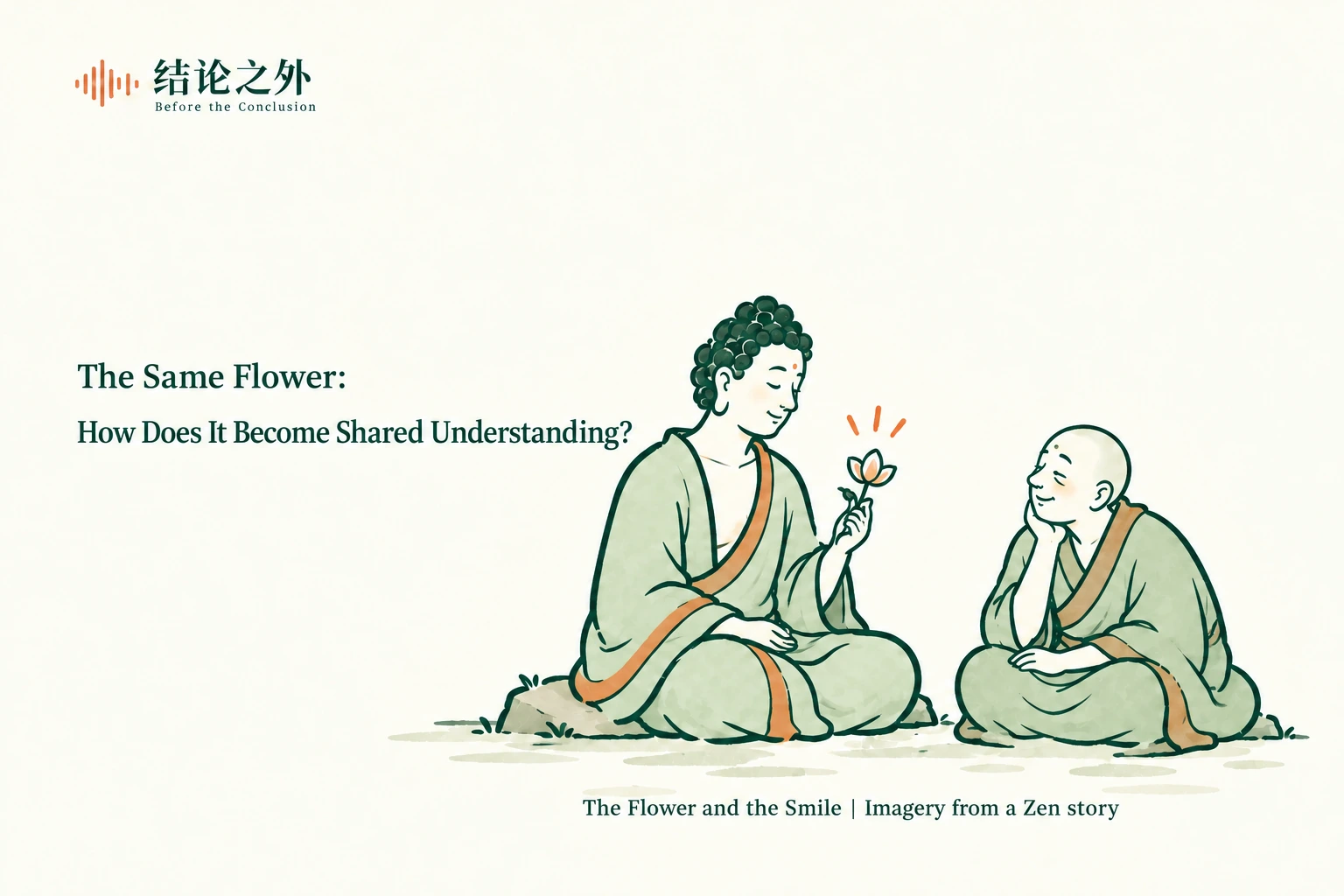
The story is commonly used to illustrate Chan's emphasis on direct realization and the transmission of insight without complete dependence on language and writing.
From the perspective of historical sources, however, one fact needs adding.
Although the traditional narrative places the story in the Buddha's lifetime, scholars tracing its textual history find that the complete flower-and-smile koan largely took shape and circulated widely in Chinese Chan texts of the Song dynasty. It cannot simply be treated as a historically verified event in the Buddha's life.
Later retellings did more than describe a moment of realization. They also established a lineage of transmission independent of scriptural teaching.
This does not prevent us from reading it as a story for reflection.
Indeed, part of its value may lie in how such a brief story leaves later readers so much room for interpretation.
If we treat it as an ordinary visual event, all the disciples faced the same flower.
The flower did not change because of Kāśyapa.
Why, then, did only he smile?
We can offer many possibilities.
Perhaps he grasped what the Buddha had not put into words.
Perhaps he experienced a direct realization and no longer needed to wait for an explanation.
Perhaps the smile itself was the spiritual resonance between teacher and disciple that the story sought to convey.
But the story offers no answer about what happened that modern science could test.
Nor should Chan “awakening” simply be understood as a special visual experience.
Kāśyapa was not considered to have understood the Buddha because he saw a more vividly colored flower than everyone else.
The koan concerns the relationships among language, knowledge, practice, and realization.
It belongs to a different domain of knowledge from the photoreceptors and color experience studied in the olo experiment.
Even so, reading them together remains interesting.
In the olo experiment, researchers carefully control external stimulation to investigate the visual experiences we can produce.
The flower-and-smile koan poses a question in the opposite direction: even if the external object is the same, will people's understanding of it be the same?
Science asks us to reconsider “What do we see?” The koan prompts us to keep asking, “What do we understand from it?”
4. Why has a story about “not relying on words” circulated for a thousand years?
There is another striking feature of the flower-and-smile story.
Chan is often associated with phrases such as “not relying on words and letters” and “a special transmission outside the teachings,” emphasizing that genuine realization cannot be obtained merely by memorizing and reciting doctrine.
Why, then, has an idea that stresses incomplete dependence on writing been handed down through so much writing?
The story was written down.
Disciples read it.
Later Chan masters explained it.
Different schools developed their own interpretations and practices.
Today it has entered literature, painting, and philosophical debate, and even become a familiar cultural expression.
This may seem paradoxical.
But “not relying on words and letters” need not mean rejecting all language and written tradition.
It is more a reminder that language and concepts cannot fully replace understanding and practice firsthand.
Words can point toward an experience without guaranteeing that everyone who reads them will have the same experience.
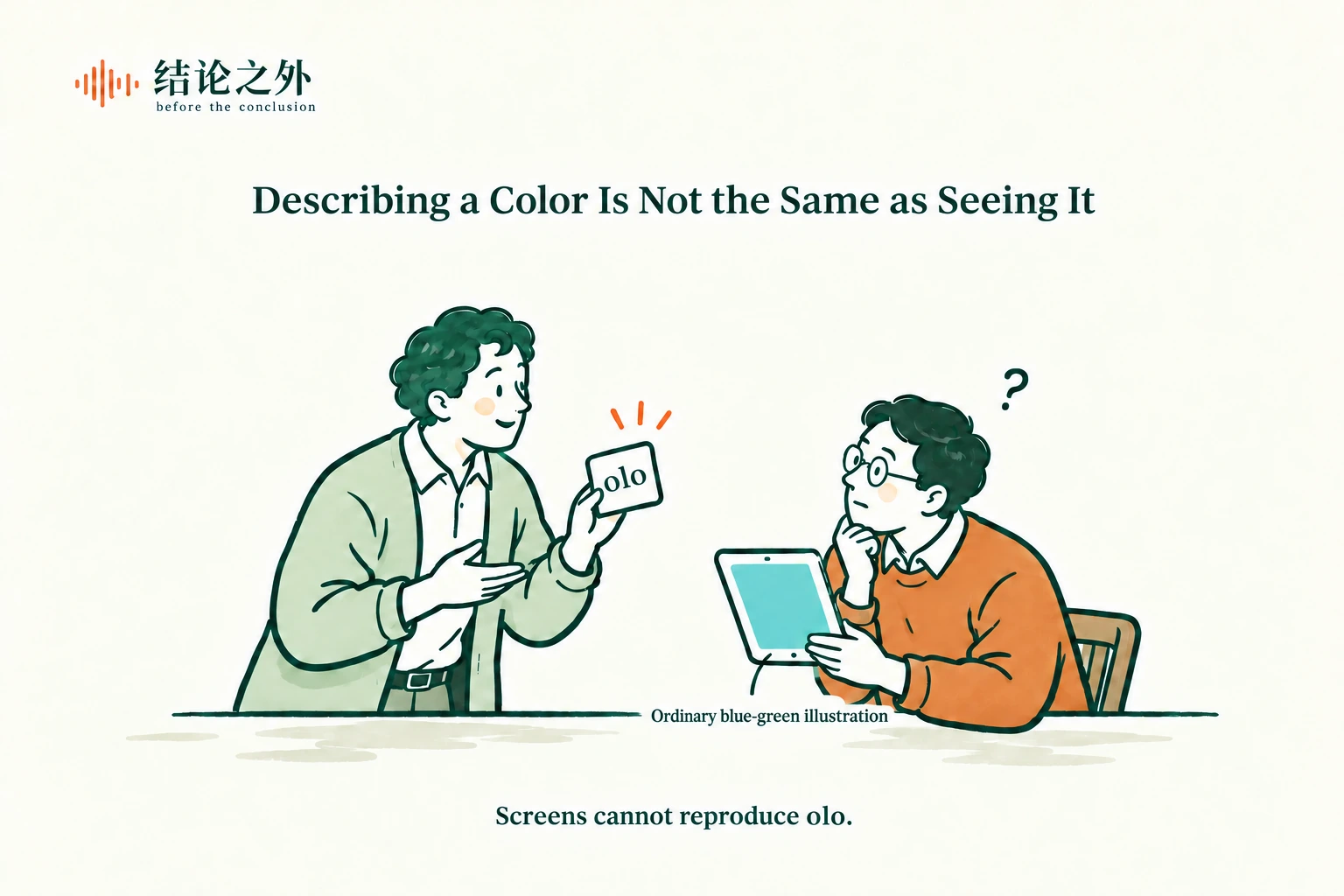
Olo provides a ready example. We can describe it only by borrowing familiar terms such as “blue-green” and “peacock green.” Someone who has not used the Oz system still cannot know what that degree of saturation feels like. The words point in a direction; they do not hand the experience itself to the reader.
The flower-and-smile story thus gains another layer worth considering.
Reading it today, we may believe we have understood that smile.
But have we understood the story itself, or the meanings later generations have continually given it through language, history, and culture?
And have all the people who read this same story really understood the same thing?
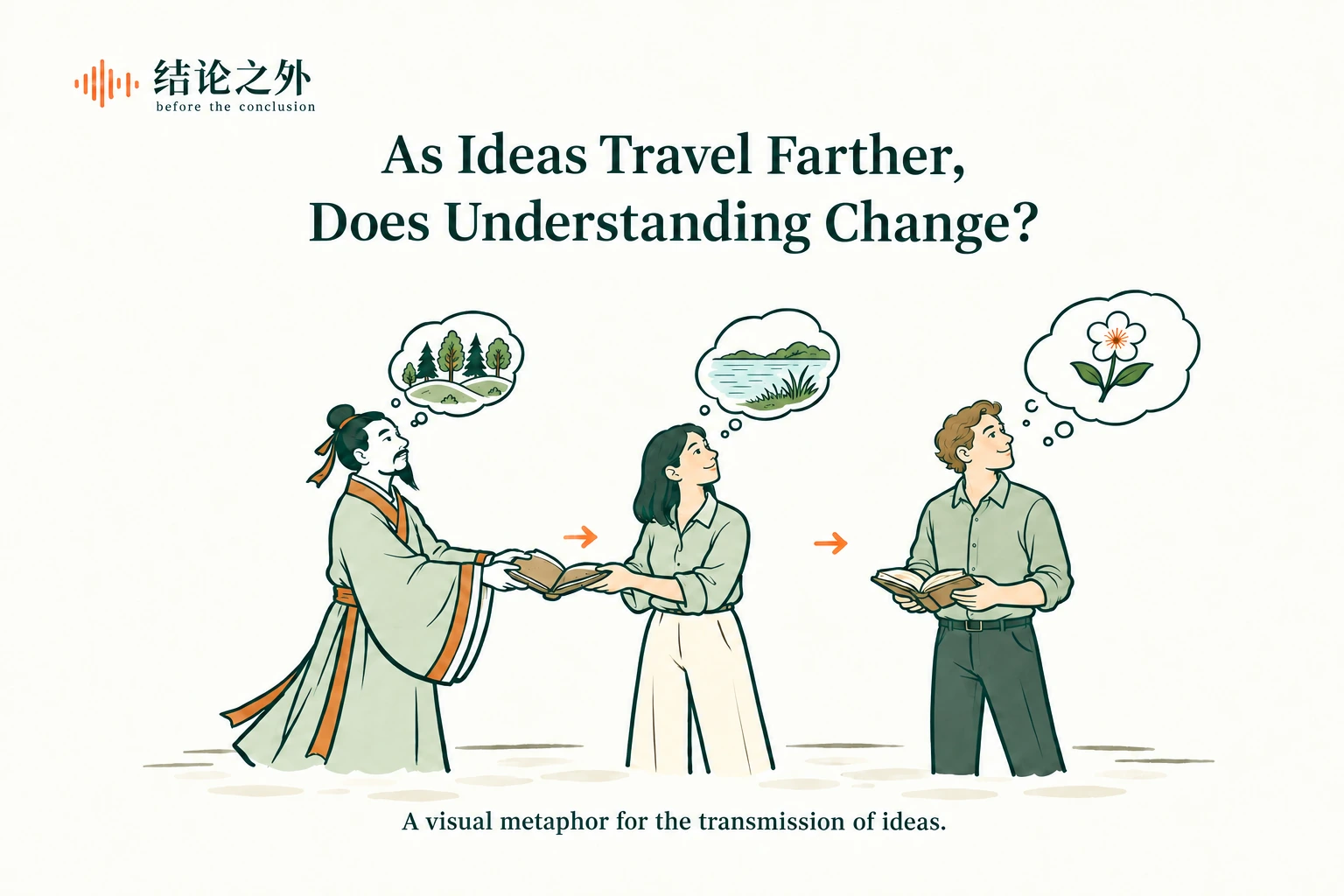
5. From India to East Asia and the world: can an idea travel unchanged?
Buddhism originated in ancient India.
Over time, Buddhist thought and traditions of practice spread to Central Asia, China, and elsewhere.
Within China's intellectual, linguistic, and religious environment, Chan gradually developed its own distinctive traditions.
Related traditions later spread to Korea, Japan, Vietnam, and other places, developing different institutions, cultural expressions, and forms of practice.
In the modern era, especially from the late nineteenth into the twentieth century, Chan and Zen entered European and American societies through monks, scholars, translators, and cultural exchange.
Some Western readers came to Zen through Buddhist philosophy.
Others encountered some of its ideas through meditation, art, literature, or psychology.
This does not mean their understanding of Zen was identical to the meditation, doctrine, and religious practice found in traditional East Asian monasteries.
Some focused on religious liberation and awakening.
Some focused on philosophical understandings of the self and reality.
Still others understood Zen as a way to reduce stress, attend to the present, or improve a way of life.
These interpretations have connections as well as differences.
Nor can the mindfulness practices widely popular today simply be equated with traditional Chan or Zen.
More precisely, ideas continually enter new languages and social environments as they spread, and continually encounter new questions.
A concept originally rooted in religious practice may be reinterpreted by philosophers.
A practice emphasizing transmission between teacher and disciple may become an individualized spiritual exploration.
A story with a particular historical setting may gradually become a universal symbol across cultures.
After such transmission, is it still the original idea?
Perhaps the answer cannot simply be yes or no.
On the one hand, transmission does preserve important concepts, texts, and practices.
On the other, the social environments, languages, personal experiences, and practical needs of those receiving an idea all help shape new understandings.
This brings to mind one fact from the olo experiment.
When scientists precisely change the input of visual signals, people can develop color perceptions unlike everyday experience.
When an idea enters a different cultural environment, it too seems to encounter a different set of conditions for understanding.
But the analogy must remain an analogy.
Cultural transmission is not an experiment in retinal stimulation, and spiritual realization is not a visual response controllable through laser settings.
What they share is a more general question: between what we receive and what we ultimately understand lies a process we cannot ignore.
Language, history, belief, education, and personal experience all participate in that process.
We imagine an idea simply passing from one person to another.
Yet in the passing, it is continually understood anew.
6. Is there also an invisible distance between people?
These differences are not confined to scientific experiments and religious ideas.
They are part of everyday life.
For example, a friend tells you about a difficulty.
You quickly analyze the problem and suggest several apparently reasonable solutions.
But perhaps your friend does not need that advice.
The first thing they want to know is whether you have really understood their situation.
You have heard every sentence they spoke.
You may still not have understood the feeling they wanted to convey.
They say, “I've been so tired lately.” You hear, “There is too much to do.” What they may mean is, “Nobody is on my side.” The same words can point to entirely different circumstances.
Misunderstandings like this can be baffling.
If we heard the same words and experienced the same events, why can we still fail to understand each other?
Perhaps because the world we share is more complicated than we imagine.
We share many observable, measurable facts.
But we do not necessarily share identical memories, emotions, expectations, or value judgments.
What one person sees as an opportunity may look like a risk to someone else.
A choice that seems obvious to one person may feel unacceptable to another.
This does not mean everyone lives in a completely sealed subjective world.
Quite the opposite: because we can communicate, check facts, and correct misunderstandings, we can gradually come to understand one another.
But using the same words does not make understanding automatic.
Borrowing the image of the flower and the smile, we might ask another question: are we so used to checking that others have seen the flower that we rarely ask what the flower means to them?
No single experiment can answer that.
But it may change how we relate to other people.
In an argument, alongside checking whether the other person heard us clearly, we might ask: how exactly do they understand this?
Why have they come to understand it that way?
And do the facts I consider obvious contain assumptions I have never noticed myself?
These questions do not guarantee that we will ultimately agree.
But they at least move understanding beyond asking others to repeat our own answers.
7. Can science prove that we see the same world?
At this point, we need to avoid the opposite extreme.
If sensory organs and the brain influence color experience, does that mean everything we see is only subjective imagination?
If the same event can be understood differently, does that make all interpretations equally correct?
No.
The external world has physical properties that can be independently measured.
We can measure the wavelength and intensity of light, study how objects reflect it, and compare different people's visual-system responses.
It is precisely these jointly testable facts that make the olo experiment possible.
The researchers cannot simply declare that they have discovered a new color.
They must design controls, measure the stimulation, conduct color-matching experiments, and submit their findings to scrutiny by other scientists.
Even when researchers disagree over how olo should be defined, they can discuss it using shared evidence.
That is a major strength of science.
It helps us move beyond individual sensations toward an increasingly reliable shared understanding of the world.
Yet what science can measure is not always equivalent to a person's entire subjective experience.
We can study the neural mechanisms of color perception and still face questions about how different individuals describe and communicate their experiences.
Similarly, we can study a religious tradition's historical origins, the formation of its texts, and the paths of its transmission. Historical sources alone, however, cannot fully answer what faith means to one particular person.
Different questions require different methods.
A scientific experiment cannot establish exactly what Kāśyapa realized when the Buddha held up the flower.
A Chan koan cannot establish the results of the olo experiment.
Yet without confusing the two, we can still bring them into a meaningful intellectual conversation.
One reminds us that human senses have limits, and science is trying to explore and extend them.
The other reminds us that human language and understanding have limits too, and communication between people is not always achieved simply by passing on information.
They do not prove one another, but both deserve careful thought.
8. Does the same flower mean the same world?
Let us return to the opening.
Scientists created the unusual color experience called olo.
The experiment matters for more than enabling a few people to see an exceptionally vivid blue-green.
More importantly, it shows that the world we ordinarily see does not exhaust all the experiences our senses can produce.
Red, green, and blue seem thoroughly familiar, as do sunlight, trees, flowers, and the sky.
Yet only when scientists could precisely control retinal cells did we discover possibilities within a familiar visual system that everyday life had never elicited.
The Buddha's flower and Kāśyapa's smile take the question in another direction.
A flower is held before a gathering.
We do not know exactly what realization that smile represented.
But the old koan seems to remind us that human understanding of the world cannot always be fully expressed through a passage of language or a shared visual object.
More intriguingly, this story emphasizing direct realization has itself undergone a long journey of cultural transmission.
From Chinese Chan texts and traditions of practice to different parts of East Asia, and then into thought, literature, and daily life in the modern world, it has been continually read and given new meanings.
Today, a modern vision science experiment allows us to read the old story afresh.
We certainly cannot say that science has confirmed Chan realization.
Nor can we say the story explains olo's neurobiological mechanism.
Yet together they leave us with a question worth considering.
When we say we have seen, heard, or understood something, how much do we really know?
For science, acknowledging the limits of knowledge is a starting point for further research.
For our relationships with others, acknowledging that someone may have different experiences and understandings may be the beginning of more attentive listening.
We need not have identical feelings to live together, nor arrive at the same explanation of every question to respect one another.
If we are willing to acknowledge that the world we see is not the whole, and that other people's inner lives are not always easy to understand, communication can go deeper.
Perhaps olo's greatest lesson is not that the world has acquired another color, but that it makes us reconsider a more fundamental habit: we tend to believe we see the world as it truly is, seldom noticing that our seeing has its own conditions, history, and limits.
Perhaps the same flower need not call forth Kāśyapa's smile from everyone.
But we can begin here, by acknowledging that what others see and understand may contain something we have yet to grasp.
And perhaps that is reason enough to stay curious and keep asking.
Main references
- Rivka Galchen. “What Would It Mean to See a New Color?” The New Yorker, July 27, 2026.
https://www.newyorker.com/magazine/2026/08/03/what-would-it-mean-to-see-a-new-color - Fong J, et al. “Novel color via stimulation of individual photoreceptors at population scale.” Science Advances, 2025;11:eadu1052.
https://doi.org/10.1126/sciadv.adu1052 - University of California, Berkeley. “Scientists trick the eye into seeing new color ‘olo’.” April 22, 2025.
https://news.berkeley.edu/2025/04/22/scientists-trick-the-eye-into-seeing-new-color-olo/ - Stanford Encyclopedia of Philosophy. “Inverted Qualia.”
https://plato.stanford.edu/entries/qualia-inverted/ - Stanford Encyclopedia of Philosophy. “Chan Buddhism.”
https://plato.stanford.edu/entries/buddhism-chan/ - Shi Huimin. “Reexamining the Historical Sources of the ‘Treasury of the True Dharma Eye’ and the ‘Flower and Smile’ Koan.” Zhengguan, 2013, no. 65, pp. 5–60.
https://buddhism.lib.ntu.edu.tw/FULLTEXT/JR-MAG/mag390273.pdf - Master Sheng Yen. “The Flower and the Smile,” The Complete Works of Dharma Drum.
https://ddc.shengyen.org/?doc=04-05-018 - “Mahākāśyapa’s Smile: Silent Transmission and the Kung-An (Koan) Tradition.” In The Kōan: Texts and Contexts in Zen Buddhism, 2000.
https://academic.oup.com/book/50253/chapter-abstract/422745505
This article takes a long-form New Yorker report on vision science and the original olo study as its scientific starting points, alongside sources on Buddhist history, Chan koans, and epistemology. It was independently written by Before the Conclusion and is not a translation of the original report. Its connections among science, culture, and personal understanding are offered as intellectual reflection. Religious koans are not treated as scientific evidence, nor are their traditional narratives assumed to be established historical events.
Beyond the conclusion, there are questions worth continuing to ask.
Medicine · Science · Ideas and Reading
Follow Before the Conclusion as we stay curious and think independently together.
Text and image usage statement
The text was originally written by Before the Conclusion. Sources for the scientific, historical, and cultural material are listed above. The illustrations were conceived by Before the Conclusion and produced with AI tools; see the captions for details. You are welcome to share the article's web link. Without separate permission, please do not copy, repost, publish screenshots, use the images separately, or make commercial use of the content.