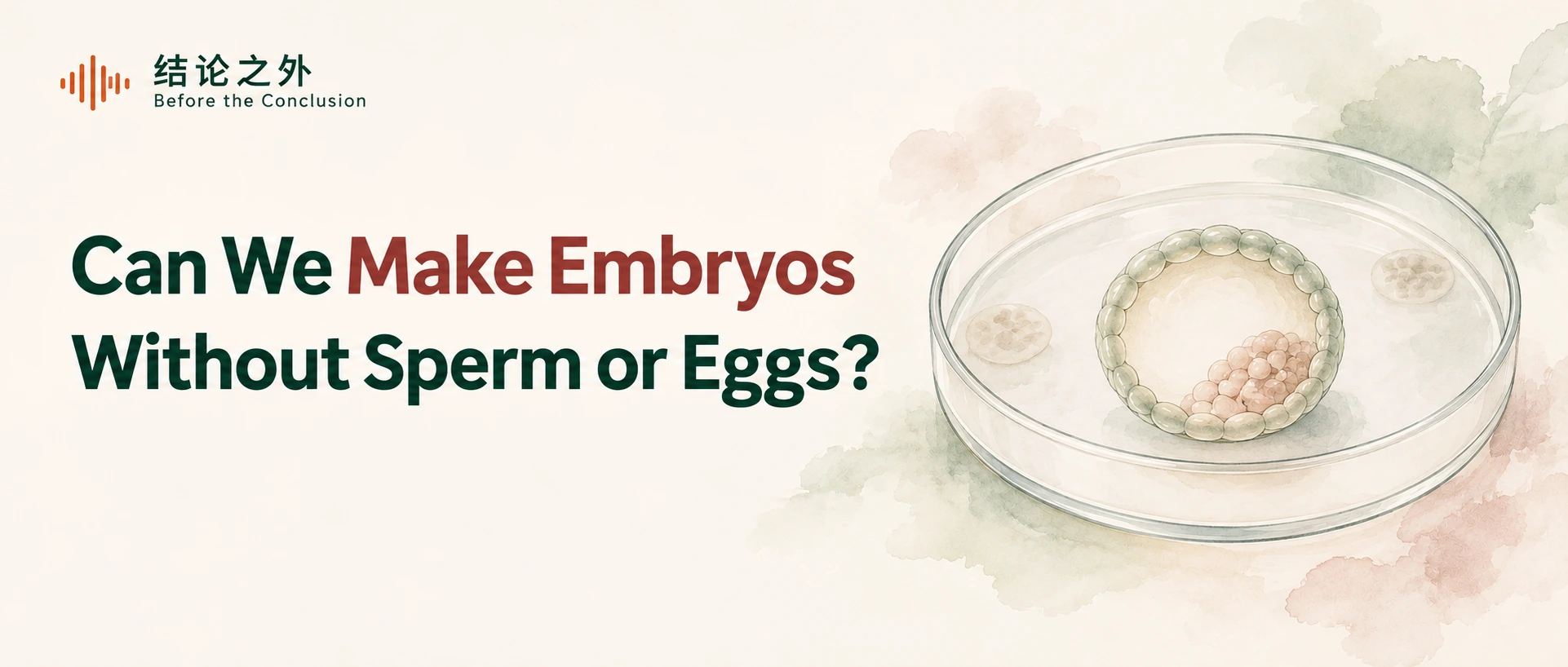
In 2023, a commercially available pregnancy test showed a positive result in a laboratory.
But this time, no one was pregnant.
Researchers at Israel’s Weizmann Institute of Science obtained the result by testing secretions produced by cells grown in the laboratory. The cells came from human embryo models made from stem cells, rather than from an embryo created through a new fertilization. [1,2]
It is an arresting scene.
A pregnancy test is an everyday object that carries an extraordinary amount of meaning. A positive result may bring joy after a long wait. It may also bring surprise, uncertainty, or a need to rethink the future.
From that line, it is easy to imagine a child and the life that lies ahead for a family.
What, then, does the same result mean beside a culture dish? Has a life already appeared in the laboratory, waiting to grow up?
We should pause before going that far.
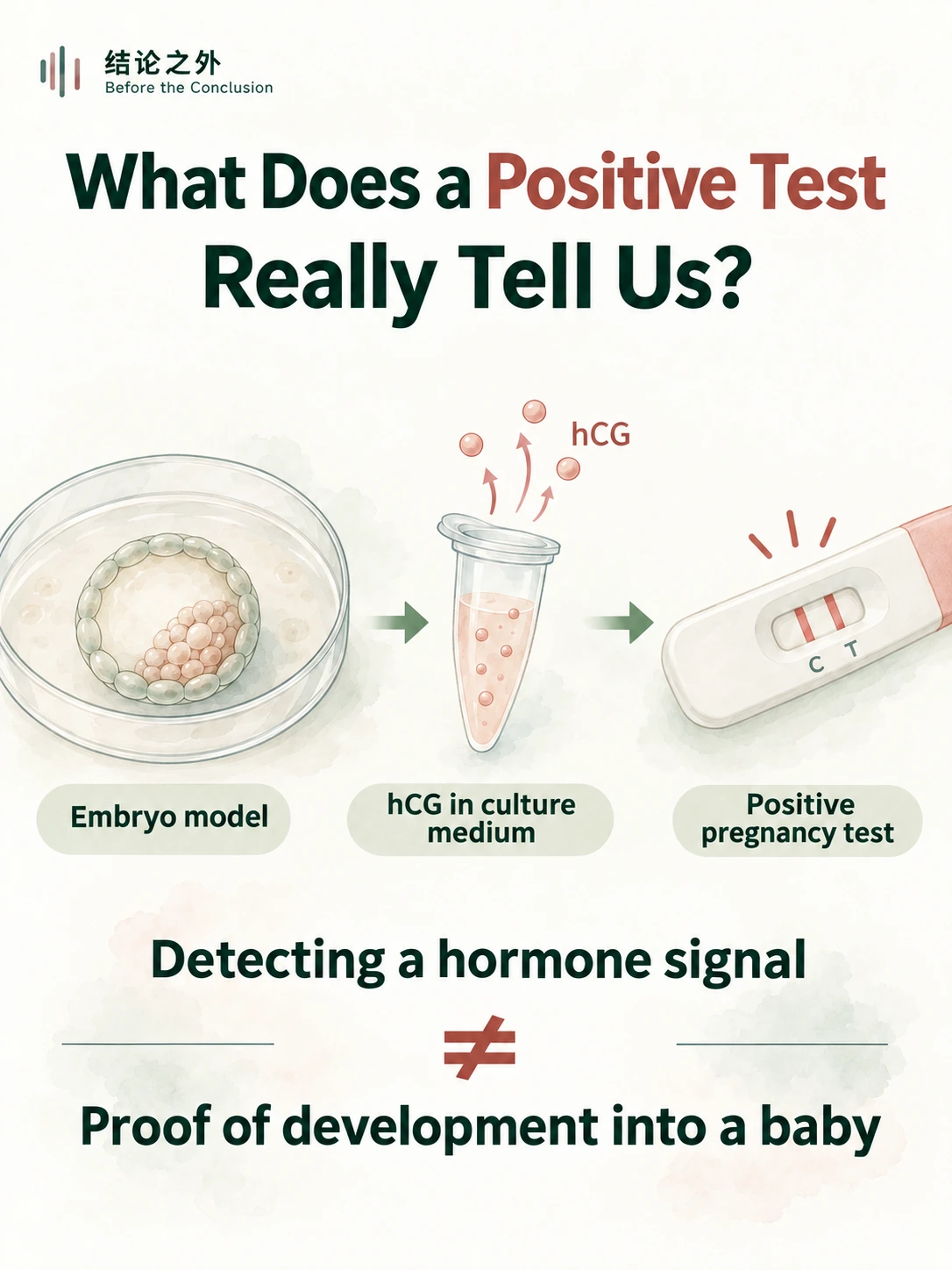
A pregnancy test detects a particular hormone: human chorionic gonadotropin, or hCG. It is not an instrument that can determine whether a complete embryo is present, still less whether a cluster of cells can develop into a baby. [3]
In this study, cells in the models associated with placental development could produce the relevant hormonal signal. The test had not been “fooled.” It had simply answered the question it was able to answer. [1,2]
It is we who so readily leap from a familiar signal to an entire imagined future.
The researchers had created embryo models able to reproduce certain key structures and processes of early human development. The study demonstrated some developmental features resembling those at approximately 13 to 14 days after fertilization. It did not establish that these models could sustain a pregnancy or develop into babies. [2]
If this is not an established way of “making children,” why pursue the research?
The answer has everything to do with what a pregnancy test means in everyday life. We often begin to imagine a new life seriously only when we see the result. Yet biological changes have already been unfolding out of sight.
Scientists want to study those processes: changes we have not yet seen that may already be influencing what happens later.
1. We see an outcome without necessarily knowing how it came about
Imagine a couple waiting for a pregnancy.
They have seen a positive result. They have not yet decided when to tell their families, but a few quiet plans for the future have entered their everyday conversations.
Or imagine a different situation: a pregnancy has not continued. After leaving the consulting room, they know what happened, but still do not know where the earliest change occurred.
For the people involved, this is not an abstract scientific question. They may simply want to ask: why?
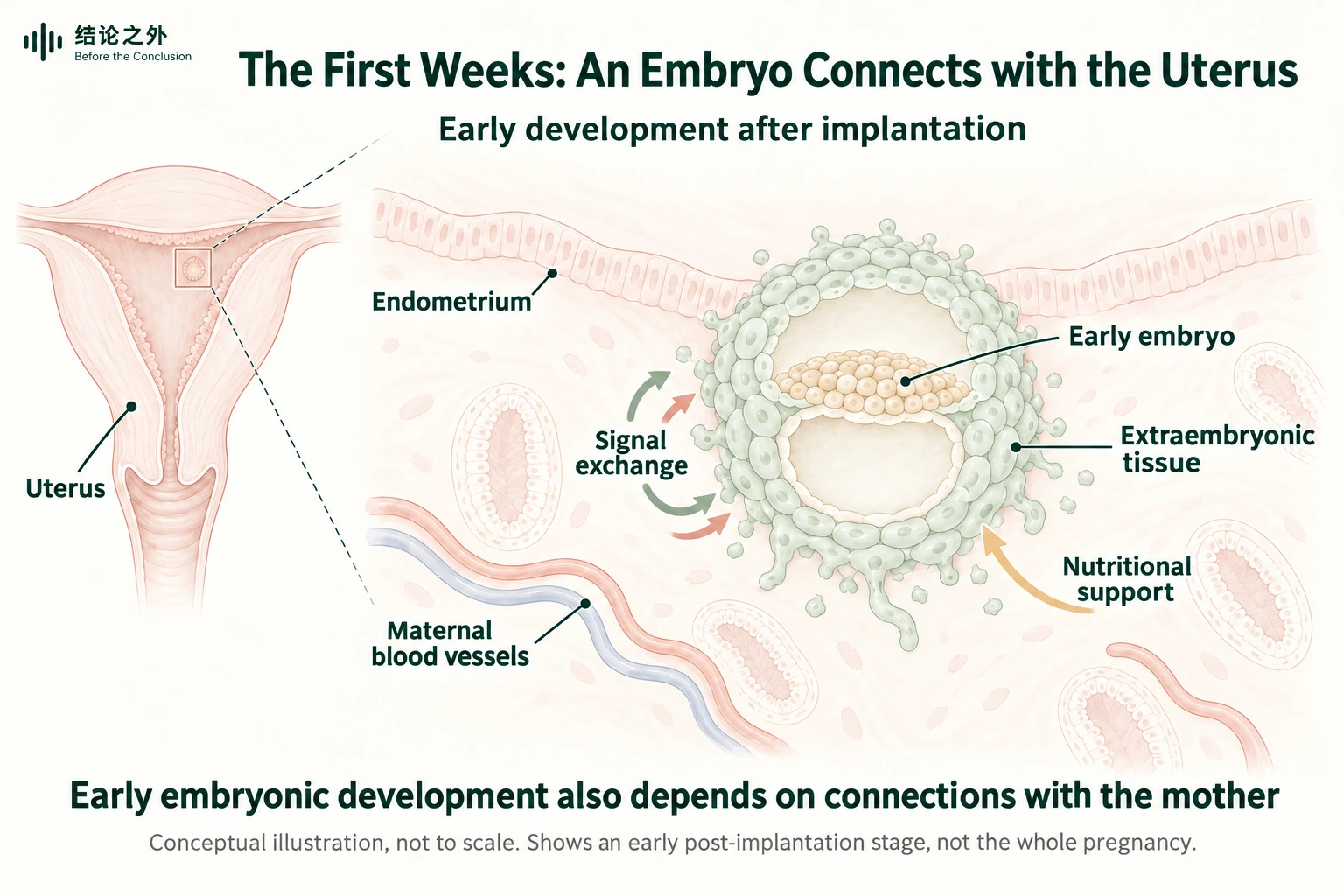
The difficulty for researchers is that early human development after implantation takes place inside the body, making it hard to observe directly and continuously. Technical and ethical constraints also limit the experiments that can be performed. It is often difficult to return to the moment when a change first emerged. [2,4]
The familiar picture of development—one cell becoming two, then four, and gradually taking on the outline of a body—therefore leaves out many details that remain to be understood.
How do different cells take different developmental paths? How do tissues that will form the body coordinate with the tissues that support its development? Why do some processes continue while others go awry along the way?
Embryo models offer researchers an opportunity to study some of these processes under conditions that can be observed and compared. They are new tools for understanding early development and associated abnormalities, rather than an established diagnostic method for explaining an individual pregnancy outcome. [4]
Studying why a developmental process can go wrong is not the same as knowing why a particular family experienced a loss.
An abnormality in a model cannot be turned directly into an explanation for a real pregnancy. Nor can it be used to suggest that the people involved must have done something wrong.
But the inability to answer everyone’s questions immediately does not make the research valueless.
In science, progress sometimes means more than producing a treatment straight away. It can mean finally being able to break “why did it not continue?” into more specific questions. Which step changed? How does it relate to the other steps? How can we test whether our explanation holds?
This is also where the research connects with ordinary life. Its greatest promise may lie less in finding another way for humans to reproduce than in gradually making comprehensible the changes that occur at the very beginning of life and have long been difficult to reach.
2. Scientists set the opening conditions; the cells begin to influence one another
When we hear “without sperm or eggs,” it is easy to imagine scientists pursuing an alternative, complete route to reproduction.
Creating an embryo model, however, does not mean repeating human development from beginning to end.
Some models primarily reproduce structures from before implantation; others examine tissue changes after implantation. They differ in the cell types, spatial organization, and developmental processes they can represent. Calling them all “embryo models” does not make them the same thing. [4]
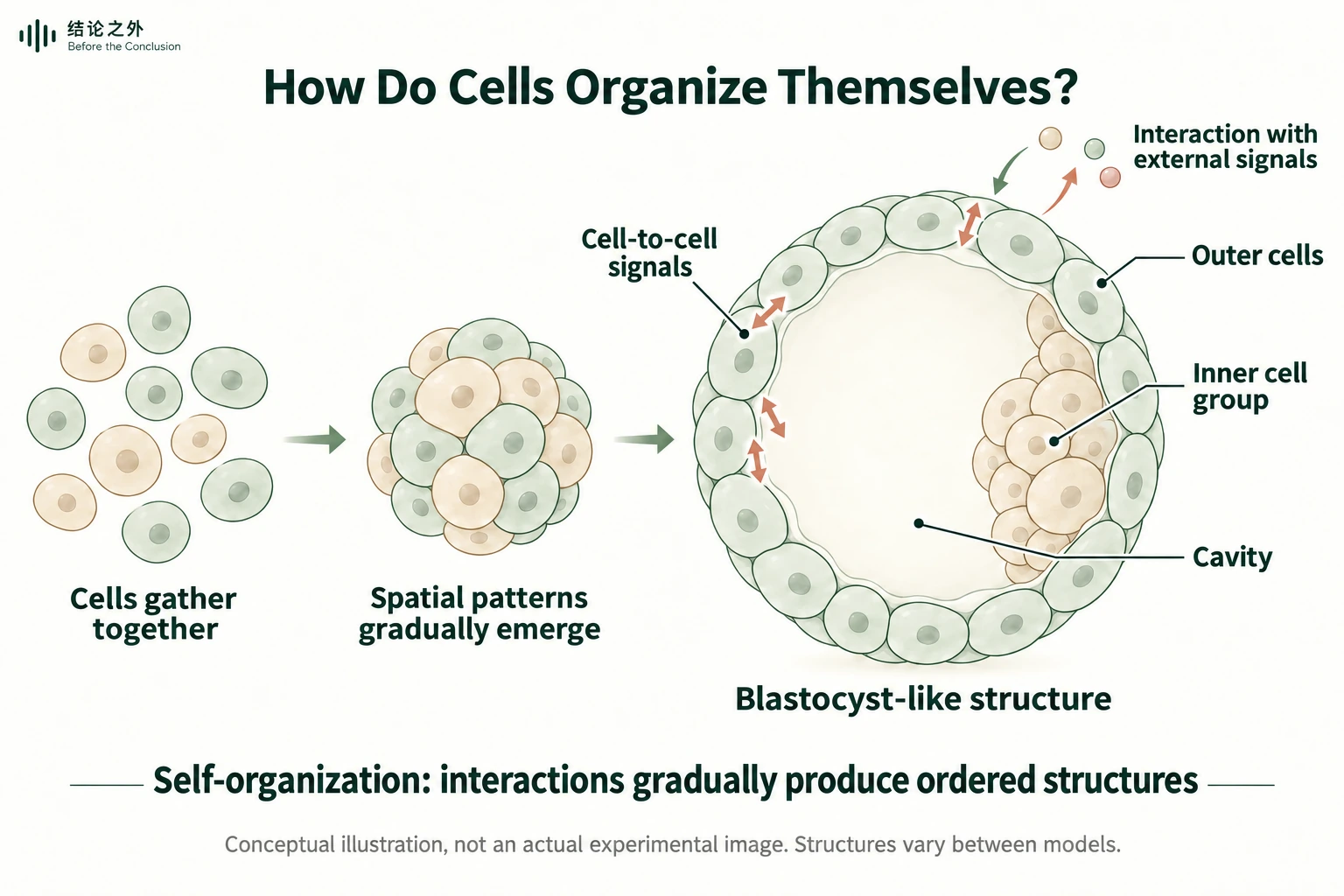
Nor are they plastic teaching models. They are experimental systems made of living cells. Researchers provide suitable cell states and culture conditions; interactions among the cells may then produce a degree of spatial organization. [2,5]
One way to understand this is that scientists set the opening conditions, rather than using tweezers to place every cell in its final position. How cells respond to surrounding signals helps shape what happens next.
The starting material also needs explanation. Some of the stem cells used come from existing embryonic stem-cell lines. Others are pluripotent stem cells made by reprogramming cells from tissues such as skin or blood. [4]
“Without sperm or eggs” therefore means, more precisely, that making certain models does not require a new fertilization. It does not mean creating life from nonliving material. Nor does it mean that every cell line’s original source was unrelated to an embryo.
What has changed is the starting point of the experiment. Science has not crossed the entire distance from cells to a baby.
Research detail: how do these cells form an embryo model?
Skip this box and continue with the main text ↓Read on if you are interested in the specific research. Skipping this box will not interrupt the article’s main argument.
In their 2023 study, Oldak and colleagues guided human stem cells into different cell states, allowing cells associated with both the embryo proper and its supporting extraembryonic tissues to participate in self-organization. They compared the models’ cell identities, spatial structures, and developmental features, rather than simply judging whether they looked similar. [2]
After approximately 8 days in culture following cell mixing and aggregation, these models displayed some key features resembling those of a human embryo approximately 13 to 14 days after fertilization. These are two different measures of time: how long the model was actually cultured, and which stage of natural development it resembled. The latter is based on comparison. It does not mean that the model went through every step following fertilization. [1,2]
End of research detail; the main text continues below.
Understanding this helps avoid two opposite misunderstandings.
The first is that once an embryo-like structure has appeared, it will inevitably become a baby if we simply wait longer. The second is that something called a “model” does not deserve serious discussion.
The first gives it a capacity that has not been demonstrated. The second ignores the fact that models themselves continue to develop.
The more useful questions are: what exactly can it reproduce, and what can it not reproduce? Are those capacities sufficient for the question we want to answer?
3. How could this help a family waiting for answers?
Suppose you are waiting for the result after an embryo transfer.
What matters most to you may be a single question: will it work this time?
To approach that answer, science must first understand smaller steps. How does an embryo make contact with the uterine lining? Which cell states and signals allow that contact to develop further?
A study by Kagawa and colleagues, published online in 2021, took the question to this level. The researchers created human blastocyst-like structures and brought them into contact with laboratory-cultured endometrial cells to observe attachment behavior associated with early implantation. These were interactions between models outside the body. The models were not transferred into a person, and no pregnancy was established. [5]
This allowed researchers to ask further questions under controlled conditions. Would changing a condition alter attachment? Which conversations between cells might matter? Which findings deserved further testing in other experimental systems or in data from human studies?
Research detail: “modeling implantation” does not mean “able to establish a pregnancy”
Skip this box and continue with the main text ↓This box explains what the experiment actually measured. You can skip it without losing the main thread.
The blastocyst-like structures in this study had features corresponding to the main cell lineages present at the blastocyst stage and developed a degree of spatial polarity. Researchers observed that they could attach in a particular orientation to a layer of endometrial cells treated with hormones. [5]
This provides a tool for studying early contact and attachment. It does not mean that the whole implantation process has been reproduced, still less that subsequent placental formation, embryonic development, and pregnancy can all proceed normally. An attachment experiment cannot be reported as “an artificial embryo has successfully become pregnant.”
End of research detail; the main text continues below.
For a family, this research may still seem to leave the most important question unanswered.
That is precisely the distance we need to describe honestly. Clues to mechanisms in basic research still require validation before they can become tools for individual diagnosis and treatment. “Helps us understand implantation” cannot be promoted directly as “already improves your chance of pregnancy.”
This does not erase the research’s value.
Where once it was only possible to ask why something did not work, it may gradually become possible to ask which step changed, whether we can identify it, and even whether we can intervene.
The research deserves support because it makes the search for answers more specific, rather than because it can already supply an answer for every family.
4. Why does greater resemblance to a real embryo demand greater caution?
At this point, a tension emerges.
To study human development more effectively, scientists want models that come close enough to the real situation. Yet as models increasingly resemble real embryos, we begin to worry: are they still simply ordinary research materials?
A name alone cannot settle the question.
Calling something an “artificial embryo” may suggest that it already has a complete capacity for development. Saying that it is “only a model,” however, can also conceal changes that deserve careful assessment.
In 2026, a group of researchers writing in Nature Cell Biology proposed that ethical assessment should consider such features as developmental stage, the extent of tissue and organ integration, potential for further development, and capacity to form neural circuits. They were proposing a framework for oversight. They were not announcing that current models already possessed all these capacities, and certainly not announcing that they could feel pain. [6]
These discussions also touch ordinary people’s value judgments.
You may think the decisive issue is whether a model has the potential to become a complete individual. Someone else may place greater weight on the structures it has already formed. Others may draw on their religion or understanding of life to argue that particular research needs stricter limits.
Even if everyone understands the same scientific facts, they will not necessarily reach the same value judgment immediately.
This does not make facts unimportant. Quite the opposite: we need to establish the facts clearly before we can identify where we actually disagree. Are we discussing what a model has already achieved, or how it should be treated even if it achieves something?
Science can help us understand the object of research. A single experimental result cannot make everyone’s value judgments for them.
5. Why not let it keep growing and see what happens?
It is a natural question.
If we do not yet know whether a model has a complete capacity for development, why not continue culturing it, or even attempt a transfer, and let the outcome supply the answer?
But that kind of test is not an act of observation without consequences.
Attempting to establish a pregnancy to test whether a model could be used for reproduction could itself expose the pregnant person and any individual who might later be born to unknown risks. We cannot treat this as an ordinary experiment first and decide only after something happens whether a boundary was crossed.
The International Society for Stem Cell Research (ISSCR) explicitly prohibits transferring human stem-cell-based embryo models into a human or animal uterus in its 2025 guidelines. It also prohibits culturing them in artificial systems outside the body with the aim of developing them to viability. Professional guidelines are not the same as national laws; research must also comply with the rules where it takes place. [7]
Even for model research that is permitted, the fact that further culture is technically possible is not an automatic reason to continue. Researchers must explain the scientific purpose, why a simpler model would not suffice, and the conditions under which the experiment will end. [8]
Research detail: why the fourteen-day boundary is more than a date on a calendar
Skip this box and continue with the main text ↓This box explains research time and the boundaries of oversight. Skipping it will not interrupt the article’s main argument.
The fourteen-day rule is an important historical arrangement in human embryo research. The relevant legal boundary in the United Kingdom concerns 14 days after fertilization or the appearance of the primitive streak, whichever comes first. The primitive streak is an elongated thickened area on the embryo’s surface through which cells migrate inward, helping form the basic layers that give rise to different body tissues. Its appearance is associated with gastrulation. It is not a switch at which consciousness suddenly emerges. [7,9]
Embryo models do not share that same starting point of fertilization, and they may reproduce only particular stages. A culture calendar alone therefore cannot tell us which day of natural development a model corresponds to. In its 2025 update, the ISSCR required a clear scientific rationale, defined culture endpoints, and appropriate oversight. A research framework proposed by a professional organization also cannot automatically replace local law. [8]
End of research detail; the main text continues below.
For ordinary readers, the most important issue is less the number of days than whether the direction of research has been explained, whether someone is responsible for its boundaries, and whether earlier judgments will be reviewed as technology changes.
Different ethical positions also reveal the care people bring to questions of life. Some worry that unnecessary restrictions will deprive families waiting for answers of hope. Others worry that we are moving so fast that we may cross a boundary that is hard to reverse before we understand enough.
These disagreements do not necessarily mean that one side respects science and the other does not. They may arise from the same seriousness: when research touches the earliest formation of life, every step needs sufficient justification.
That care also includes responsibility toward the unknown. We cannot yet be certain how far models will eventually go, but we already need to consider the consequences of our actions.
Responsibility sometimes arrives before answers. Respect for life may be expressed in this kind of restraint: letting curiosity lead us toward the unknown while remembering to ask, seriously, whether each step we can take is one we should take.
6. Who else should have a seat at the table?
Ethical discussion is easily portrayed as science moving ahead, followed by outsiders stepping on the brakes.
In this research, however, boundaries need to be part of experimental design from the outset. If a simpler model can already answer the question, why increase its complexity? If the risks of a particular step have not been clarified, are there other research paths we could take first?
The discussion should also extend beyond researchers.
In 2024, Cambridge Reproduction and the UK’s Progress Educational Trust jointly issued a code of practice for embryo-model research, developed with both professional and public perspectives. It is not a single global regulation. It does, however, demonstrate an approach in which people with different experiences participate in discussing research boundaries. [10]
Families who have experienced infertility or pregnancy loss can remind researchers why the questions are urgent. People with different values concerning early life can also raise questions that technical enthusiasm should not brush aside.
Cell donors deserve equally serious consideration. A willingness to provide cells for disease research does not remove the need to understand whether those cells will also be used in embryo models, or whether the original consent covers those uses. The source of materials, the purposes of research, and the scope of consent all require appropriate review. [7]
These questions deserve discussion before the technology becomes usable for reproduction.
Members of the public do not have to learn how to culture cells before they are entitled to ask how those cells will be used.
What we need is clear information on which both support and opposition can rest, rather than an immediate, identical answer from everyone.
Scientists need to explain the technology, and society needs to explain what it hopes to protect. Only then will the value and cost of research be defined by more than one side alone.
7. Back to the pregnancy test
Let us return to that pregnancy test in the laboratory.
Its positive result did not announce that a child was about to be born. It told researchers only that cells in a model had reproduced a particular, measurable function.
Yet that small result still leads us toward a much larger question.
How many processes remain insufficiently understood behind the signals we use in everyday life to confirm that something has “begun”? And as science gains the ability to reproduce some of them, how are we preparing to use that ability?
For families waiting for answers, the research means hope. For scientists, it means new questions that can be tested. For society, it also means boundaries that need to be discussed together.
We do not need to describe every advance as “humans can now make people” to recognize its significance.
Changes in a model are not individual diagnoses. Success in the laboratory is not a promise of reproduction. The ability to form a structure does not automatically establish the ability to complete development.
Equally, these limitations are no reason to dismiss the value of the research.
Sometimes the most important scientific advance is not the opening of an entirely new path for life. It is finally having a chance to see how the path every one of us once traveled began.
As we become able to see more, we must also decide more carefully how far we should go to understand these processes, and why we should stop where we do.
Main sources and further reading
- Weizmann Institute of Science. Human Embryo Models Grown from Stem Cells. September 6, 2023. The research institution’s original account of the pregnancy-test experiment. https://www.weizmann.ac.il/pages/news/life-sciences/human-embryo-models-grown-from-stem-cells
- Oldak B, et al. Complete human day 14 post-implantation embryo models from naive ES cells. Nature. 2023;622:562–573. https://doi.org/10.1038/s41586-023-06604-5
- U.S. Food and Drug Administration. Pregnancy. Explanation of home pregnancy testing and hCG. https://www.fda.gov/medical-devices/home-use-tests/pregnancy
- Nuffield Council on Bioethics. Human stem cell-based embryo models: A review of ethical and governance questions. November 27, 2024. https://www.nuffieldbioethics.org/publication/human-stem-cell-based-embryo-models-a-review-of-ethical-and-governance-questions/
- Kagawa H, et al. Human blastoids model blastocyst development and implantation. Nature. 2022;601:600–605. Published online December 2, 2021. https://doi.org/10.1038/s41586-021-04267-8
- Moris N, Martinez Arias A, Pera M, Rivron N, Sermon K, de Graeff N. Morally relevant features warranting ethical oversight in human stem cell-based embryo models. Nature Cell Biology. 2026;28:659–664. https://doi.org/10.1038/s41556-026-01881-4
- ISSCR. Guidelines for Stem Cell Research and Clinical Translation. 2025 update, Chapter 2. https://www.isscr.org/guidelines-online/laboratory-based-human-embryonic-stem-cell-research-embryo-research-and-related-research-activities
- ISSCR. The ISSCR Releases Targeted Update to the Guidelines for Stem Cell Research and Clinical Translation. August 11, 2025. https://www.isscr.org/isscr-news/the-isscr-releases-targeted-update-to-the-guidelines-for-stem-cell-research-and-clinical-translation
- Regulatory Horizons Council. Modernising regulatory pathways for assisted reproductive technologies: a case study on in vitro gametogenesis (IVG). 2026. See “2.2.5 The 14-day rule.” https://www.gov.uk/government/publications/modernising-regulatory-pathways-for-assisted-reproductive-technologies-a-case-study-on-ivg/modernising-regulatory-pathways-for-assisted-reproductive-technologies-a-case-study-on-in-vitro-gametogenesis-ivg
- Cambridge Reproduction and Progress Educational Trust. Code of Practice for the Generation and Use of Human Stem-Cell-Based Embryo Models. 2024. https://www.progress.org.uk/engagement/resource/scbem-code-of-practice/
- Klotz F. The Embryos That Don’t Come From Eggs and Sperm. Undark, September 25, 2026. The reading and starting point for this article’s subject. https://undark.org/2026/09/25/brain-trust-model-embryos/
This article takes an in-depth Undark report as its starting point and was written independently using original research, research institutions’ accounts, and professional guidance; it is not a translation of that report. The family scenarios are constructed to aid understanding and do not describe any particular real participant. The article does not describe embryo models as embryos validated for reproductive use or equate basic research findings with individual diagnosis or treatment advice. Sources checked through October 31, 2026.
Beyond the conclusion, there are still questions worth asking.
Medicine · Science · Ideas and reading
Follow Before the Conclusion as we stay curious and think independently together.
Text and image use
The text was conceived and written by Before the Conclusion, with sources provided for the research and other materials discussed. Illustrations were conceived by Before the Conclusion and created with AI assistance. All are conceptual illustrations and do not represent actual experimental images or individual clinical cases. You are welcome to share the article’s link through the platform’s official sharing function. Without permission, please do not copy, republish, distribute screenshots of the article, or use the illustrations separately. Commercial use is prohibited.