We live in an age that increasingly asks us to do less for ourselves.
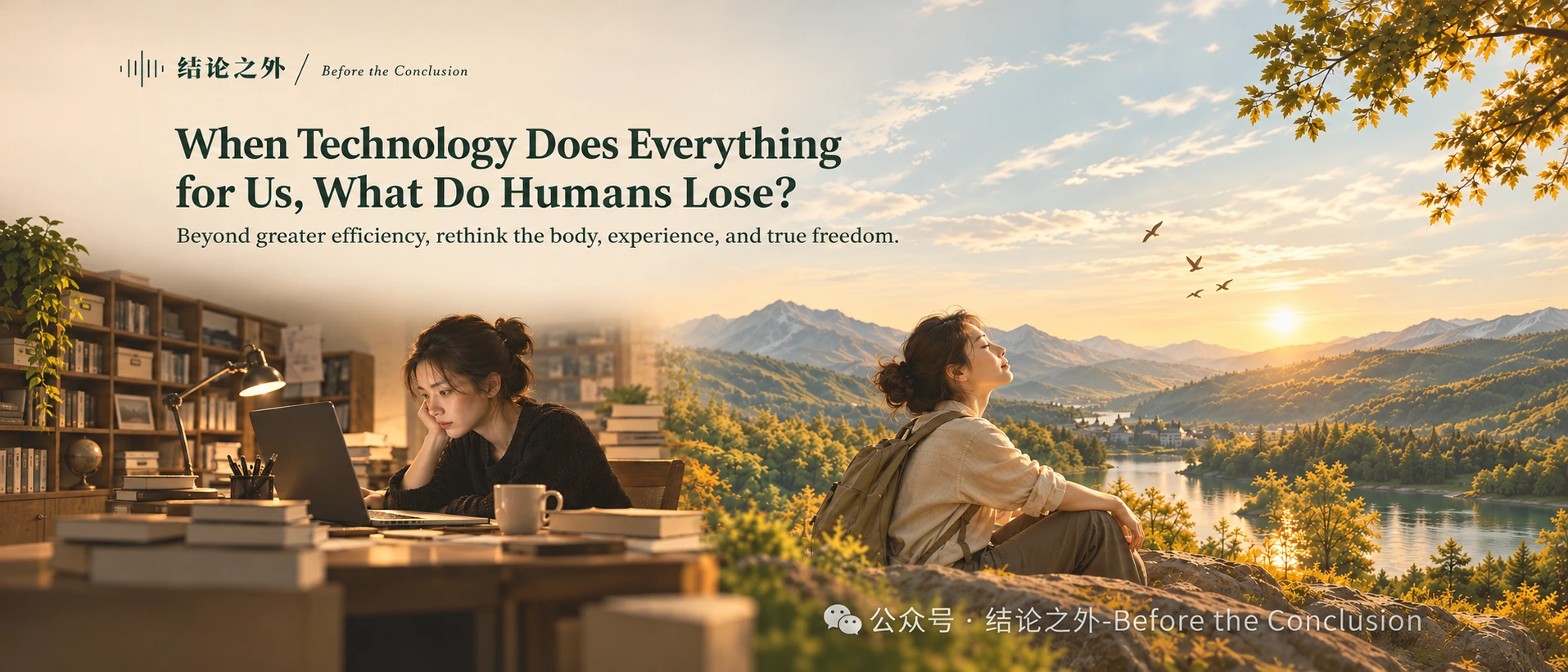
Travel somewhere unfamiliar and navigation finds the route for us. Want to understand a question and search engines and artificial intelligence organize the answers. Need to write an email, or even an article, and software can already suggest a structure, wording, and revisions. Technology saves enormous amounts of time. It also puts within reach many tasks that once required learning, practice, and accumulated experience.
This is certainly progress.
Yet as we enjoy the convenience, another question emerges: if we can hand more and more things over to technology, might we gradually lose some of our own abilities?
In October 2026, the British writer Melanie Challenger published an essay in Aeon titled “Deskilling the body,” exploring how dependence on technology changes our relationship with our own bodies.
Her concern is more fundamental than whether we might forget a particular skill. Could the processes technology seems able to remove be precisely the ways in which we develop abilities and understand the world?
1. When convenience gradually takes the place of capability
Imagine a simple situation.
You arrive in an unfamiliar city and need to walk from your hotel to a bookshop. In the past, you might have looked at a map first, remembered a few intersections, and watched the shapes of buildings and the direction of streets along the way. You might occasionally have stopped to check whether you were going the right way. If you got lost, you might have asked someone for directions and adjusted your route accordingly.
Now, you can simply open a navigation app and follow the blue line to arrive at exactly the right place.
Both methods get you to the bookshop. What they leave with you may be different.
The first experience might gradually acquaint you with the city’s spatial layout, help you remember a café on a corner, or reveal an alley that barely stood out on the map. The second saves time, but even after arriving successfully, you may still be unable to say exactly where you have been.
Navigation itself is not the problem. It has irreplaceable value for safety, efficiency, and accessible travel in unfamiliar surroundings.
The real question is what happens to our own abilities when a tool does more than help us complete a task, continually replacing the observation, judgment, and practice that the task requires.
Challenger describes this as the deskilling of the body: the gradual disuse of bodily capacities.
We are not born with fully developed spatial judgment, coordinated movement, or awareness of our surroundings. These capacities are built through continued interaction with the outside world and maintained through use. Technology can find the shortest route for us, but it cannot automatically turn spatial experience along the way into our own memories.
Similar changes may occur elsewhere.
When software routinely selects content for us, will we still actively seek out work that initially falls outside our interests but later changes our understanding? When AI can rapidly provide an article’s outline, will we still be willing to find structure within our own muddled ideas?
An important distinction lies here: is technology extending our abilities, or continually replacing the activities through which those abilities form?
Even with the same AI tool, writing a first draft independently and then asking for help revising it is a different learning process from accepting a fully generated article. The former may make technology an aid to thinking. The latter may allow us to skip important stages of thought.
This does not mean that every task is worth doing personally, or that efficiency necessarily conflicts with learning. Repetitive, cumbersome work can sometimes safely be handed over to machines. The question is whether we can recognize which steps merely consume time and which are shaping our abilities.
2. Beyond reaching the destination, what does the journey itself mean?
Modern technology has a clear direction: reducing friction.
Find answers faster. Complete tasks more accurately. Make fewer mistakes. Reach goals more easily.
There is nothing wrong with these aims. But if we treat every process as friction to be eliminated, we may overlook something else: some capacities form only through overcoming resistance.
Someone learning to swim cannot gain a sense of balance in water merely by watching videos. They must enter the water, feel its buoyancy, adjust their breathing, and experience their initial lack of coordination.
Someone learning an instrument cannot develop a fluent relationship between fingers and sound simply by understanding music theory. The imperfect notes, repeated practice, and gradually developing muscle memory are all part of that ability.
Understanding the world works in a similar way.
We often think of knowledge as the answer we finally obtain. Yet understanding a problem usually involves more than storing the correct answer in memory. It also involves asking questions, encountering difficulties, revising judgments, and discovering possibilities we had not previously recognized.
This recalls Before the Conclusion’s first long essay, about Hilbert, Gödel, and the boundaries of knowledge: “Will humanity eventually know everything? From Hilbert to Gödel.”
There we discussed mathematicians’ attempts to build reliable formal systems and move knowledge toward certainty through clear rules and rigorous reasoning. Gödel’s work revealed that a sufficiently powerful, consistent formal system contains propositions that cannot be proved using that system’s own rules.
This mathematical result has a strictly defined scope. It cannot be generalized directly to suggest that every system in everyday life has the same limitations. Yet the intellectual question it inspires remains worth asking: when we construct a method to understand the world, should we continually examine what that method can answer and what it leaves out?
If the earlier essay asked how far a system of knowledge can take us, here we can ask something further: beyond reaching a destination, is the search for a route itself part of understanding the world?
An unfamiliar road connects more than a starting point and an endpoint. It also gives us opportunities to encounter things we did not know existed. An exploration that goes less than smoothly can change our understanding of a problem’s structure. Even failure can leave an understanding that lasts longer than an answer handed to us directly.
AI has increased the speed at which we can obtain answers to an unprecedented degree. As answers become easier to come by, we need all the more to distinguish between understanding an answer and merely possessing it.
3. The brain is not a computer detached from the body
Modern society can leave us with the impression that thinking happens mainly inside the brain, while the body carries out its instructions.
In this picture, a person resembles a computer. The brain processes information; the body is merely the equipment connecting it to the outside world.
The idea of separating thought from bodily activity has had a profound influence on modern Western philosophy and the history of modern science. Descartes’s mind–body dualism is a prominent example. Western philosophy has also, however, always contained other traditions that emphasize the body, experience, and action.
Some research in modern cognitive science has encouraged us to reconsider the body’s role in thinking.
Embodied cognition does not simply mean that the body affects the brain. It emphasizes the close connections between cognition and perception, action, bodily states, and the surrounding environment. How we see the world, move through space, touch objects, judge distance, and coordinate movements may all help shape how we understand it.
The body is not a passive tool waiting for the brain’s commands. It is also part of how we gain experience.
Challenger describes an experience of her own in the essay.
After working indoors for a long stretch, she goes outside and walks uphill to a place overlooking a valley. Just after leaving her desk, she still finds it difficult to disengage from her tense thoughts, as if her whole self has been compressed into her head. As light, breeze, and birdsong return to her senses, she gradually relaxes and her thoughts begin to flow again.
There is no startling discovery in this scene. It is very ordinary: someone finishes a long session of screen work, steps outside, experiences nature, and stretches out their body again.
Yet it reveals something that technological life can easily obscure.
When we stare at screens for long periods, concentrating on words, numbers, and abstract symbols, other forms of bodily perception may temporarily recede into the background. Outdoors, light, sound, air, movement, and changes in space become part of our experience again.
A walk does more than give the brain a temporary rest. The body also resumes interacting with its surroundings.
The physiological changes brought by movement, together with the effects of external sensory stimulation on attention and emotion, may help alter our mental state. Of course, one personal experience cannot establish that walking improves everyone’s thinking. Nor can every cognitive problem be attributed to insufficient physical activity.
It does at least suggest that thinking cannot be entirely detached from the body and its environment.
Interestingly, inquiry into the relationship between thought and life is not confined to modern science. As early as the fourth century BCE, the Chinese philosopher Zhuangzi explored letting go of fixed judgments and attachments through “fasting the mind,” or xinzhai. In nineteenth-century Russia, Dostoevsky’s Notes from Underground portrayed a man whose excessive self-consciousness made it difficult for him to enter fully into life.
They come from different intellectual traditions but touch on a similar problem: as we grow better at analyzing ourselves, might we find it harder to form a real connection with the world? The question remains fresh and deserves a separate article.
Here, however, we need to return to a more concrete question: as direct contact between body and world diminishes, what exactly does technological convenience free us to do, and what does it cost us?
4. Technology raises productivity, yet we become busy people in our free time
One important promise of technological progress is greater freedom from burdensome labor.
Machines help with physical work, software reduces repetitive operations, and automated systems take on more tasks once handled by people. AI extends further into writing, programming, analysis, and organizing information.
In principle, if the same work takes less time, we should have more life left to direct as we choose.
Things seem less simple in practice.
Greater efficiency often does not lead us to stop. Instead, we fill the time saved with more tasks. Standards of workplace efficiency gradually enter our leisure as well.
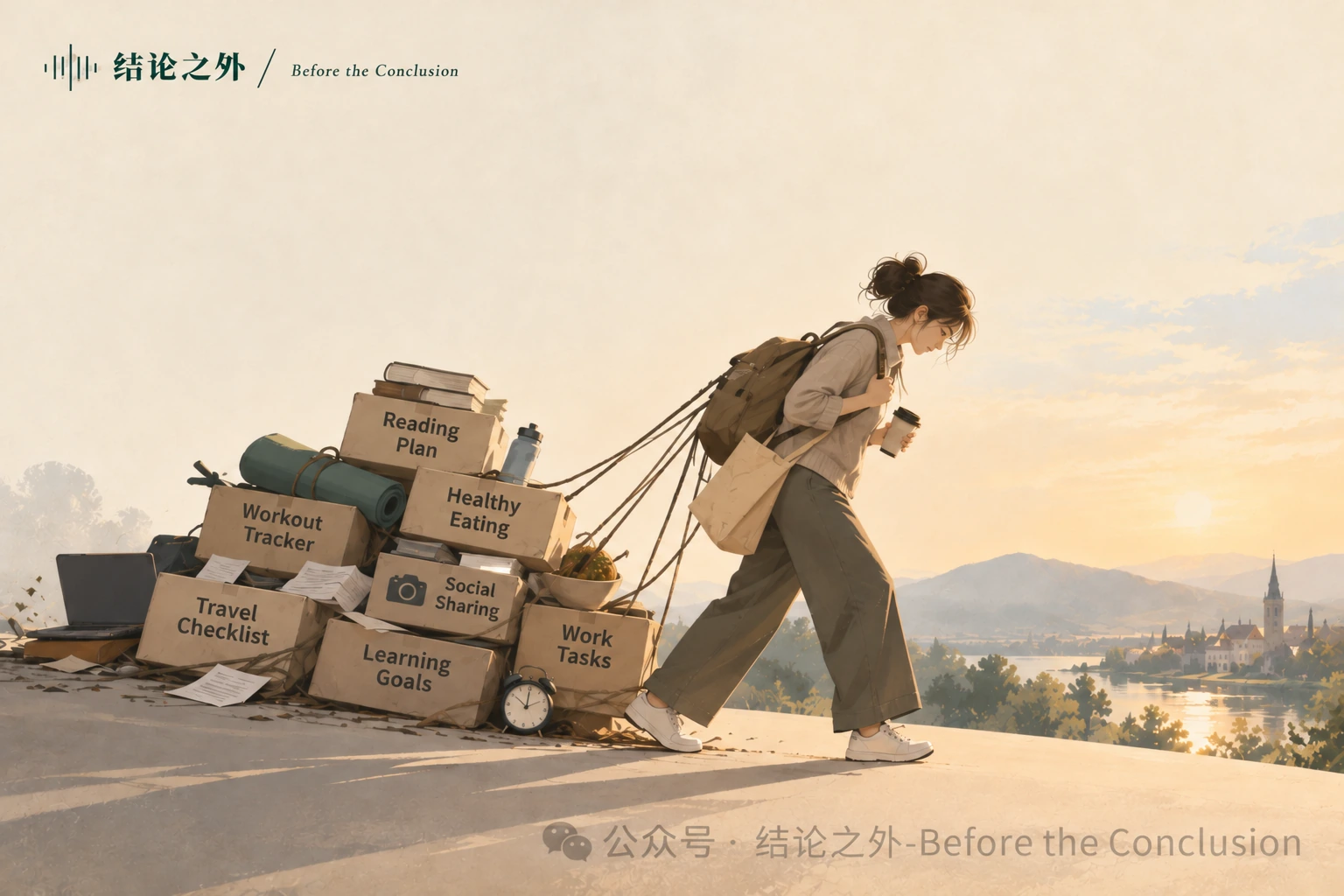
Reading requires finishing a reading list. Travel requires checking off attractions. Exercise requires recording sessions. Learning requires daily check-ins. Even a weekend intended for relaxation can turn into a schedule to complete item by item.
We seem to have become busy people in our own free time.
On the surface, our time away from work belongs to us. In practice, we still arrange life according to the logic of work: setting goals, measuring progress, recording results, displaying what we have completed, and preparing for the next round.
Planning and goals are not themselves the problem.
Some people find motivation to persist through exercise records. Others develop lasting habits through reading lists. Others carefully plan every stage of a trip because they love travel. All of these approaches may enrich life.
The question is whether, even when we have freedom of choice, we still use the number of tasks completed to prove that our time has not been wasted.
If a book does not count toward an annual reading total, does it provoke any less thought? If a journey leaves no photographs and never appears in a social feed, does it become less worth remembering?
If we spend an afternoon simply sitting under a tree, watching the light move and occasionally hearing birdsong, without learning a new skill or reaching any goal, has that time been wasted?
Modern life is increasingly good at recording what is easy to count: steps walked, pages read, plans completed, places visited.
Yet some experiences that determine the quality of life are precisely those that resist measurement.
An unexpected conversation, a walk without a clear purpose, a sudden thought, or a quiet stretch of time in which nothing needs to be completed immediately may all leave an influence long afterward.
Technology can help us pack a schedule more tightly. It cannot decide for us what each stretch of time should mean.
Perhaps what matters most is less how much more output technology enables than whether, after it has assumed some of our work, we can decide afresh how to live.
5. When life becomes a display, how much experience remains our own?
Another change in free time is that more of our experiences now enter public view.
Open WeChat Moments or another social platform and it is easy to find carefully planned trips, sustained exercise programs, extensive reading records, and one celebratory moment after another.
Such sharing can, of course, have positive meaning.
It can convey happiness, document growth, keep distant friends connected, and encourage others to begin reading, exercising, or exploring somewhere new.
But as sharing becomes habitual, we may gradually overlook a question: are we doing something because it is worth experiencing, or because it can produce a result worth displaying?
These motives do not necessarily conflict. Someone can climb mountains out of love for climbing and also want to share the view from the summit with friends.
What deserves attention is whether, as external evaluation becomes more important, we start choosing how to live according to how others may view and judge us.
Social platforms make it especially easy to see selected and organized fragments of life. We see someone’s travels without necessarily seeing their exhaustion. We see their achievements without understanding their resources or costs. We see a full weekend without knowing whether they enjoyed all their plans.
As these fragments appear repeatedly, they can gradually form an invisible standard: an enviable person seems always to be reading, traveling, exercising, learning—always using time to become a better self.
Free time must then be fully used, and must also look fully used. This brings us back to Wang Shuo’s phrase, “looks beautiful.” What we now work to cultivate is not only life itself, but how life appears.
Does life really need continual proof?
Going further, as we become more practiced at sharing, we can also consider how our expressions enter other people’s lives.
This does not ask people to hide their happiness or achievements for fear of making others anxious. Everyone is free to record and share their life, and no one can be responsible for every emotion someone else experiences.
But if we hope to understand questions from several perspectives, perhaps we can retain some awareness of other people’s circumstances when presenting our own lives.
We can share the results of our efforts without presenting our way of life as the only right choice. We can record rich experiences without implying that people without those experiences lead insufficiently fulfilling lives.
This is a gentle reminder to ourselves rather than a heavy moral duty.
Our freedom does not depend on comparing ourselves with one another. Differences in bodies, time, resources, responsibilities, and interests inevitably mean that the lives available to each person differ.
One person’s fulfillment need not become another’s goal.
Return to the opening question: as technology does more and more for us, what will humans lose?
Perhaps we need to be alert to more than the decline of a particular skill or machines doing some things better than people. Technology really does extend our capacities, and its conveniences can improve life.
The question is whether, as we become more accustomed to technology choosing routes, supplying answers, arranging schedules, and even helping decide what deserves attention, we retain our capacity to observe, try, judge, and choose for ourselves.
And when efficiency finally wins us a little free time, do we rush to turn it into another task that must be completed?
Humans do not have to reject technology to preserve their value. A mature way of using technology may consist in knowing when a tool is useful and when to retain judgment for ourselves; when speed matters and when it is worth finding the way slowly.
We need to participate more fully in life as well as accomplish its tasks more efficiently.
Technology can help us reach more places. It cannot experience everything along the way for us.
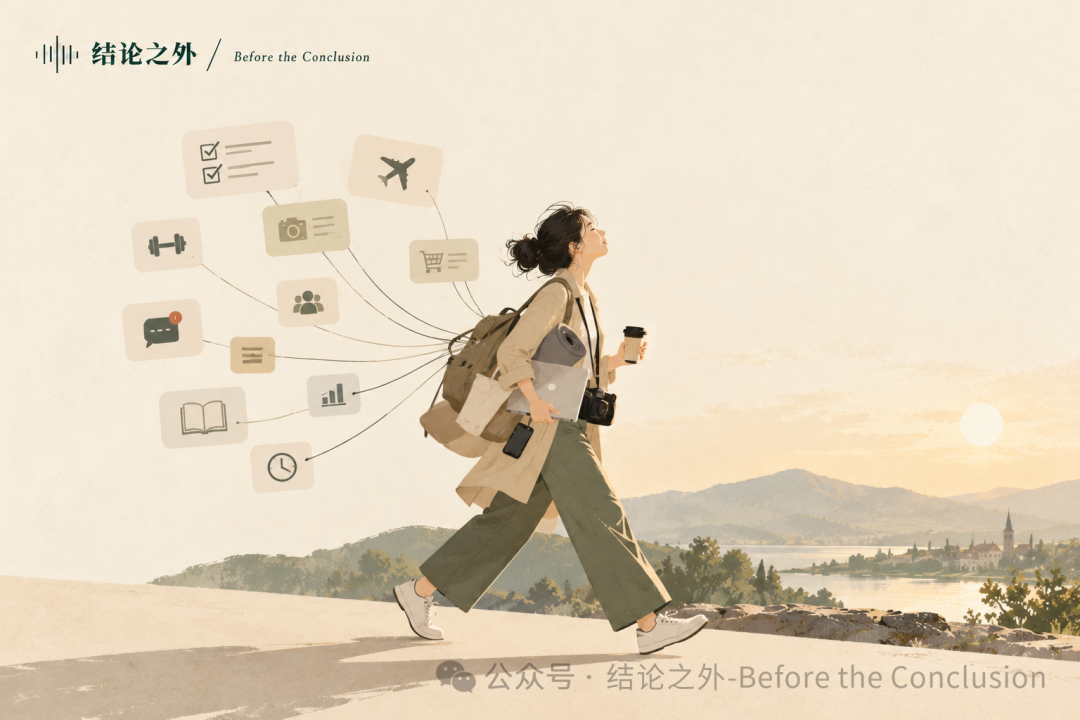
Perhaps real freedom means more than being able to do more. It also means being entitled to decide which things need not be completed, which moments need not be displayed, and which experiences belong to us alone.
Main references and further reading
Melanie Challenger, Deskilling the body: The more we rely on tech, the more we deskill our bodies, Aeon, October 2026. Original essay: https://aeon.co/essays/the-more-we-rely-on-tech-the-more-we-deskill-our-bodies
Kurt Gödel, On Formally Undecidable Propositions of Principia Mathematica and Related Systems I, 1931. A classic paper on the incompleteness of formal systems.
René Descartes, Meditations on First Philosophy, 1641. A classic text in modern discussion of the relationship between mind and body.
Lawrence W. Barsalou, Grounded Cognition, Annual Review of Psychology, 2008. A review of the relationship between cognition and perception, action, and environment. https://doi.org/10.1146/annurev.psych.59.103006.093639
Zhuangzi, “In the Human World,” on “fasting the mind” (xinzhai); and “The Great and Venerable Teacher,” on “sitting in forgetfulness” (zuowang). These themes will be explored further in a separate article.
Dostoevsky, Notes from Underground, 1864. A literary work concerning excessive self-consciousness, reason, and the difficulty of action.
Beyond the conclusion, there are still questions worth asking.
Medicine · Science · Ideas and reading
Follow Before the Conclusion as we stay curious and think independently together.
Text and image use
The original text was written by Before the Conclusion, offering independent analysis and commentary based on public sources. You are welcome to share this article’s web link. Unless separately authorized, please do not republish or excerpt the text by copying, reposting, or distributing screenshots, use the images separately, or use the text or images commercially. Relevant rights are subject to applicable law.