Dostoevsky, Zhuangzi, and modern cognitive science
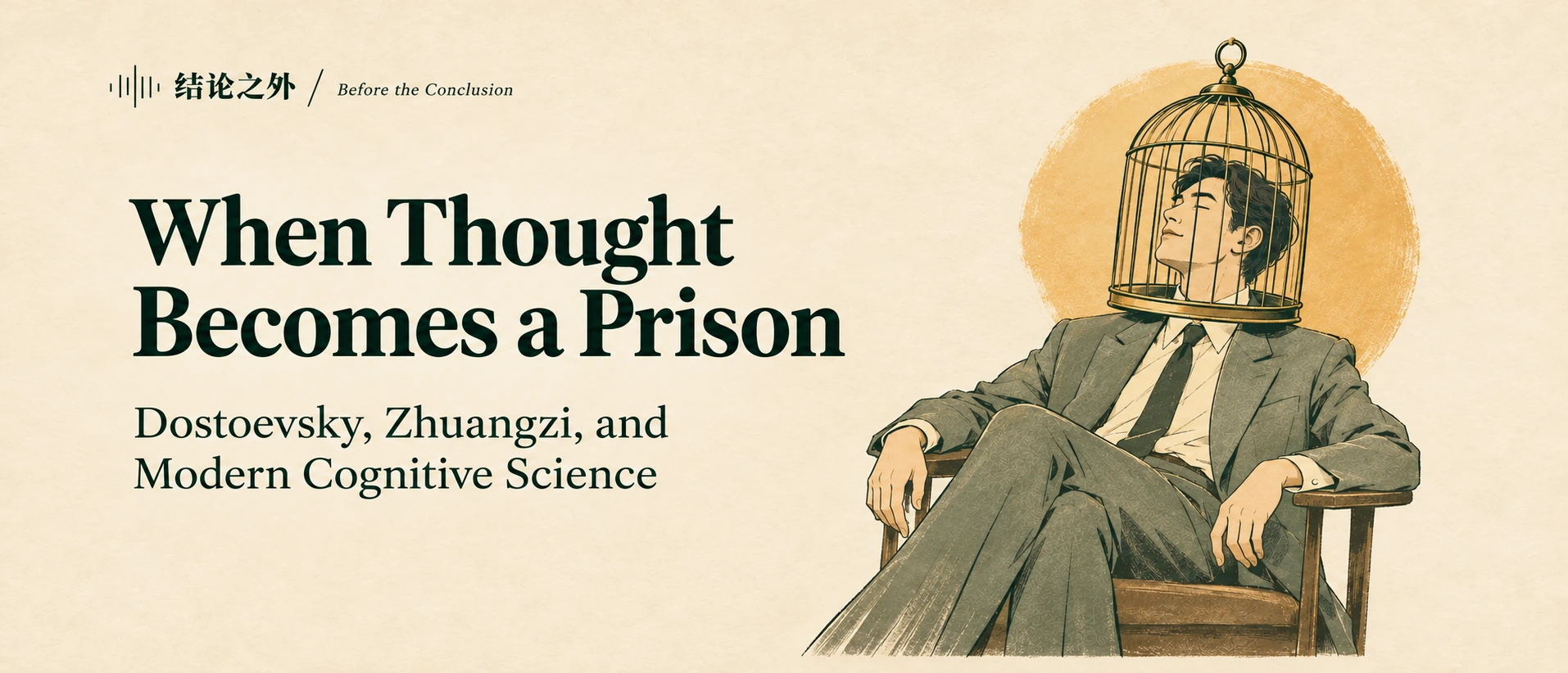
A conversation has ended, but you have not yet left it.
Back home, you recall the other person's momentary pause, an ambiguous glance, and your own reply that now seems not quite appropriate. You try to work it out: why did they say that? Why did I not respond differently? Gradually, the questions change: why am I always like this? Why can other people live naturally, while I have to inspect even a single sentence again and again?
At first you were recalling an event. Later, you began putting a person on trial—and the defendant was you.
We usually regard thought as a form of freedom. It lets us step back from immediate impulses, question habits, understand complicated situations, and preserve the possibility of another way to live. Yet sometimes thought seems quietly to change its purpose. It repeatedly calls up the same material, arrives at the same painful judgment, then asks us to think it through once more, as though enough diligence will finally reveal an exit.
An unsettling question follows: why can the capacity that helps us understand the world also distance us from it?
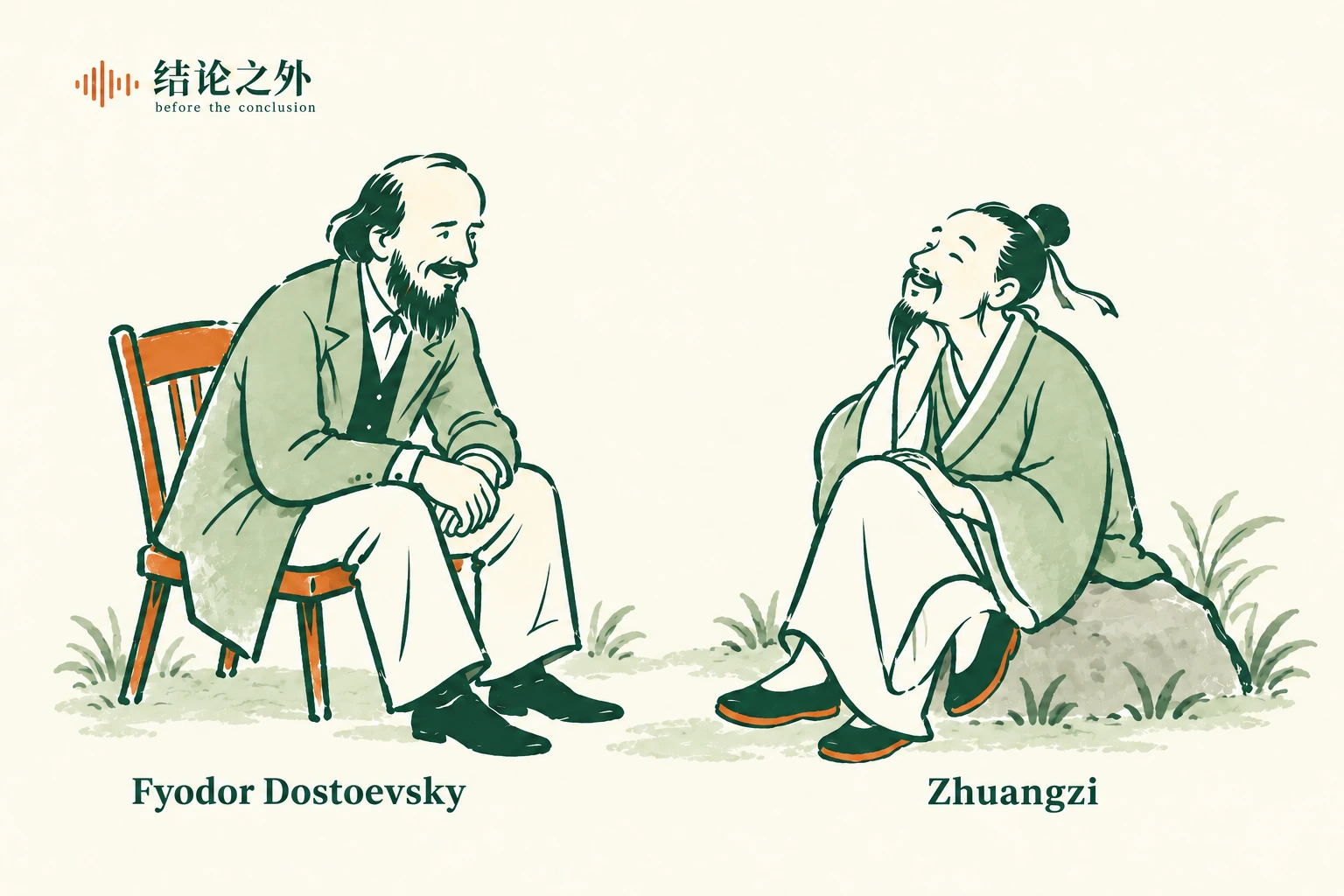
More than a century ago, Dostoevsky wrote this predicament into one person's monologue. Much earlier, the Zhuangzi had also questioned whether people could be trapped by judgments they had already formed. Today, psychology and cognitive science use experiments, scales, and clinical studies to distinguish processes that may look similar within the mind but have very different consequences.
Putting them together cannot produce a universal map to liberation. They can, however, help us recognize anew how we are using our own thoughts.
1. In the underground lives a man who never stops explaining himself
Published in 1864, Notes from Underground has a narrator who is almost impossible to listen to comfortably. Nameless and isolated, he is astonishingly perceptive about his own cowardice, vanity, resentment, and contradictions. No sooner has he defended himself than he exposes the self-interest in that defense. Having admitted something shameful, he suspects that the confession itself may be another performance. Readers also need to question his accounts of himself: disclosure and concealment are often entangled.
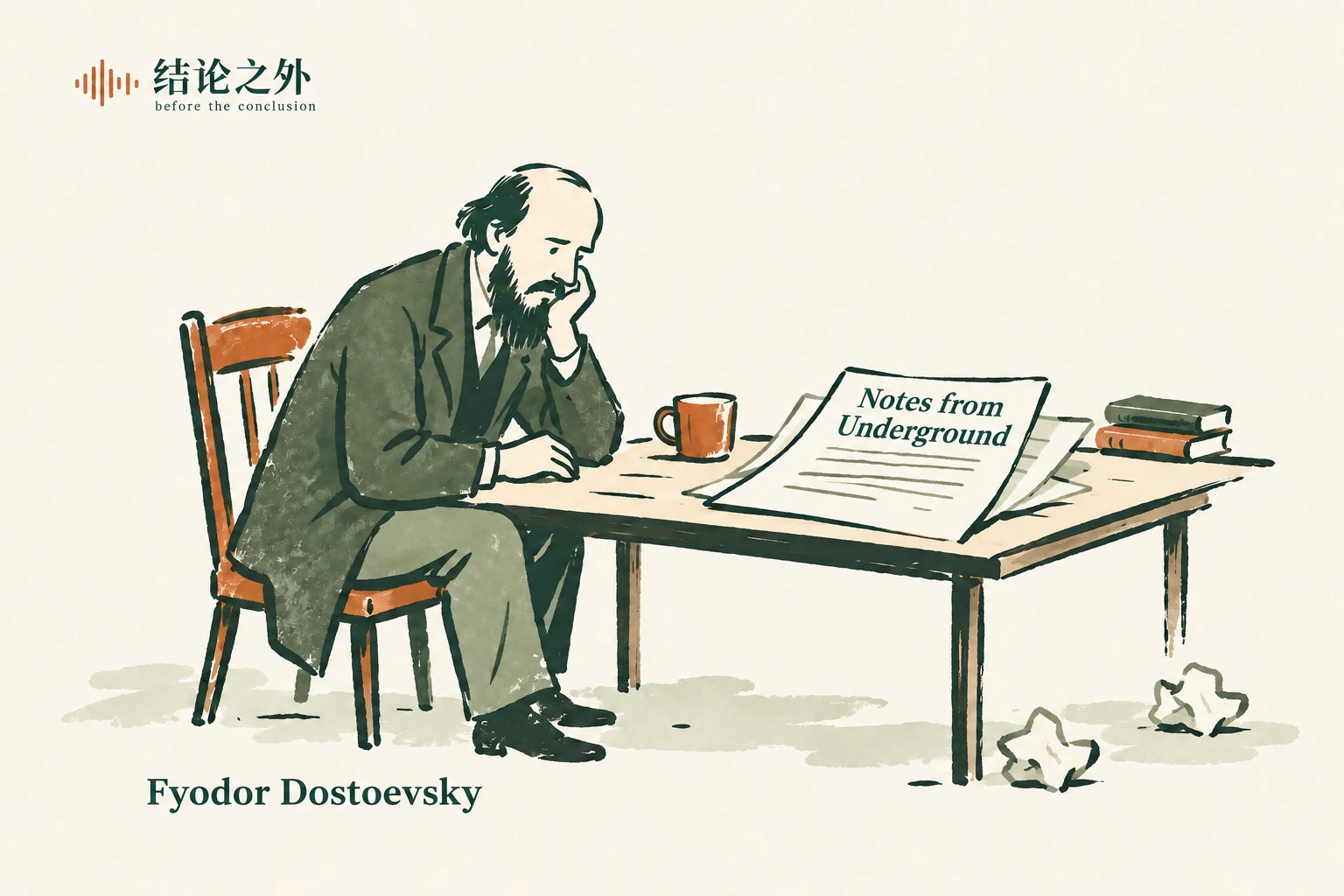
Reading his monologue can produce an odd exhaustion: every sentence seems to have an inspector behind it, with another inspector behind that one.
He is particularly concerned with how others see him. In the novel, an officer happens to pass near him and moves him aside without giving him a proper look. The incident may long since be over for the officer, but it keeps replaying in the narrator's mind. He then expends great effort planning how to collide with the officer head-on in the street, hoping that physical contact will establish their equality in social standing.[1]
A person's dignity apparently needs confirmation through a collision of shoulders rehearsed and refined endlessly in his own mind.
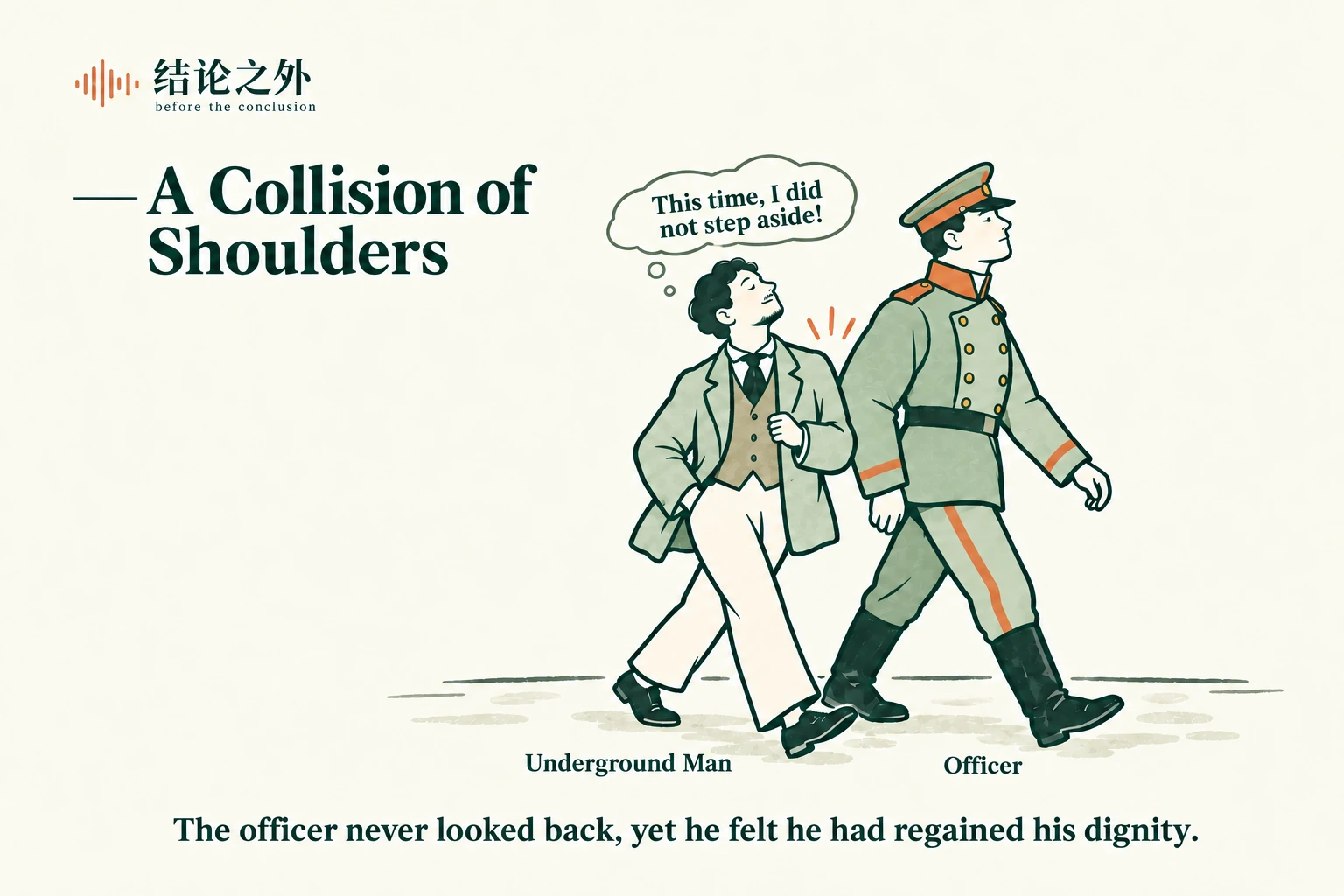
We can read this as absurd comedy and laugh it off. We can also see its sadness: he has moved another person's gaze inside his own head. Even when that person is absent, he is still trying to prove something to him. Streets, clothing, footsteps, and an ordinary encounter all become part of an argument over self-worth. The circumstances differ, but the inner state may be familiar to every one of us.
He is not oblivious to his predicament. He sees the vanity and the insecurity behind it. He can even anticipate every criticism a reader might make. Yet this perceptiveness does not consistently help him change. Sometimes it makes change harder: the moment he tries to take a step, his mind supplies numerous explanations, each carrying a suspect motive.
Does accepting help make him look weak? Is approaching someone merely a desire for approval? Is admitting a mistake a way of playing a noble person? These questions can certainly be discussed. But when every action first requires proof of a flawless motive, life becomes difficult to begin.
The underground man has a particular predicament: he can expose himself, yet finds it increasingly difficult to allow himself to be an imperfect person who can still act.
In 1973, the literary scholar Bernard Paris analyzed this character using Karen Horney's theories. He emphasized the tensions among an idealized self-image, conflicting demands, and self-hatred. This is a psychological interpretation of literature, rather than a clinical diagnosis of a fictional person. It reminds us that the underground man's difficulties involve maintaining self-esteem, forming relationships, and bearing his own limitations.[2]
Perhaps his inner argument cannot end because it has taken on too many jobs: explaining pain, sustaining a sense of superiority, and ensuring that nobody else ever sees through him completely.
2. He longs for freedom but struggles with real closeness
Notes from Underground also argues with a particular conception of humanity: if people's interests could be correctly understood and their behavior rationally arranged, could we obtain a perfectly ordered society?
The underground man detests this idea. He insists that people may knowingly do something harmful, and may reject happiness calculated for them by others in order to preserve their own will. The novel places a difficult question before the reader: if everything can be calculated in advance, what remains of human freedom?[1]
This protest has force. People cannot readily be reduced to an algorithm of interests. But Dostoevsky does not make the protester an enviably free person. The underground man continually defends his right to act capriciously, while remaining governed by humiliation, comparison, and other people's gaze. Rejecting external arrangements does not give him the ability to live with others.
In a 2012 paper, Peter Roberts discussed the novel's criticism of rational egoism, connecting it with the coordinated development of reason, emotion, and will. This reading preserves the novel's complexity: we need to ask what relationship analytical ability has actually formed with a person's life.[3]
The novel's most painful relationship is between the underground man and Liza, a young woman who makes her living through prostitution. Adopting the stance of someone persuading and rescuing her, he describes another life and leaves his address. Later, Liza actually visits him and sees his poverty and embarrassment. Unable to bear the collapse of the image he had maintained, he turns his shame into an attack on her. Even when Liza offers understanding and closeness, he responds by hurting her.[1]
If the officer causes him pain by failing to treat him as someone worth taking seriously, Liza unsettles him precisely because she begins to see a real person.
This is what makes the relationship so disturbing. In his inner script, he can imagine himself admired and thanked, or misunderstood and persecuted. Opposite though these roles are, they all keep him at the center of the story. Real closeness brings something harder to control: another person will have an understanding of their own, and will see parts of him he wants to hide.
One possible reading follows: thought can sometimes be used to maintain a controllable story about oneself. The story may contain pain, even self-condemnation, as long as control over its interpretation stays in one's own hands.
Understanding the underground man's pain, of course, does not excuse the harm he causes. Liza has her own dignity and circumstances; healing him is not her obligation. The novel leaves a sharp tension intact: someone can be extraordinarily skilled at talking about himself while still struggling to respond to the other person before him.
3. Are we understanding the problem, or repeating it?
Modern psychology calls a form of thinking that repeatedly circles around distress, its causes, and its consequences rumination. The word suggests bringing back something already chewed and chewing it again.[4]
Repetition alone, however, cannot tell us whether thinking is helpful. A mathematician may spend years on one problem. A researcher repeatedly checks data. Someone who loses a loved one may need a long time to understand their life. Thinking for a long time does not automatically mean becoming trapped in rumination.
A more useful question is: what has this round of thinking brought?
Has it added information, changed the previous understanding, or clarified a next step? If it has not, can we still turn our attention elsewhere and do what needs doing now?
After an unpleasant conversation, we can review specific circumstances: what did the other person actually say? Which remark may have been misunderstood? Should we find a chance to clarify it? Yet the same event may gradually become a boundless self-interrogation: why do I always disappoint people? Does this mean I am fundamentally unworthy of respect?
The first questions retain verifiable details and room for adjustment. The second can turn one experience into a verdict on the entire person. At that point, the mind may be generating many sentences without adding material that helps us understand the event.
A 2005 experiment asked participants with depression to focus on their experience either abstractly and evaluatively or more concretely. Compared with abstract self-focus, concrete self-focus improved performance on a social problem-solving task. The finding suggests that we should examine how thinking unfolds, rather than simply count how long someone thinks.[5]
But this should not become another slogan: every “why” question is harmful, and every “how” question helpful.
Two other experiments, also published in 2005, found that asking about causes could support calmer reflection when participants understood anger-provoking experiences from a distanced perspective. The researchers examined combinations of perspective and mode of attention; their findings restored a proper place for “why.”[6]
In other words, the same question asked of ourselves can have different consequences within different psychological processes. We need to consider both the content of thought and our relationship to it.
Pause here for a moment. Someone who repeatedly asks “Am I thinking too much?” may soon begin repeatedly checking “Am I ruminating again?” The mind's inspection department has expanded its staff.
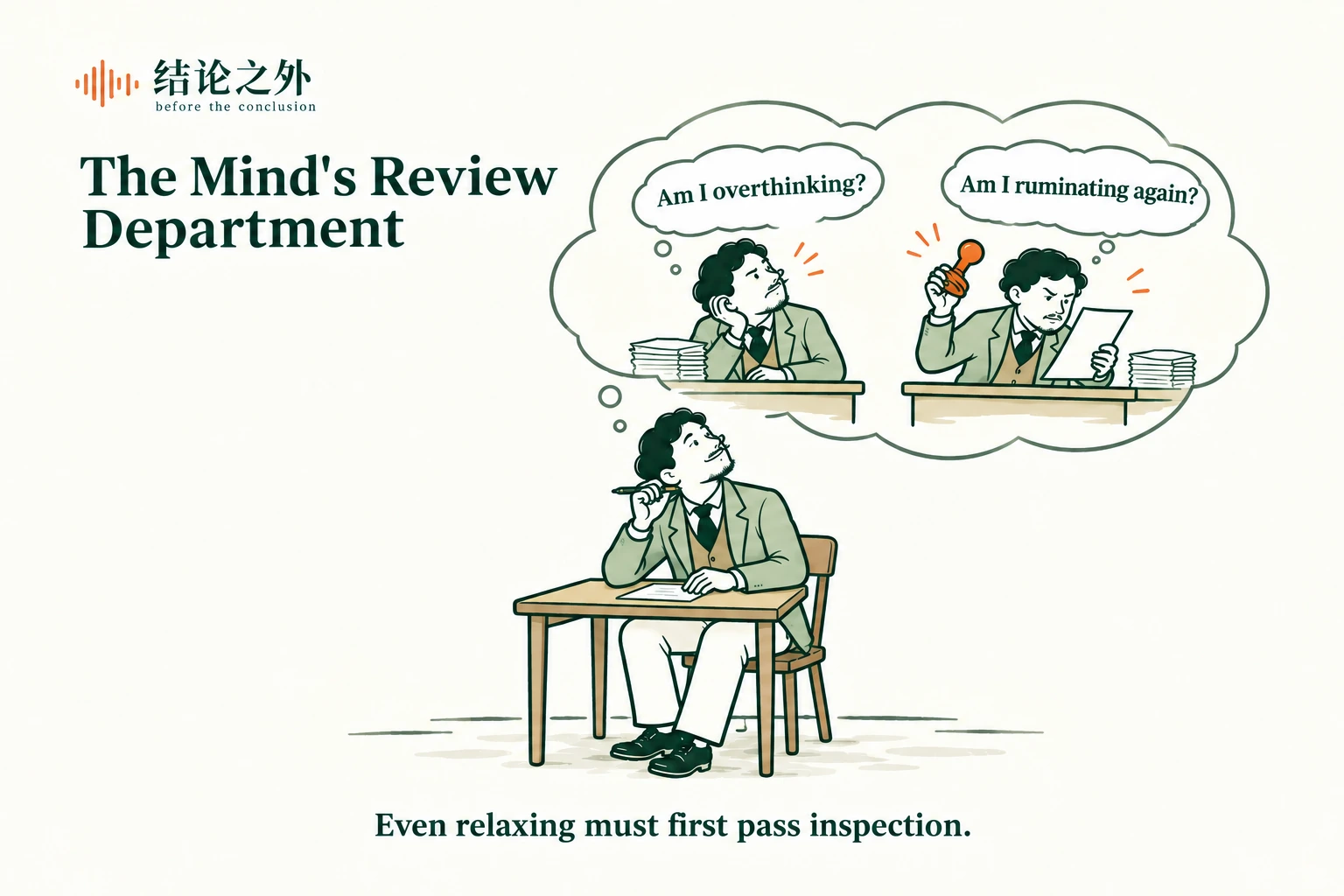
If even relaxation must pass a strict examination first, we have merely added another task to the original predicament.
4. What was Zhuangzi trying to loosen?
Faced with this predicament, people may readily summon Zhuangzi to offer a simple instruction: “Don't think so much!”
Yet the Zhuangzi is exceptionally skilled at thinking—and at changing its readers' perspective. Through fables, questions, exaggeration, and debates between characters, it makes apparently self-evident judgments unfamiliar again. Calling Zhuangzi simply an antirational thinker obscures the text's complex discussions of language, judgment, and practice.[7]
“Fasting of the heart-mind,” or xinzhai (心斋), appears in a specific situation. In the chapter In the Human World, Yan Hui wants to visit the state of Wei and persuade an autocratic ruler. Rather than encourage him to prepare a more powerful argument, the Confucius of the story repeatedly asks whether he understands the person he is about to face and the danger of his undertaking.[8]
The question here concerns how someone enters a complicated and dangerous world carrying their convictions. Good intentions and sound reasons matter, but do not automatically make an action appropriate. Sometimes we are so eager to prove ourselves right that we fail to see the situation before us.
The “fasting of the heart-mind” that follows offers another possibility through the language of emptiness, listening, and responding to things. The chapter describes qi as empty and waiting for things, says that the Way gathers in emptiness, and names that emptiness the fasting of the heart-mind.[8]
First we need to understand that the classical word xin, “heart-mind,” means more than the anatomical heart, and cannot simply be equated with the brain studied by neuroscience today. It often encompasses perception, thought, emotion, will, and judgment. Understanding xinzhai therefore requires more than applying modern anatomical definitions of organs. Nor should we import later ideas about spiritual practice and simply interpret it as stopping the brain from producing thoughts and entering a blank state.
For contemporary readers, “empty and waiting for things” (虚而待物) can offer a reminder: temporarily set down the preconceptions, preferences, and fixations already occupying the mind, and leave room for what we do not yet understand. A familiar Chinese expression describes an open mind as a valley. A valley can contain things precisely because it has not been filled. Perhaps the mind is similar: when we stop rushing to explain everything with what we already know, and stop demanding an immediate answer to every question, we may have more room for complexity, contradiction, and uncertainty.
In this sense, “fasting of the heart-mind” need not mean ceasing to think. It can mean allowing thought to occupy less than the whole of our inner space, preserving the capacity to feel, observe, and understand the world alongside thinking. This is an extension from a classical text toward contemporary experience. It does not directly equate concepts such as qi with modern psychological terms.
We often believe we are listening to another person while actually identifying their mistakes, preparing a rebuttal, or judging whether their words injure us. Before they have finished speaking, we have rehearsed our response. Setting aside some assumptions at such moments may allow understanding to begin.
“Sitting in forgetfulness,” or zuowang (坐忘), in The Great and Venerable Teacher, takes the question further. Yan Hui gradually forgets certain norms and distinctions he previously cherished, eventually speaking of leaving form behind, setting knowledge aside, and becoming one with the great pervasiveness. These words concern the self, the body, knowledge, and people's relationship with change. They have long received different interpretations and resist reduction to a single relaxation technique.[9]
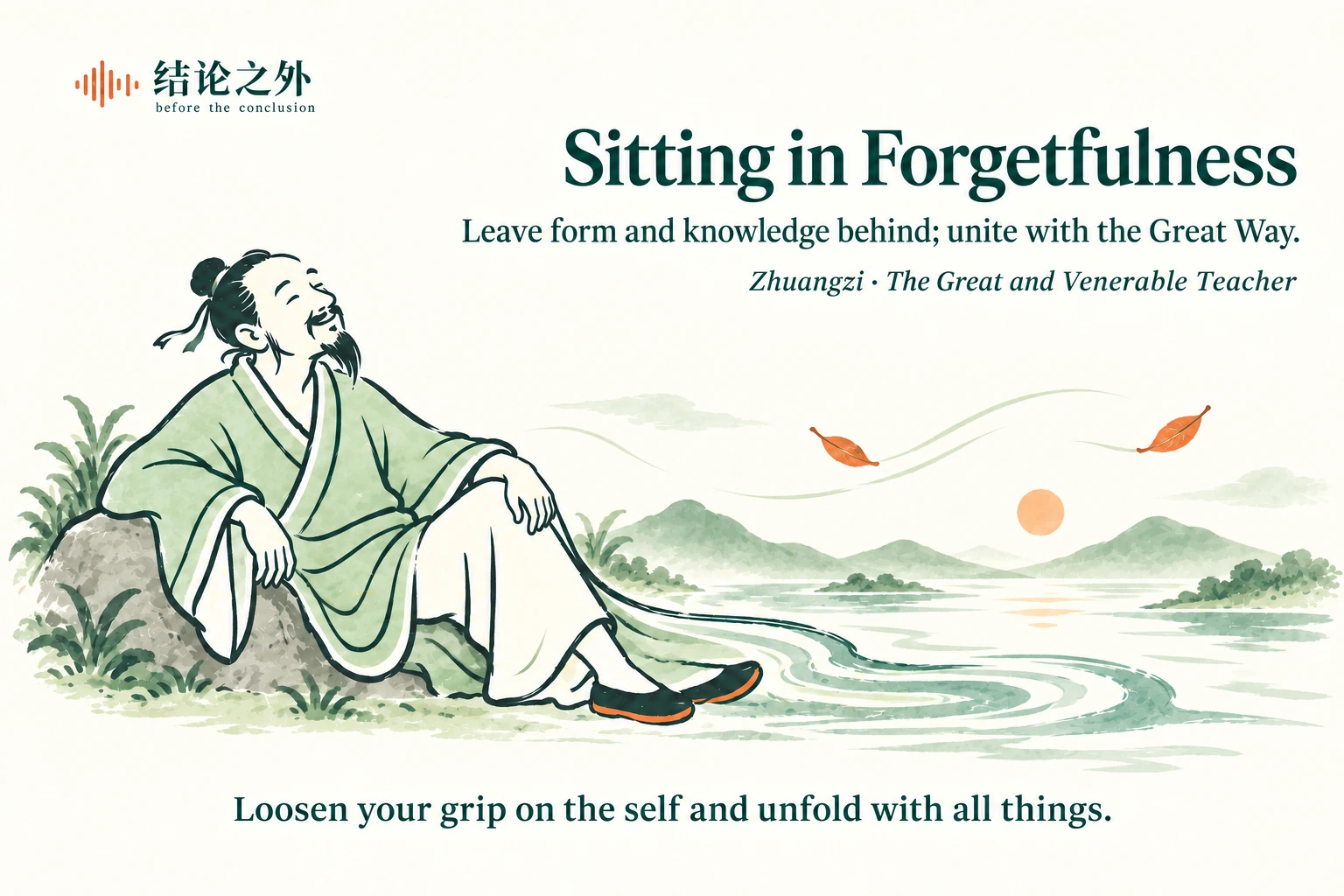
Bringing these two fables back to this article, we might ask: when someone holds too firmly to who they are, how the world should be, and how others must respond, how much capacity remains to receive what is actually happening?
Here, Zhuangzi and Dostoevsky meet in an interesting way. Dostoevsky's underground man constantly adds explanations in an effort to retain his definition of his circumstances. Some of Zhuangzi's fables invite readers to loosen definitions so that action has a chance to respond to things again.
They do not form a single theory. One writer portrays a character amid the social and intellectual conflicts of nineteenth-century Russia; an ancient text explores life and change in its own philosophical setting. From different directions, however, they show us that our grasp of the world can also constrain how we encounter it.
5. Once a thought appears, what choices remain?
A concept in modern psychology relevant here is decentering.
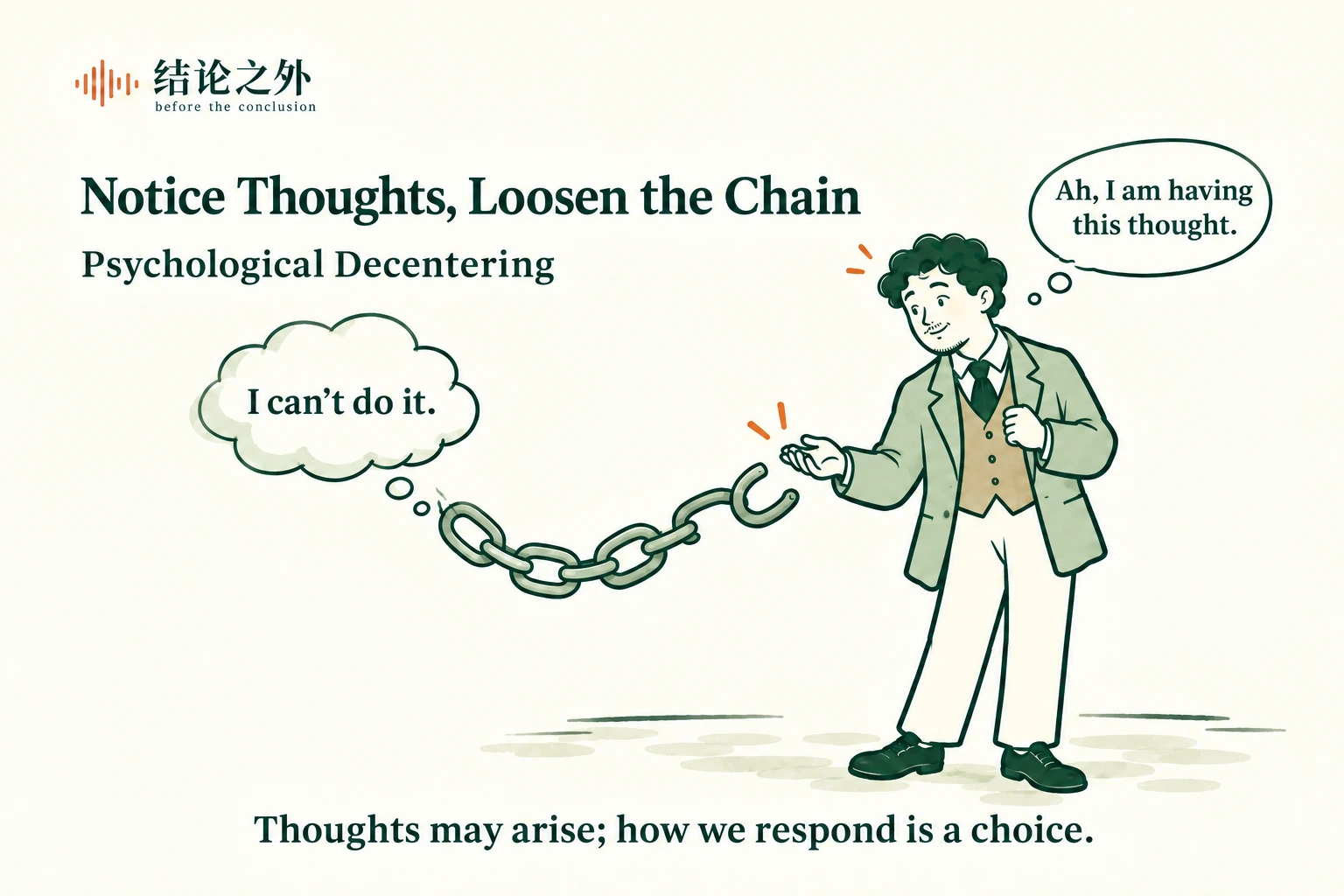
The name sounds abstract. Consider the thought “Everyone looks down on me.” We might immediately treat it as fact, then search for evidence, avoid interaction, or attack someone preemptively. Alternatively, at some moment we might notice: I am having a thought about being looked down on.
The same content gains a little space in that second statement. It is still uncomfortable, but it has become a mental event that can be observed, checked against facts, and need not immediately determine behavior.
Researchers have proposed a framework describing decentering as several related processes: awareness of thinking, reduced identification of inner experience with the self, and reduced automatic reactivity to thought content. This model of psychological processes still requires continued testing and refinement.[10]
Seen this way, there is an important distance between “seeing one's thoughts” and “constantly evaluating one's thoughts.” The underground man is already exceptionally good at evaluating himself, yet struggles to let a thought remain simply a thought. As soon as he notices vanity, he must explain what it means, how others will interpret it, and how he should respond. The chain of judgment continues.
Decentering attempts to give that chain a chance to pause. If “This will make me look weak” appears while we prepare to apologize, we can still check the facts, consider our responsibility, and offer the apology. The thought may remain, while behavior gains more possibilities.
Can training change this capacity?
Existing research offers a preliminary yes. Some structured psychological interventions can help reduce rumination, although the strength of evidence differs between approaches, and we still cannot be certain which specific psychological processes produce the change.
If the experimental data do not interest you, you can skip the following technical passage and continue with the article afterward.
A closer look | Optional research details
A 2025 systematic review and meta-analysis of 29 randomized controlled trials, involving 2,535 participants, found that mindfulness-based cognitive therapy reduced rumination-scale scores. The pooled standardized mean difference was −0.51, with a 95% confidence interval of −0.64 to −0.39, usually described as a moderate effect. This number expresses a between-group difference in standard-deviation units; it does not mean rumination fell by 51%. Participants, control conditions, and intervention arrangements varied, and the pooled effect cannot by itself establish any particular mechanism.[4]
In particular, the results of a structured intervention cannot be converted directly into the effect of casually practicing for a few minutes. What training includes, how long it lasts, and who guides it all relate to the changes ultimately observed.
Another related approach is “detached mindfulness,” a technique within metacognitive therapy that emphasizes noticing thoughts while reducing further involvement in processing them. “Detached” here does not mean indifference to reality.[11]
A 2026 review summarized 14 research reports representing 12 independent samples. Only three samples were actually clinical treatment studies, and two of those had no control group. The authors identified preliminary favorable signals while explicitly noting limitations in study numbers, sample sizes, methodological quality, and long-term follow-up.[11]
These studies make a question testable: when people change how they relate to thoughts, do distress and behavior change too? Evidence is still accumulating about which processes matter most and who benefits more.
They have not scientifically certified ancient philosophy. Literature reveals tensions in experience; philosophy reorganizes questions; experimental research turns certain processes into objects that can be manipulated and measured. Allowing them to inform one another while preserving the questions each can answer leaves room for their conversation to continue.
6. What can the body and action bring?
At this point, we can easily retreat into the mind once again: if the problem is a way of thinking, solve it with a better way of thinking.
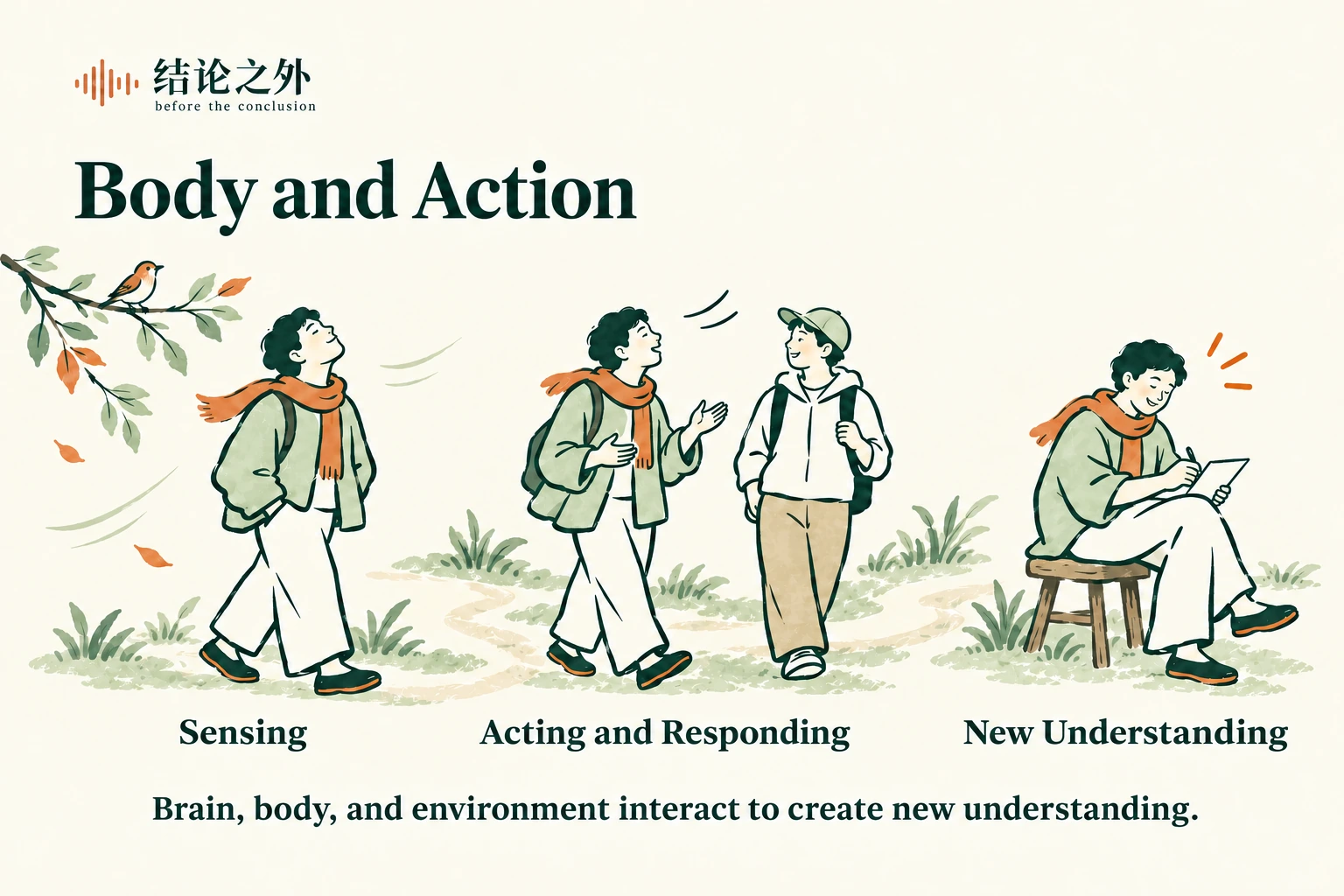
Yet our relationship with ourselves also continually forms through sensation, action, and other people's responses. Someone can tell a story about what kind of person they are, and can also directly feel tension, warmth, breathing, or physical fatigue in a particular moment. These experiences belong to life too. The parts that can be narrated are not the only ones deserving attention.
There is therefore more than one way to know ourselves. We can use language to review and interpret experience; we can also return attention to present bodily sensations and gain information through action. Relevant research provides clues, but does not establish that any one approach is better in every situation.
A closer look | Optional research details
The following passage concerns brain imaging and theories of embodied cognition. If these details do not interest you, skip to “End of research details” without losing the article's main thread.
An early functional MRI study in 2007 compared a “narrative” task focused on lasting personal traits with a task focused on present experience. It also examined differences between people who had completed eight weeks of mindfulness training and novices, observing patterns of brain activity associated with task and training experience. This suggests that self-related processing can take different forms. It cannot establish that one pattern is always better, nor can a brain image diagnose whether someone is “living in the present.”[12]
Embodied cognition is not a settled, unified theory. Some approaches emphasize that understanding how a cognitive task is performed requires examining how brain, body, and environmental resources jointly organize action. This requires specific analysis and testing, and does not directly imply that “more exercise solves overthinking.”[13]
End of research details | Continue the main article here
This also echoes another earlier Before the Conclusion article, When Technology Does Everything for Us, What Might We Lose? That article asked what we may lose as technology increasingly takes over human thinking and action. This article asks a further question: what happens when someone relies so heavily on their own thinking that they cannot fully enter life?
One question concerns an absence of thought, the other an excess. They appear opposite but both touch on people's relationship with their own thinking. Recognizing that the brain is continually connected with the body and environment may give us more ways into the predicament.
For this article, it opens a perspective on experience: action can change the information we encounter.
When imagining a conversation, we can draw only on material we already possess. Once we speak, the other person may respond unexpectedly. A task may seem impossible to begin in imagination, yet its difficulty may become concrete once we write the first paragraph. We may also discover that something we feared really does happen, but our capacity to respond differs from what we imagined.
These are examples from everyday experience. They illustrate that when we begin interacting with the environment, the problem itself may take on a new shape.
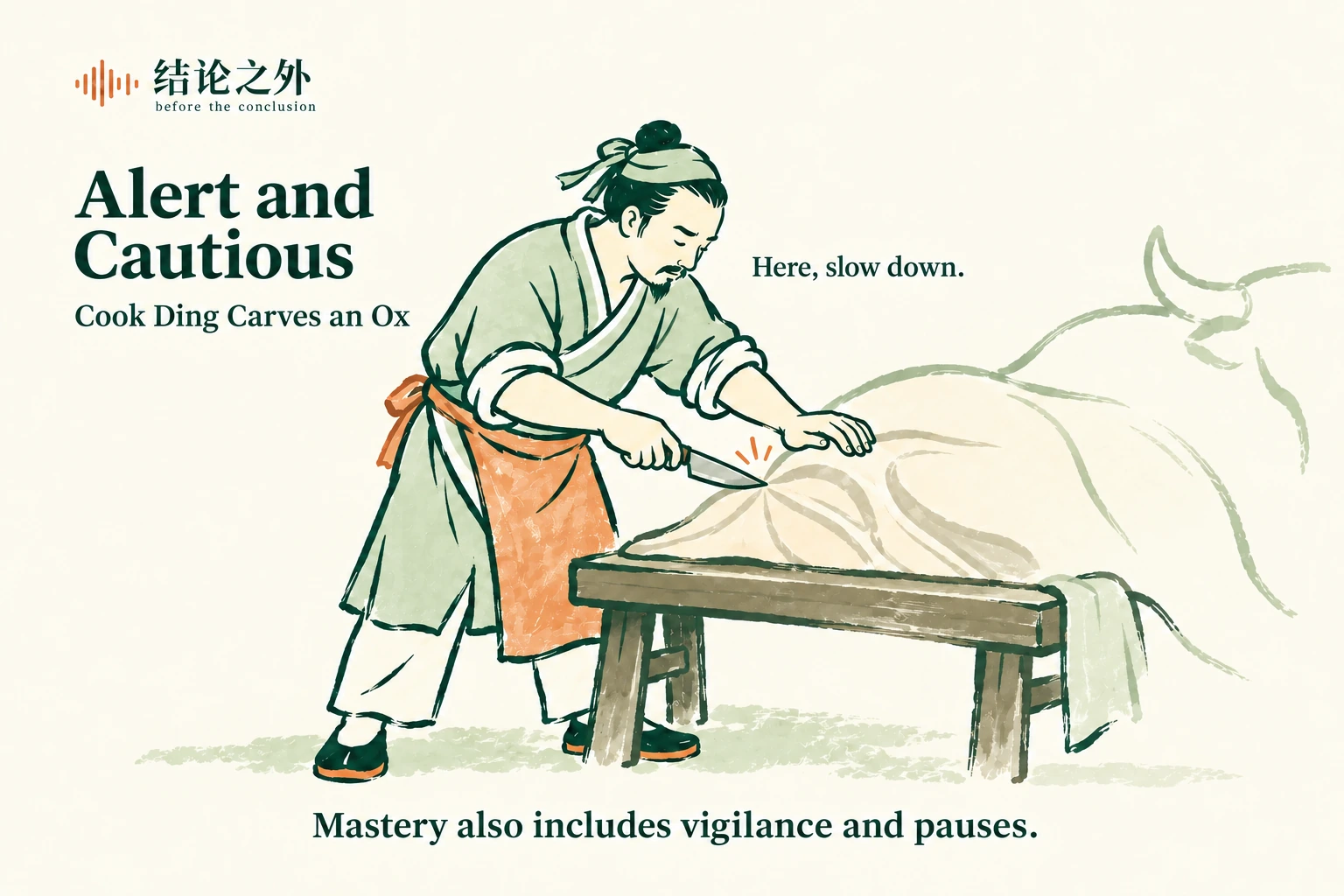
The story of Cook Ding cutting up an ox in the Zhuangzi offers another picture worth placing alongside this one. His skill comes from long practice and careful responsiveness to the ox's structure. Particularly interestingly, when he encounters an intricate tangle of sinews and bones, he remains “alert with caution” (怵然为戒), slows down, and proceeds carefully.[14]
This detail keeps Cook Ding from becoming a myth of perpetual effortlessness. Skill can include vigilance, and action can include pauses. In this reading, attention adjusts to the difficulty of things, and thought gains room to advance and withdraw.
We should nevertheless respect the distance between Cook Ding's story and “sitting in forgetfulness.” The latter includes loosening attachment to bodily form and knowledge, whereas embodied-cognition research emphasizes how cognition depends on the body and environment. Their concepts and questions differ. We can let them illuminate each other while continuing to ask how a person enters experience.
Can the environment affect rumination? Existing research offers some leads worth pursuing, but does not establish that changing environments provides lasting relief. The following experiment explains how one study was conducted and where its limitations lie.
The next technical passage concerns an experiment on natural environments, rumination, and brain perfusion. If the methods and statistical findings do not interest you, skip to “End of research details” without losing the main thread.
A closer look | Optional research details
Researchers have experimentally examined whether the environment can affect rumination. In 2015, a small randomized experiment assigned 38 healthy participants to walk for 90 minutes either in a natural environment or beside a busy urban road. Rumination scores fell in the nature group, but the between-group difference in score changes did not meet the conventional threshold for statistical significance.[15]
There were also changes in brain perfusion, but these cannot replace the between-group comparison of psychological measures. This short-term study offers leads for further inquiry rather than establishing long-term efficacy. Both groups walked, so it also cannot determine the effect of walking itself. The environment in which people act deserves a place in the study of psychological processes, while the size and duration of specific effects require more evidence.
End of research details | Continue the main article here
Looking back toward the underground from here, we can see that “reentering life” can include many concrete things: hearing an unanticipated remark, meeting a task that needs adjustment, feeling the road underfoot, or discovering that the person before us does not entirely match our previous judgment.
These experiences do not automatically solve our problems, but they can bring understanding material it did not previously have.
7. Life need not wait for a perfect explanation
People's distress, of course, sometimes comes from actual harm, injustice, illness, and sustained pressure. Any discussion of thought and suffering must retain those circumstances. Someone may need protection, resources, treatment, or institutional change; simply asking them to adjust their relationship with thoughts is insufficient.
Reflection itself also has irreplaceable value. Without it, we struggle to recognize habitual prejudice, understand harm we have caused, or reorganize our lives. The underground man's sharpness is worth reading precisely because he does see problems that people moving smoothly through life may overlook.
The question is whether, having seen, we remain willing to let experience continue.
Sometimes thought can first do part of the work: identify facts, acknowledge responsibility, and recognize what cannot currently be resolved. Then we need to allow some incompleteness. A letter can be sent before its wording is perfect. An apology can be spoken while we still fear rejection. Work can begin without full confidence.
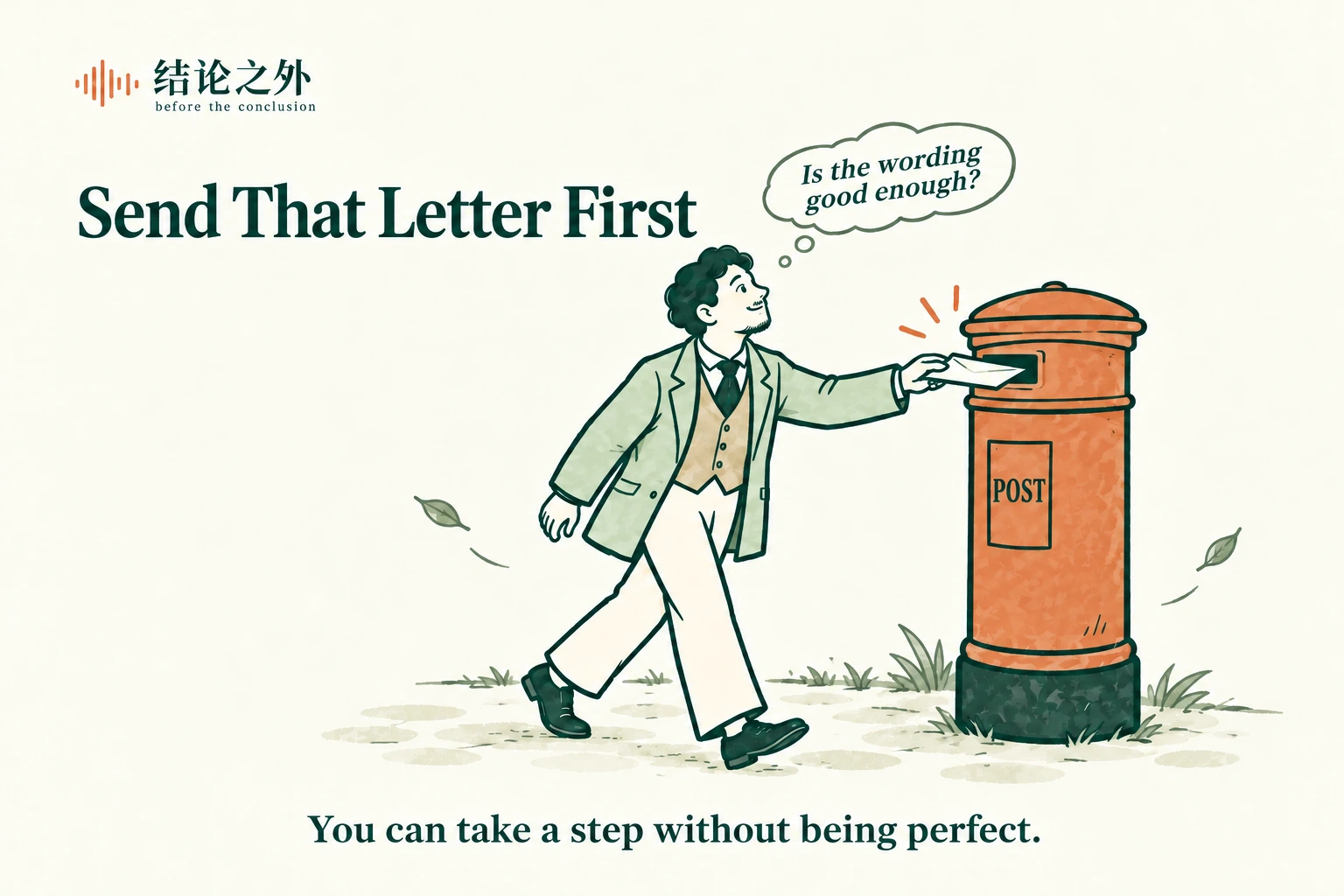
We can hardly wait for perfectly pure motives before forming relationships. Nor can we first prove in our minds that we can bear failure before allowing ourselves to try. Action carries risk; sometimes new understanding can form only by passing through it.
The underground man's tragedy makes this particularly clear. He so perceptively identifies threats to freedom, yet struggles to bear what freedom also includes: other people can respond in their own ways, relationships may change him, and life's outcomes cannot all be controlled in advance.
We need not write him an easy ending. Nor can we declare that accepting Liza's closeness would certainly have given him a different life. The fissure the novel leaves open lets us keep asking: when a real person has come before us, can we temporarily stop explaining ourselves and look at her seriously?
Perhaps the freedom people need to learn also includes this capacity: knowing that some questions remain unresolved, yet returning attention to the life before us.
We spend a lifetime learning how to think, yet few people teach us when to stop arguing with our own thoughts and step back into life.
References and further reading
[1] Fyodor Dostoevsky, 1864. Notes from Underground. Project Gutenberg: Notes from the Underground.
[2] Paris, B. J. (1973). “Notes from Underground: A Horneyan Analysis.” PMLA, 88(3), 511–522.
[3] Roberts, P. (2012). “Education and the Limits of Reason: Reading Dostoevsky.” Educational Theory, 62(2), 203–223.
[4] Wei, S., et al. (2025). “The effectiveness of mindfulness-based cognitive therapy on rumination and related psychological indicators: a systematic review and meta-analysis.” BMC Psychology, 13, 968.
[5] Watkins, E., & Moulds, M. (2005). “Distinct modes of ruminative self-focus: impact of abstract versus concrete rumination on problem solving in depression.” Emotion, 5(3), 319–328. PubMed.
[6] Kross, E., Ayduk, O., & Mischel, W. (2005). “When asking ‘why’ does not hurt: distinguishing rumination from reflective processing of negative emotions.” Psychological Science, 16(9), 709–715. PubMed; DOI.
[7] Hansen, C. “Zhuangzi.” Stanford Encyclopedia of Philosophy.
[8] Zhuangzi, “In the Human World.”
[9] Zhuangzi, “The Great and Venerable Teacher.”
[10] Bernstein, A., et al. (2015). “Decentering and Related Constructs: A Critical Review and Metacognitive Processes Model.”
[11] Myers, S. G., & Solem, S. (2026). “Detached mindfulness as a stand-alone intervention: a Systematic Review and meta-analysis.” Frontiers in Psychiatry, 17, 1771705.
[12] Farb, N. A. S., et al. (2007). “Attending to the present: mindfulness meditation reveals distinct neural modes of self-reference.” Social Cognitive and Affective Neuroscience, 2(4), 313–322.
[13] Wilson, A. D., & Golonka, S. (2013). “Embodied Cognition is Not What you Think it is.” Frontiers in Psychology, 4, 58.
[14] Zhuangzi, “Nourishing the Lord of Life.”
[15] Bratman, G. N., et al. (2015). “Nature experience reduces rumination and subgenual prefrontal cortex activation.” PNAS, 112(28), 8567–8572.
Before the Conclusion: there are still questions worth pursuing.
Medicine · Science · Ideas and Reading
Follow Before the Conclusion to stay curious and think independently together.
Text and image use statement
The text of this article was written originally by Before the Conclusion. You are welcome to share the article's web link. Without separate permission, please do not copy, repost, adapt, or commercially use its text or original illustrations. Rights in third-party materials and images belong to their respective rights holders.
Open links to the 15 original sources and further readings
- Source 1: Notes from the Underground
- Source 2: DOI and journal page
- Source 3: DOI · University of Canterbury repository
- Source 4: PubMed · Open full text · DOI
- Source 5: PubMed
- Source 6: PubMed · DOI
- Source 7: Full encyclopedia entry
- Source 8: Original text at the Chinese Text Project
- Source 9: Original text at the Chinese Text Project
- Source 10: Paper version provided by the authors' laboratory
- Source 11: PubMed · Journal full text · DOI
- Source 12: PubMed · Open full text · DOI
- Source 13: Open full text · DOI
- Source 14: Original text at the Chinese Text Project
- Source 15: Journal full text and DOI · PubMed